“5 Reasons Not to Use Gender-Based Jokes in the Pulpit”
 I’m honored today to be over at The Junia Project with a post about gender-based humor. You know what I mean, the quips and jokes that pastors tell during a sermon that revolve around gender. My argument is that the chuckles in the moment aren’t worth the potential damage to individuals, to our witness, and to our faith communities.
Find the post here, and an excerpt is below.
Recently, a friend mentioned his pastor’s habit of occasionally peppering his sermons with gender-based jokes.
You know what I mean, the quips about women shopping, or men hunting, or the woman “wearing the pants” in the marriage, or about blonde women being ditzy and men being emotionally distant. And maybe a million more.
My friend wanted to know my thoughts on this brand of humor. Here’s what I think:
If you’re in Christian leadership, and you find yourself with a microphone in hand in front of a room full of people waiting on your every word, do everything you can to avoid using stereotypical gender jokes.
Here are five reasons to steer clear of these kinds of jokes:
#1 It’s likely you’re alienating someone in the room.
Unless you know everyone in the room and their backstories, it’s likely you’re alienating someone every time you tell such a joke. You might offend someone who is like the stereotype but trying to change. Or you might offend someone who is not but wishes they were. Or you might offend someone, like me, who cares deeply about gender equality and finds such jokes distasteful. A church service should be a place of hospitality and welcome; alienating someone through an ill-advised joke thwarts that purpose.
#2. You’ll be perpetuating a culture of gender brokenness.
In all gender-based humor, someone is the punchline, and most gender-based jokes paint women in a negative light. My question is, why would you want to do that to a group that has historically been marginalized by the institutional church? Indeed, every time a pastor makes a crack about the stereotypical bossy/shrill/emotional/nagging/etc. woman, the status quo is reaffirmed and women are pushed back toward the edges of the church.
Read the rest of the post here.
2014 in Review
 I love the end of the year, in part because of all the retrospectives. Everyone is looking back at the year that was, in all of its glory and struggle. It’s true on the news, in sports, and of course it’s true in cyberspace, as seemingly every blog is recounting its top posts from the year that was.
Every year in December, WordPress sends me a run-down on my year, and so I’ll join the chorus and reflect back a bit. In and among the 94 new posts this year, readers from 92 different countries (I see you Zambia, Finland and Peru!) liked these five Challenging Tertullian posts the most:
5. A Tale of Two Brands. “Sometimes we’re Always, and sometimes we’re Old Spice.” To me the best thing about this post is that it captures the complexity of it all. Wouldn’t it be easier if something, or someone, or some company, were all bad or all good? I mean, I think our mind longs for binaries, either/or’s, but the older I get, the more I realize that most things exist somewhere in the middle.
4. Meet Pierce Beaver. I’m glad this one made the list, as this new missiologist hero of mine was a welcome discovery in 2014.
3. Remembering Yami. Now almost three months after we received news that she passed, Amy and I continue to mourn Yami. But the pain is somewhat tempered by the fact that Yami lives on in our hearts and in our house. On Christmas, we welcomed friends into our home for brunch. As we pulled the apple crisp from the oven and surveyed the bountiful spread before us, one of our girls remarked, “Yami would be proud.” Indeed.
2. Shame on Old Spice. I love this post for two reasons. One, it reflects me at my best in terms of parenting. I wish I helped our kids interpret their experiences more frequently! Second, I like this post because it vividly captures one of the basic problems with the Tertullianized culture that we live in: women as the object of male consumption. Here’s the issue:
Reducing “manhood” down to merely the carnal instinct to chase women, especially with the connotation of inappropriateness, doesn’t serve anyone, male or female. Not only does it neglect every other aspect of what it means to be a man, it also perpetuates the man as hunter/woman as quarry narrative, one that too easily and often becomes toxic.
1. Finally, a Driscoll Post. I suspected this one might make the list. I waited a long time to post about Mark Driscoll, primarily because I couldn’t ever find the right balance between angrily throwing him under the bus and a compassionate “there but by the grace of God go I.” In the end, what got me to post were some quotes that surfaced, quotes that sounded eerily like Mr. Tertullian himself. 1,800 years separate these two influential leaders, but when it comes to the role of women in the church, the comparison is depressingly similar.
Let me close by saying a hearty “thank you” to my readers. I’m grateful you’ve taken this journey with me. Here’s to another great year in 2015!
Reflections on Year One
 Honestly, it’s hard to believe year one is over. On December 12th, I uploaded my final literature review and that was it. It feels amazing to be done.
Now that I have some time to catch my breath, I’m doing some reflecting on the year that was. Here are six thoughts:
1. Doctoral programs are no joke. The Masters wasn’t easy, but this program clearly takes it to another level. In the end, my lit review referenced 72 sources (out of more than 100 total sources processed) and it spanned 63 pages. That’s just a level above what I’ve done before. It also made for a very busy Fall.
2. Cohorts rule. I’m in a cohort with 7 saints and 2 professors from around the world. Among other things, this means that I have been given opportunities to learn about what God is doing (and wants to do) in all kinds of contexts. Along the way, I’ve learned about business as ministry on the Honduran island of Roatan, internet evangelism in China, hospital administration in Malawi, holistic inner-city ministry in Michigan, and church planting in Cairo. Truly, I end year one with a greater appreciation for God’s global mission and for those living it out, day to day.
3. My topic is compelling. It’s of course of interest to me, but practically every time I’ve shared what I’m studying, the other person has expressed curiosity and interest as well. I’ve realized that very few people or communities are talking about inter-gender dynamics. Frankly, it’s time we right that wrong.
4. We need some theologizing about inter-gender partnership. The first third of my lit review was a theological survey. And while plenty of ink has been spilled on the topic of women in leadership or ministry, comparatively little has been written about partnership dynamics from a theological perspective. We need someone to study male/female partnerships in Scripture in order to help us know what kinds of missional relationships we should be building. Who’s in?!?
5. A little bit of training could go a long way. The middle third of my lit review was an articulation of 7 qualities and characteristics that make for flourishing inter-gender partnerships in mission. And the more I think about the list, the more I think that with a little intentionality and creativity, we really can train people to build better partnerships. To me, thinking intentionally about opportunities to train men and women to build healthy missional partnerships could be the story of a little bit of energy yielding lots of fruit.
6. This is the right program for me. The DMiss offers a blend of concept/theory and “real world” application. In Fuller’s official literature, it’s a “contextualized applied research” degree. And that’s me. If it’s too heady, I lose interest, but if it’s too practical, I lose track of why we’re doing what we’re doing. This program is right in the middle, and therefore it fits me well. Good thing too, since there are three more years to go!
Next up is a break til March. When I emailed my professor to ask what I could do over the break to be prepared for year two, she replied, “relax.”
Will do.
Welcome, Bishop Lane
 Every once in awhile, I read a gender equality-related story and I think, “wow, I’ve been blogging for a long time.”
Case in point. I’ve blogged before (here, and here) about the journey that the Church of England has been on regarding gender equality. In fact, I seem to post about said journey every year at this time.
And so I’m happy to report that yesterday was another milestone on their way, as Rev. Libby Lane was named as the first female Bishop in the 500 year history of the denomination.
Find the full story here.
I’ll just mark this latest (and greatest) chapter of the Church of England’s story with the new Bishop’s gracious and humble acknowledgment of the moment:
“On this historic day, as the Church of England announces the first woman nominated to be bishop, I am very conscious of all those who have gone before me, women and men, who for decades have looked forward to this moment. But most of all, I am thankful to God.”
Me too. Amen.
Olives, Trucksters and Women in Government
In our family culture, we have a tradition we call Family Fun Days. The only rules for FFDs are that we spend them together, that we do something fun and that we try to spend as little money as possible. Oh, and it’s always my goal to have us visit something random.
Basically, think Clark Griswold without the family truckster, Aunt Edna or Wallyworld.
Recent Family Fun Days have seen us visiting the American Graffiti monument, the world’s largest bulldozer, the world’s largest box of raisins and a collection of Swedish dala horses.
Now, don’t you wish you were a Dixon?!?
Several years ago, our FFD adventures took us to Lindsay, CA. You may never have heard of Lindsay, but you might well have eaten its primary export. You see, Lindsay is California’s olive capitol. In fact, Lindsay is home to the world’s largest olive.
Not kidding. Here’s photographic evidence:

Yesterday, in the paper, I noticed something else about Lindsay, CA:
The Lindsay City Council is majority women.
This is noteworthy on several levels.
First, because it could be a first here in the central valley. From this article: “it’s uncertain, but Lindsay’s council may have been the first in the central San Joaquin Valley to achieve the status of a majority of women.”
It’s also noteworthy more broadly. Again, according to the article, in our state, “until the November election, 12% of the 482 cities in California had city councils that have a majority of women members, according to the Women’s Caucus of the League of California Cities.”
Further, it’s also out of the norm nationwide. In my just submitted DMiss paper, I cited this fact sheet out of Rutgers University about women in government in 2014. It notes that women hold only 18.7% of the seats in the US congress, only 22.6% of statewide elective executive positions, and only 24.3% of state legislative seats.
Finally, from a global perspective, the Inter-Parlimenary Union notes that in 2014 the United States ranks 83rd in terms of women’s participation in parliament (data here). For those of you scoring at home, that puts us behind places like Rwanda (the leader), Cuba, Nicaragua and Serbia.
So, what’s the bottom line? Tragically, when it comes to U.S. politics, Tertullian continues to have his way in our country’s mayor’s offices, statehouses, and on capitol hill. It’s like he’s having his own perpetual Family Fun Day.
Except that evidently he doesn’t like olives…
Christmas Shopping…With a Purpose!
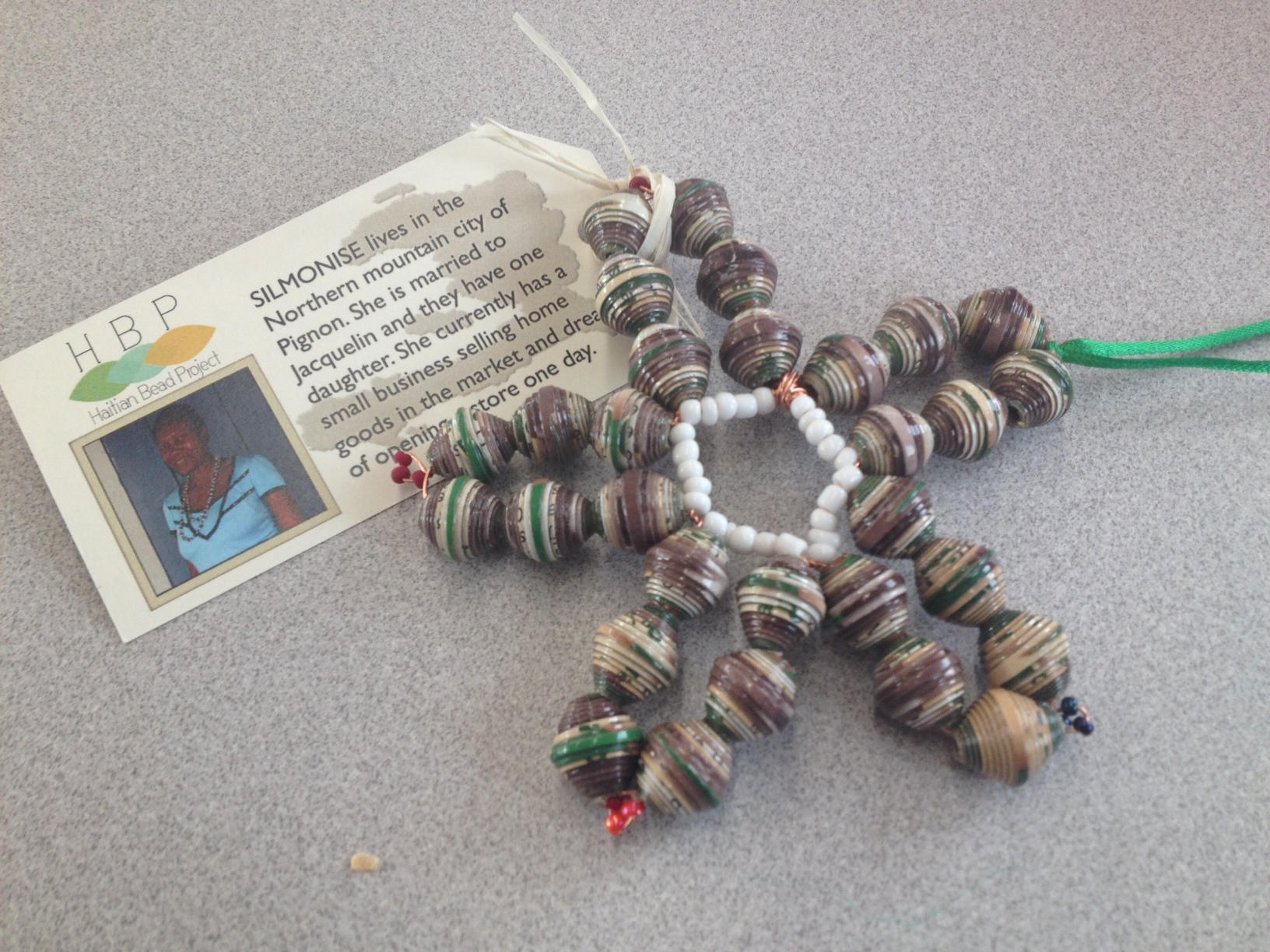 Just a quick post today to say that as you’re purchasing Christmas gifts for your friends and family, consider investing your money in gifts that can help reverse the plight of women around the world.
For starters, check out this post on the Junia Project. They link to 6 different sites where you not only find some cool gifts, you can empower women around the world at the same time.
Another option could be to shop on the Haitian Bead Project site here. The HBP is a dynamic ministry that empowers women in rural Haiti to create beautiful jewelry (and more) as a way to, among other things, provide income, nurture creativity and affirm the basic human dignity of these amazing women.
Here’s how the HBP works:
Our products feature handmade beads created from “upcycled” materials like cardboard and coconut shells. Each piece of jewelry is unique. No two necklaces or bracelets or even beads will ever be the same because of the creative process for making this jewelry.
Our artisans take various types of recycled thin cardboard like cereal boxes and cut these into triangular strips using a paper cutter. The artisan then rolls the strips of cardboard on bamboo skewers to form the shape of the bead. The bead is coated with glue to help secure the layers of cardboard. Next the artisan will varnish the bead to seal and protect the bead, making it waterproof and giving it a shine. The skewers of beads are then set in the sun to dry. After the beads are dried, the artisan goes to work making jewelry pieces. She may mix seed beads, glass beads or other unique beads with her own handcrafted beads to create unique bracelets, necklaces and earrings. The goal is to create quality, beautiful pieces that customers can wear or use to make a fashion statement. Every purchase has a purpose, honoring the artisan and the individual who wears it.
Personally, I’ll add that the HBP Christmas ornaments are absolutely stunning. In fact, give it a week and you can ask my leadership team what they think…
This Christmas, enjoy some justice-minded, Tertullian-free shopping!
“Women Pastors and Male Privilege”
 Even as I continue to labor in the DMiss cave this week, I appreciated this post from Dr. Jeremiah Gibbs. I find it to be a concrete illustration of the reality of Tertullian’s continued influence. Dr. Gibbs is someone I respect on topics like these, and his full portfolio of articles on women in ministry can be found here.
Here are the first few paragraphs of Dr. Gibbs’ piece:
Until recently I was able to say that I had never had a single person mention the way that I was dressed in 14 years of church leadership. Recently, one of the older men has teased me a couple times that I should wear a tie more often. My streak is broken.
When I was in seminary I learned that many of my female colleagues hear comments about their clothing, hair, and make-up every week.
It’s easy to dismiss this as an odd reality of culture. Some of these remarks are compliments and aren’t meant to make a woman’s job harder. But consider how the constant discussion of physical appearance changes the way women pastors spend time preparing for Sunday morning:
Maybe a skirt? A skirt for preaching shouldn’t be too short or figure-hugging. So a long skirt. But it would still need to look current or it could communicate a kind of Puritanism, a disengagement from the culture which may cause members to disregard me as irrelevant. So a long but current skirt it is. But a skirt doesn’t have a pocket for the wireless mic pack. Oh, and there is a large window behind the pulpit. Sun behind a skirt is not good. How can a congregation focus on my words if they are treated to a view of my upper thighs?
Oh, thighs. Help me set aside the thought of thighs. My value is not found in how I compare to women in magazines. My value is not found in how I compare to women in magazines.
While there could be lots of reasons for doing so, this really excellent article in Christianity Today where this quote is found was submitted anonymously. She names the crazy dilemma that so many women pastors endure with a remarkable humor and subtlety, yet she doesn’t even take credit for doing so.
Few male pastors would select a wardrobe so carefully. Few would be concerned with reactions to this article such that they would write it anonymously.
When I prepare to preach I spend no more than 45 seconds thinking about what I will wear, and I never second guess that decision. I’m guessing that a majority of male preachers have a similar pattern. While my female colleagues are wrestling with the flats and the heels, I spend additional time rehearsing my sermon again, praying for the congregation, or simply resting in God’s presence. If you think I’m overstating my case at all, then read about this male news anchor that wore the same suit every day for a year without anyone noticing. Seriously.
While I’m praying over my sermon, she must try on her third pair of shoes.
Don’t stop! Read the rest here.
(RE-Post) 2 Reasons Why I Coach Girls Soccer
 Note: This post first appeared on November 11, 2013. I’m re-posting today, for two reasons. One, I am continuing to spend my writing time working on my DMiss project, due December 12th. And, two, because I want to commemorate a truly great soccer game yesterday. Though our girls lost in sudden death penalties in yesterday’s tournament final, this is one seriously proud coach!
When I started, it was mostly about need.
As in, my daughters’ team of under 8 girls needed a coach, and I needed some venue to express my love of all things soccer. Somewhere along the way, need morphed into, well, a calling of sorts. Like, I feel called to coach soccer. Even more to the point…
I feel called to coach girls soccer.
There are more than this, but here are two key reasons why:
First, I see coaching these girls as a way to make a tiny dent in the largely anti-female culture of American (and global) sports. I’ve blogged about sports culture before (here, here and here), but in case you need a reminder, we live in a world where boneheaded talk radio jocks say things like this:
“I enjoy many of the women’s contributions to sports — well that’s a lie. I can’t even pretend that’s true. There are very few — a small handful — of women who are any good at this at all. That’s the truth. The amount of women talking in sports to the amount of women who have something to say is one of the most disproportionate ratios I’ve ever seen in my freakin’ life. But here’s a message for all of them … All of this, all of this world of sports, especially the sport of football, has a setting. It’s set to men… It’s a man’s world.”
I wish this sentiment was an aberration, but I’m afraid it’s not. And while we rarely experience sports as this overtly and verbally sexist, Tertullian is still there, lurking in the shadows. Recently I read this article, about a group of elite women cyclists and their supporters, who are seeking to create a Tour de France for women. The litany of legal, financial and attitudinal barriers they are facing is staggering and depressing.
So, by choosing to coach girls, perhaps I can punch a small hole in a long-established male-favored sports culture.
Second, coaching the girls gives me an opportunity to try to be a healthy male role model. To be sure, I don’t know the full stories of each of the girls on my team, but I know enough to know that some of them could use a positive and encouraging male role model in their lives. And, sure, I’m only with them 3 hours a week, but I am acutely aware that I when I am, I have an opportunity to bless and encourage them, in a way that they might not get consistently at home.
That’s right, what I’m saying is that soccer coaching can be ministry.
Both of these reasons–culture shaping and role modeling–are ways that I’m trying to leverage my male privilege to bless others. In the overall scheme of things, there are small, almost token acts.
And yet, at the end of the day, I don’t live in the overall scheme.
I live in my neighborhood, with these girls and their families, coaching and playing soccer.
A Junia Thanksgiving
 I’ve said it before, but I love and appreciate being a part of a community of scholars, bloggers, practitioners and writers thinking about issues of gender equality. To put it mildly, it’s nice not to have to challenge Tertullian alone.
And one group of vital allies in the movement are the good folks behind the Junia Project. I’ve encouraged you to hang out with them a few times over the last year or so.
Once again, I was honored to be mentioned on the Junia Project blog the other day, as a part of their thankful list. The whole post is more than worth reading, particularly if you are someone who is interested in learning from a diversity of voices.
I’ll excerpt the first portion of the post below. It’s amazing to be mentioned in the same company as these other men, and, again, it’s an honor to be mentioned by my friends at JP.
1. Men who publicly advocate for women
We appreciate the men who consistently advocate for women’s equality in public spaces. Men like Rob Dixon, Tim Fall, Nick Quient, Jeremiah Gibbs, JW Wartick, Bob Edwards, Eugene Cho, and many more who advocate through social media and blogging.
Men like John Ortberg (that link takes you to what may be one of the best introductory sermon on women’s equality in the church out there), Bill Hybels, Greg Boyd, and many more who advocate from the pulpit.
Men like Craig Keener, Miroslav Volf (see “Exclusion and Embrace”), Andrew Sloane (“Tamar’s Tears”), and many more who advocate through their scholarship.
These public affirmations are gamechangers, folks. As Rob Dixon writes in his post “Taking My Cue From Jesus“:
Jesus was/is a gamechanger. He really saw women, he trusted them, he taught them as disciples, he respected them, he valued their stories and he mourned with them. And here’s the kicker…he did it all publicly. What I mean is that there was a public dimension to each of the stories. It’s not like Jesus was going around empowering women behind locked doors; he was engaging with women on the streets, in house meetings and surrounded by crowds.”
Linking Black Friday with Male Privilege
 For the next couple of weeks, I’ll be re-posting older content as I work to finish up my literature review, due December 12th. This post was originally published on November 19, 2012. Enjoy!
The Holidays are upon us! In fact, this week we celebrate two cherished American holidays, Thanksgiving and Black Friday. You know Black Friday of course; it’s the yearly post-Thanksgiving consumer orgy that last year generated some 11.4 billion dollars. That’s “billion” with a “B.”
Because of this, slowly but surely Black Friday is morphing into Black Thursday. I noticed the other day that Walmart will open at 8pm on Thanksgiving for their “family specials” and 10pm for “gadget die-hards.” Then, doors open at 5am on Friday for, evidently, the non gadget-loving single people.
Why am I talking about Black Friday and American consumerism in a blog dedicated to the topic of male privilege?
Because with the arrival of Black Friday, the season for introducing and reinforcing the reality of male privilege for the next generation is upon us.
One way to answer the question of where male privilege comes from in our culture is to point to the way we enculture our children through the toys we buy them. Think about this with me:
For the most part, toys that cater to boys present a traditionally and stereotypically masculine image marked by power, strength and control. Toys for little boys include things like superhero action figures, building sets and water guns. By contrast, toys marketed to girls communicate an image of femininity marked by softness, humility and passivity. Toys for little girls include things like tea party sets, princess dolls and jewelry.
Can you see in this the seeds of male privilege?
Make no mistake about it, the toys we buy communicate a lot. Specifically, we communicate a view of the world where men possess power and women do not. For girls and young women, the results can be devastating.
In her excellent (and disturbing) book Cinderella Ate My Daughter, journalist Peggy Orenstein details some of the fallout:
“According to the American Psychological Association, the girlie-girl culture’s emphasis on beauty and play-sexiness can increase girls’ vulnerability to the pitfalls that most concern parents: depression, eating disorders, distorted body image, risky sexual behavior. In one study of eighth-grade girls, for instance, self-objectification—judging your body by how you think it looks to others—accounted for half the differential in girls’ reports of depression and more than two-thirds of the variance in their self-esteem.”
So what’s the bottom line here?
In American culture, boys are taught at an early age that they intrinsically have more power and privilege while girls need to figure out other, often more destructive, ways to make their voices heard.
So what’s the solution here? How do we push back against this biased system? Here are some of things we’re talking about in my house:
Don’t buy toys at all. Maybe a puzzle or board game instead?
Buy toys according to how our girls are wired. Our oldest daughter is clearly an artist, so for her it’s art supplies over princess castles. Our middle daughter loves sports. That new soccer ball looks better than the costume jewelry.
Or, if we do buy some of the more traditional toys, we will aim to supplement or offset that with lots of intentional conversation about how our girls can grow up to be whoever God has called them to be.
Lastly, here’s another thought: when it comes to buying toys, forget going to Walmart this week and instead buy your little girls something like this. It’s the story of Goldieblox, and it’s a great story.
What about you? How do you identify the roots of male privilege in our culture?
 Challenging Tertullian