Rest in Peace, Men of the Cross
 I’m having a difficult time getting the images out of my head.
The Libyan seashore looks beautiful, with waves coming into the pale sands. The line of orange jumpsuit clad men on their knees is striking in contrast. The horrible men wearing black standing behind them adds a menacing tone to the scene.
The death of 21 Coptic Christians at the hands of ISIS is horrific and painful, and yet for me there is a small but important ray of hope in the midst of the pain. For these men died as martyrs, thus joining the long line of men and women who have given their earthly lives for the sake of the Gospel.
In this profound piece, Ramez Attalah, General Director of the Bible Society of Egypt, quotes a young worker in his office responding to the news with hope:
“I am encouraged” she said, “because now I know that what we have been taught in history books about Egyptian Christians being martyred for their faith is not just history but that there are Christians today who are brave enough to face death rather than deny their Lord! When I saw these young men praying as they were being prepared for execution and then many of them shouting “O Lord Jesus” as their throats were being slit, I realized that the Gospel message can still help us to hold on to the promises of God even when facing death!”
This young woman’s words remind me of this famous quote:
“We (Christians) are not a new philosophy but a divine revelation. That’s why you can’t just exterminate us; the more you kill the more we are. The blood of the martyrs is the seed of the church.”
Who penned these words?
You guessed it. It’s Tertullian. The quote is from perhaps his most famous work, Apologeticum, written in or about 197AD.
I spend my time on this blog sparring with Tertullian, and rightly so, given his teaching on women. But, today, I’m not challenging Tertullian…
I’m agreeing with Tertullian.
Rest in peace, men of the cross.
On the Journey
 I spent this past weekend thinking about being white. And I wasn’t alone. I joined some 40 InterVarsity students and staff exploring what it means to be white. We spent some 36 hours learning about white culture and how we engage others a multiethnic world.
And, along the way, we talked about white privilege.
Whenever I’m a part of group of people talking about privilege, be it white privilege or male privilege, there’s always some degree of wrestling that happens. That’s particularly true when it’s someone’s first exposure to the idea of privilege. There’s struggle. Maybe there’s pushback. There’s denial. There’s guilt. Then, occasionally, there’s repentance. And hope. And a commitment to justice. A willingness to learn. And perhaps a million more responses.
All of this got me thinking…could there be a pattern of response as men engage the idea of male privilege? I’ve been bringing this content to people enough now to think that maybe there is. Here’s one draft path or pattern:
1. Blissful naïveté. This is where we start as American men. We’re are happily unaware that there is a problem, or that we are the beneficiaries of a biased system.
2. Paradigms challenged. Something happens to press our naive view of how the world works, and we experience dissonance. Perhaps this happens when we read data on cultural gender disparity. Or maybe it happens when a female friend shares their pain-soaked experience in the patriarchal church. Or, like two weeks ago at Fresno Pacific University, perhaps this happens when a guy like me gets on a mic and flat-out calls students to consider their male privilege.
3. Denial and distancing. No one likes to be told they have privilege. Or that the world is biased in their favor. So usually there is some degree of pullback that occurs. We say, “that simply can’t be true.” Or, “Well, I’m not that way.” Or, “That may be true for others, but that’s not my reality.” Let’s face it, new things are tough to absorb.
4. Second encounter. Or maybe third. Or possibly fourth. But the idea is that the topic of privilege comes around again, and there is another chance to respond. Men are once more offered the opportunity to wrestle with the concept of privilege.
From this second encounter, two paths diverge.
5a. Shutdown. “It doesn’t fit.” “It won’t fit.” “It’s part of some liberal PC agenda.” “I’m done with it.” The person shuts down and dismisses the teaching. I’ve seen it happen too often for my liking, and, when it happens, it’s a tragedy.
5b. Pressing in. After the second encounter, the man takes a learner’s posture. Lots of questions. Lots of learning. Lots of observing culture with a critical eye. Lots of seeking to see the world through another’s eyes. Over time, a continual pattern of pressing in results in things like healthy inter-gender partnerships, empowerment and advocacy.
It’s from the perspective of race and ethnicity, but I think this post, by a Fresno pastor named Brad Bell, captures the essence of this journey.
For now I’ll call this a draft, and I welcome your thoughts!
Another Prophetic Picture
The joke around our house is that someday, we’ll all be working for Gracie.
Gracie is our middle daughter, and the third of our four kids. And she’s a leader. Headstrong. Hasty. Loud. Confident. Always the first to volunteer. A perfectionist. With an overdeveloped sense of right and wrong. Truth-teller. Competitive. Direct.
Come to think of it, she’s a handful.
But she’s our handful. And she’s a wonderful handful. And, while I think she’s going to need to have some of her rough edges tempered and rounded off, may she never lose what I think is her basic, most foundational drive:
To lead.
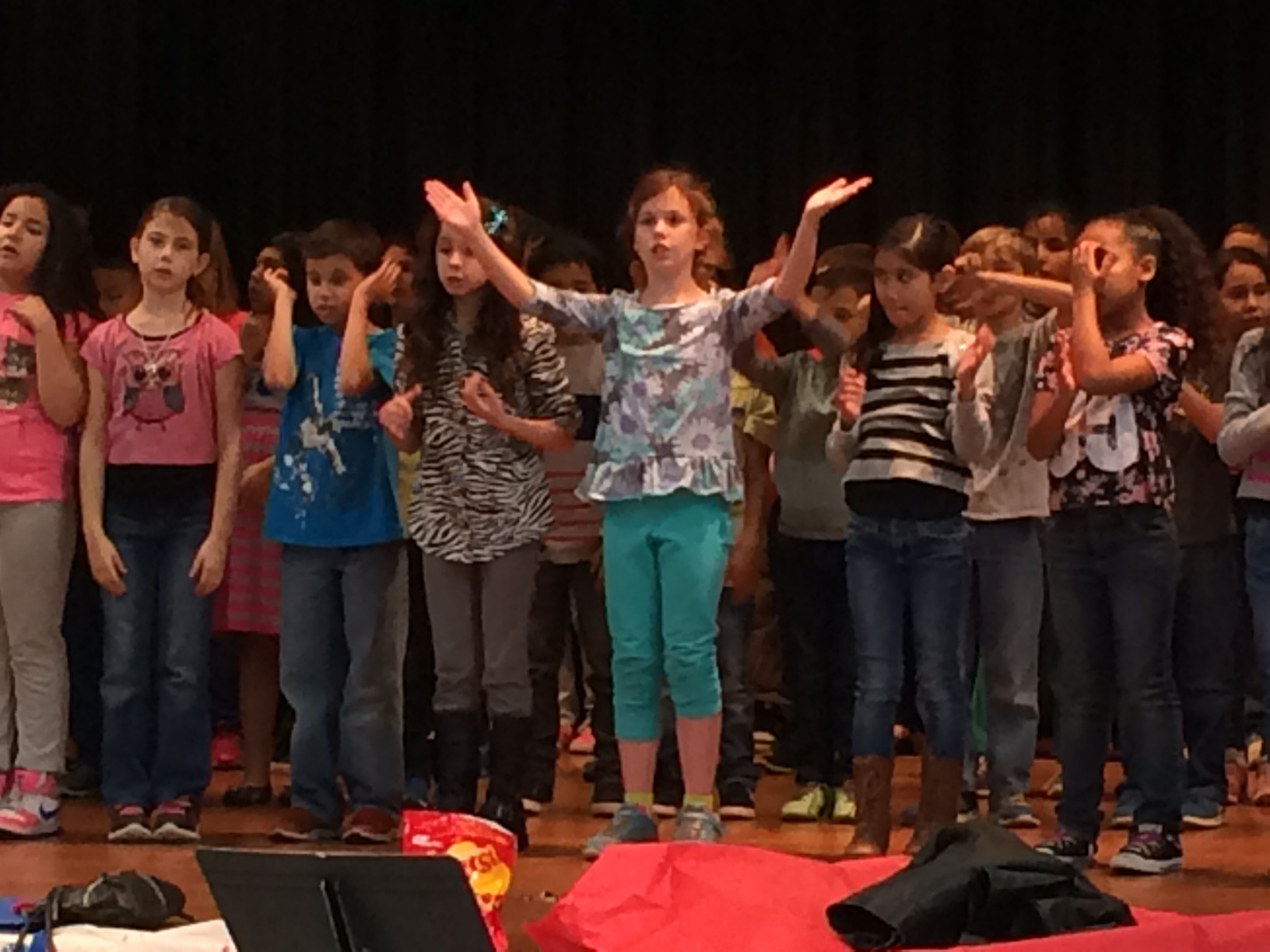
Gracie’s class has an oral interpretation competition tomorrow, and Grace has a solo. Today, as I was watching rehearsals, I snapped the following picture. To me it captures our Gracie at her best. Leading her peers, showing the way.
I’ve said this before, but this Challenging Tertullian stuff is personal for me. Because when it comes to women and leadership, any barriers, theological, cultural, ecclesiastical and more, need to be torn down. Why?
So that Gracie can lead.
RE-Post Look @ Me, Look @ You
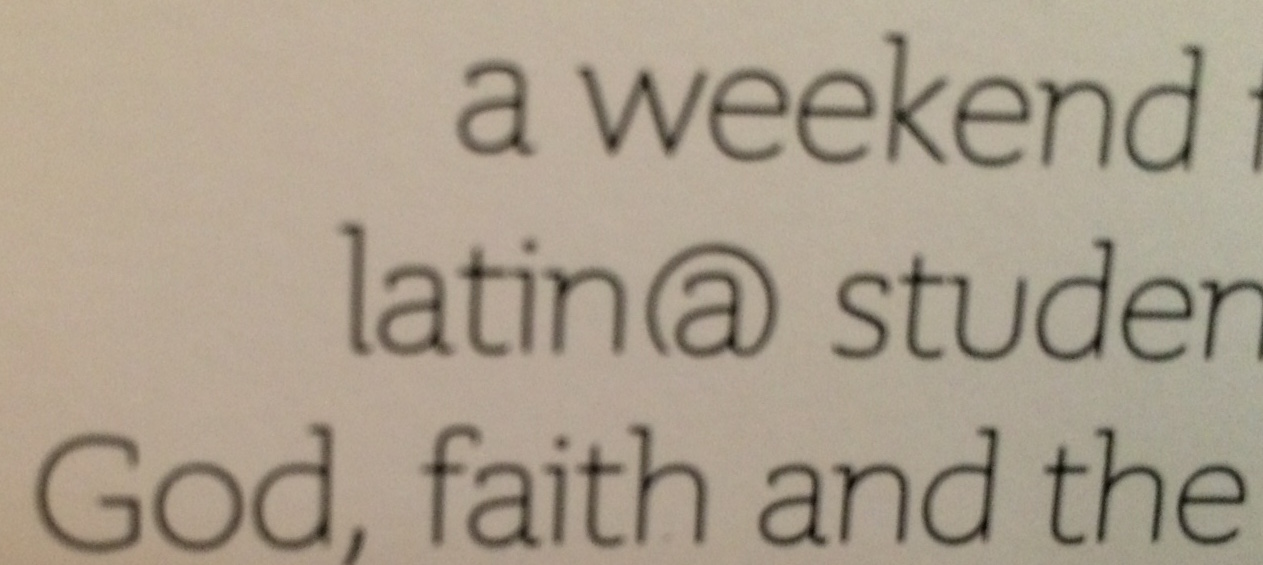 This weekend I attended a conference for Latin@ students, and the “@” is very much on purpose. In fact, the conference leadership had boldly (I thought) chosen to use the “@” on the program cover. It reminded me of the following insightful post from my dear friend Noemi. Thank God for small but important steps toward gender reconciliation in the church!
One of my favorite stories about Jesus is his encounter with a woman who suffered from continuous bleeding (Mk 5:21-34). Mark’s careful attention to the fact that Jesus allowed this woman to tell her whole truth highlights for me two qualities of Jesus that I admire.
First, he stops and sees. Jesus stopped to see this woman. She could have gone unnoticed after receiving her physical healing, but Jesus wanted one more healing for her – relational healing, so he stopped in order to engage this woman.
Second, Jesus models for us what it truly looks like to see somebody. When we sincerely look into the eyes of the person we are speaking with, we are sincerely confirming her/his worth, beauty, and identity as a sacred image bearer of our sacred God. Jesus models the significance of listening to and looking @ one another.
Jesus sees the worth of a person and he challenges us to do likewise. You may imagine my great delight when I felt “seen” for the first time in the male-dominated language of my heart – Spanish. I remember the exact place and time I saw the @ symbol after the word Latin.
In 2011 I was on a service trip to one of Mexico’s garbage villages and our Mexican student leader was writing on an easel board some Latin@ demographics. For five minutes after first encountering the @ symbol my mind wandered to new questions and possibilities: Why am I barely seeing this for the first time?!? How wonderful to have a written symbol to include all of the people in the room! Can I bring this back to my community? Would they understand?
As I pursue my Masters in Theology I have witnessed how far we in the Christian community still have to go to see one another. My heart is breaking for gender reconciliation. Querido (dear) Spanish is my first language, my heart language. Yet, it is a male privileged language . We do not have a neutral word for speaking to a gathering of men and women, so we default to the male form of the word. The word Latino can be used to speak of a man as well as a group of people. Latina can only be used to speak of women.
So when I saw that @ symbol after Latin, I felt seen.
Since then, I have cautiously introduced the @ symbol in my own use of the word Latin@. It often sparks confusion and conversation, but it’s a conversation worth having – how can we better include and seeone another in language?
When I use the @ symbol, it is a declaration that I am trying to truly see the entire room – men and women who bear the image of our Creator.
Questions, Questions and More Questions
 On Tuesday night, it was this male’s privilege to once again present on the topic of gender reconciliation to a group of young urban leaders in downtown Fresno. These saints are spending this year living in intentional Christian community and pursuing experiences with justice, reconciliation, and ministry with the marginalized. Honestly, it was an honor to be among them.
So I did my 40 minute talk, and then I opened the floor for questions. And, when that happened, the torrent began. Insightful question after insightful question. We spent about 20 minutes, and we could have gone much longer. Some reflections.
1. We need to help people understand the Scriptures related to faith and gender. I gave 2 minute expositions of Ephesians 5 and Genesis 3, and then I gave a longer treatment of 1 Timothy 2. The question about the Timothy text came from a woman in the front row who raised her hand and said, “there’s this one passage, from Paul, in 1st Timothy. Doesn’t it say that woman can’t teach in the church?” After I said my piece, she had a look on her face that said, “I can’t believe there is another way to interpret that text.” What venues can we create in our faith communities where people can honestly wrestle through the Scriptures?
2. People are craving new models for how to live this stuff out. That’s certainly true when it comes to inter-gender partnerships. Models of functional, missional partnerships are so scarce, I had to exhort the students to move heaven and earth in order to seek them out. And then I got asked about how my egalitarian marriage works. Why? Because no one has ever seen one!
3. Creating safe places where people can ask their questions would be a good use of our time in the church. There were a lot of questions on Tuesday night, but, then again, there always are. I think it speaks to the persistent (and frustrating) silence in our churches on the topic of faith and gender. And let’s not fool ourselves. When it comes to these topics, it seems like the church is the only one being silent. The culture certainly isn’t.
Between last week’s sessions at Fresno Pacific and Tuesday evening’s presentation, I’m in need of a break. Good thing the next DMiss year doesn’t start for another 5 weeks…
3 Reasons Why it’s Tough to See Male Privilege
 That Tertullian, he can be tough to find sometimes.
I certainly think that was the case last week at Fresno Pacific, where I had the joy of speaking to the men at two chapel services, on Wednesday and Friday mornings.
Together we wrestled with the notion of male privilege, and I challenged them to respond by admitting that male privilege exists, submitting their privilege to Jesus, and then committing to use their privilege to empower and advocate for others (find an older post about this three-fold response framework here).
It’s that first one, admitting that privilege exists, that I find to be the biggest challenge for men. At least that’s true the first time they engage teaching on this topic.
Why is that?
I think there are at least three reasons.
First, by its nature, male privilege is extraordinarily subtle and therefore difficult to spot. Male privilege sort of lurks in the culture. Because of this, it takes intentionality to locate, and that intentionality can be difficult to come by. On Wednesday morning, I told the men this story, of Tommy the bug guy. In hindsight, my male privilege becomes clear, in the stark contrast between my experience with Tommy and Amy’s. On the other hand, if Amy and I hadn’t intentionally made space to debrief the experience, it’s quite possible that we would never have been able to see (or feel) it.
Next, no one likes to be told that they have more power than someone else. That’s not exactly a popular message, and it’s almost like we have an allergy to the idea of privilege. In our perfect worlds, we’re all equal and there’s no such thing as a power differential. Sadly, the world doesn’t work that way, and yet I find that coming to grips with that reality can be a difficult paradigm shift.
And the kicker is that that is particularly true if you are the person with the privilege. In the same way that it’s hard for white people to see white privilege, it’s hard for men to see male privilege.
Finally, male privilege is tough to see because few people or institutions are pointing it out. During Friday’s talk, I offered to buy lunch for anyone who had heard teaching on male privilege before, either in class or in their churches. Needless to say, I only paid for myself. Perhaps this is a post for another time, but I think part of the reason for the silence is that, deep down, as men we like our privilege. After all, when the system is working in your favor, there is risk in pointing out its flaws. With this in mind, I think it’s incumbent on those of us who see male privilege to point it out to others.
In the end, on Friday I exhorted the men to step out of the river. I think culture can be like a river, carrying us all along. And, from time to time, we all need to swim over to the bank, get out onto the shore, take a long step back and contemplate at the river. When we do that, we’ll undoubtedly see good things, beautiful things, things worthy of praise.
But we’ll also see broken things. Things that cause others (and ourselves) pain. Things that must be redeemed.
Things like male privilege.
A Male Privilege Prayer
 I had a great time yesterday speaking to the men of Fresno Pacific University at chapel. It was fun to field test my male privilege material, and while there are things I would do differently next time, I think it was a good first outing. I’m praying that my words hit home with the students.
In round 2, tomorrow morning I’ll be inviting the men to submit their privilege to Jesus, so last night I cooked up a simple prayer that they can pray in order to help that happen. Perhaps for some it will become a daily litany that they offer each morning.
I know I want it to for me.
Here it is:
“Jesus, thank you for being my Lord. All that I have and all that I am belongs to you. If there is anything in my life that is not under your leadership, reveal that to me so that I can give it to you. Thank you that life is better and more joyful when you are in control.
Help me to see more clearly the privilege that culture gives me as a man. And, as I see it, strengthen me to submit it to your leadership alongside everything else. Jesus, I commit to use my privilege to expand your Kingdom and to bless others. Show me the way. Amen.”
(RE-post) Embracing the Prophetic Blessing
 I originally published this post on October 27, 2014, as I processed the prophetic dimension to my DMiss literature review. I’m posting it again today as I prep two messages that I will deliver next week at Fresno Pacific University’s chapel services on the topic of male privilege. It’s my hope that the men of FPU will honestly wrestle with what is sure to be a new (and prophetic) teaching for most of them. Join me in praying; I speak on Wednesday and Friday mornings at 10am PST.
November is an anniversary month for me.
In November of 1996, after about 10 months of full-time fundraising and part-time Junior High study hall proctoring, I started getting paid to do ministry. It’s still mind-boggling to me that what started as a 3 year “blip” between college and the “real world” has now lasted 18 years.
Indeed, somewhere along the way, vocational ministry became the real world!
And when you’ve been doing this 18 years, you’ve learned a few things. For instance, I’ve learned how I’m wired (and how I’m not). I am an introvert. I love to write. Put me in charge of a conference, or a system, or a project, and you’ll be in good shape. And, for the love of God, let’s have fun while we’re doing our ministry work.
I’ve also learned how I’m gifted. Like spiritually gifted. And, for the most part, my gifts are in the “behind the scenes” things. I’m a director/administrator. I like to help new things happen. I have a passion for service.
Truth be told, at least in my contexts, this gift mix makes me somewhat unique. Because many of the ministers around me are gifted in different, “louder” areas. Like preaching. Or evangelism. Or discernment. Or healing. Or pastoring.
Which is why my initial reaction to being blessed to be a prophet caused me to recoil.
There I was, two weeks ago now, in a corporate prayer time, when a good friend of mine came over to me, laid his hand on my shoulder, and whispered this in my ear:
“I think God wants me to anoint you to be a prophet in your DMiss work.”
Me? A prophet?!? Heck no.
I mean, have you read the Old Testament? As a group, prophets strike me as ornery and cantankerous. They probably smell bad. They eat locusts. No one likes them. It’s like they’re permanently pissed off and in turn want to piss others off.
If that’s what the prophetic blessing entails, I’ll pass.
But, as I’ve received that prayer blessing and pondered it a bit, what if there was room for a different kind of prophetic ministry? Maybe one that involves writing. Or blogging. Or a certain DMiss program? What if you could speak truth into the culture–into the church culture–by doing excellent research, reading and writing?
Several months ago, I introduced you to F. Pierce Beaver, missiologist, professor, and prophet. In writing about the profession of missiology, my chosen field of study, Beaver wrote this:
“The missiologist is called to be the pioneer and to blaze the trail. The missionary will not escape from his (or her) uncertainty until the missiologist points the way, and the church will not move ahead in mission unless the missiologist sounds a ‘prophetic call.’”
Today I’ll start writing my Literature Review in earnest. The idea will be to enter the “conversation” that other authors, theologians, sociologists and historians have been having about my topic of inter-gender partnerships in mission. Over the course of some 50 pages, I’ll hope to discern what could make such partnerships flourish, in my organization and, more broadly, in the church.
And, in all of it, I’ll hope to be prophetic.
So, this introverted, fun-loving administrator is going to take his prophetic unction out for a test spin. We’ll see how this goes. I’m all in.
Well, except for the locust-eating part…
In Their Words…
 Well, I hope you can handle one more post in response to last week’s events, because that’s what you’re getting today!
In case you missed it, last Thursday morning, my post “5 Reasons Not to Use Gender-Based Jokes in the Pulpit” went live on The Junia Project blog. And then madness ensued. Right now, it’s been viewed over 14,000 times, and that’s incredible. To be honest, it’s simultaneously exciting and overwhelming.
Next, on Monday, I published some reflections on my experience, in a post entitled “What it Says.” In the post, I expressed my hope that “the response indicates that people are hungry for honest and real conversations about gender in the church.” May it be so!
Then, on Tuesday, The Junia Project folks posted a selection of comments from around social media in response to the “5 Reasons” post. Find the whole post here, but I’m going to excerpt many of the quotes below. I recommend that you read then slowly, as I did yesterday. As you do so, contemplate the importance of this dialogue about gender equality in the church.
“I find [gender-based humor in the pulpit] extremely distracting.“
“I basically left a church because he wouldn’t stop doing this!”
“I can’t listen to anything else after.”
“I can think of one more: Gender-based jokes are dehumanizing.”
“’They’re inherently sexist’ isn’t enough?”
“It leads me right out the door. I feel the same with any sort of ethnic “humor.” There is no place for any of it, but I am glad if a pastor is relaxed enough to show his true colors so I can leave early.”
“I have been in many services where I spent thirty minutes reeling from the sting of some painful joke at the expense of women.”
“Sexism costs: 1) Giving my non-Christian wife a reason to ignore the sermon. 2) Belittling my marriage struggles with cheap “happy wife” lines. 3) Forcing me to reject community by making every men’s event about violence. 4) Reminding me of the dismissal of my wife and daughters giftings…”
“Most pastors would never think of making racial jokes in the pulpit. Gender jokes should be just as obviously off limits. I don’t like it anymore if the joke is on men, just for the record…”
“I’ve heard more gender stereotype jokes aimed at men (by men). Though they may have been intended to come across as self-deprecating, it can be used as an excuse to disengage from their families. “I’m just a man. That’s my wife’s thing.” Thus raising children and running a household isn’t a man’s responsibility. And the jokes give other men the perfect excuse to opt out, too.”
BLOG
“I am equally frustrated with the big dumb buffoon male trope as I am with the ditzy female or poor overworked wife/mother trope. Let’s cut out all ‘humour’ that reduces people to one characteristic. It’s not just insulting; it’s a disastrous dismissal of the complexity of humans created in God’s image.”
”When I realize that all a “preacher” is doing is a standup routine, I’m out the door.”
”…I remember getting really upset during the sermon one day because the male youth pastor described someone being weak, as, “He was acting like a little girl!” It got big laughs, but as a woman sitting there next to my strong but impressionable middle school girls, I was offended and angry.”
”How am I supposed to take seriously the advice of someone who thinks I must care only about shopping and my husband about sports, when we don’t fit the stereotypes?”
“May I add Point 6? It reinforces an “us vs. them” mentality between men and women…Preachers talk constantly about the need for spouses to respect each other. Well then, stop pitting us against each other!”
“I know many preachers who make jokes about marriage think they are being cute or clever or amusing their audience, but these days, with over 50% of the adult American population being single…the marriage jokes only make singles feel more excluded and marginalized than we already are.”
“This is one of the main reasons that I stopped attending my previous church. As a single professional woman in my 30s I couldn’t take any more of the “let’s celebrate all the things women do around the house” portrayal of women [and] Duck Dynasty-based quotes about ‘real men grow beards’.”
”I’ve been in church when the pastor decided to joke about ‘ditzy blonde women’. All I could think about is how many of those women would not be back the next Sunday.”
What it Says
 First, if you are one of the more than 10,000 people that read my Junia Project post the other day, welcome! Thanks for reading that post, and thanks for checking out Challenging Tertullian. Feel free to grab some coffee and stay for awhile, and, to get the big idea, you can find this blog’s first post here.
For this blogger, last week was equal parts fun and overwhelming. Thousands of page views, who knows how many retweets, Facebook shares, blog comments…at one point, I canceled something I had planned in order to keep up with social media.
Add it all up, and one thing is clear:
The message of the post, that gender-based jokes from the pulpit are unhelpful, struck a chord.
Or perhaps we can go a step further? Maybe it says something deeper, that folks long for pastors and preachers who are careful with their words? That gender equality is something worth fighting for? Or maybe the response indicates that people are hungry for honest and real conversations about gender in the church.
Honestly, I hope it says each of these things.
One of my favorite things about last week’s experience was interacting with people who found the post to be life-giving and affirming. One comment in particular really grabbed me, in all of its heart-breaking vulnerability. In good part, the following words capture one main reason I’m doing what I’m doing on Challenging Tertullian and elsewhere:

May the Junia Project post, and more like it, catalyze a deeper conversation about gender in the church.
 Challenging Tertullian