The Myth of the “Self-Made Man”
By all accounts, Manchester Boddy was quite the character.
Boddy lived from 1891-1967. He spent the bulk of his vocational career as the publisher of the L.A. Daily News. As one of the city’s cultural elite, Boddy hob-nobbed with stars, lived lavishly and dabbled in politics. Personally, I appreciate one of Boddy’s other interests, horticulture. Growing up just a few miles from his estate-turned-botanical gardens, I benefited more than once from both his appreciation for nature’s beauty, as well as the power of his bank account, which allowed him to create such a breath-taking location.
Manchester Boddy. Entrepeneur. Publisher. Senate candidate. Agronomist. Oh, and add one other title:

Because, as it turns out, Boddy’s story is also a rags-to-riches one, and, as the museum panel will tell you, that makes him a “self-made man.”
As you might imagine, my first issue with the descriptor is that it’s gender exclusive. What about the “self-made woman?!?” As if only men can, through sheer will and determination, end up “self-made.” It’s high time we eliminate such biased labels from our cultural lexicon.
That said, let’s take it a few steps further and debunk the myth of the “self-made man” with these truths:
1. God is the one who does the making in the first place. As Psalm 139:14 points out, you and I are “fearfully and wonderfully made.” Friends, we’re no accidents!
2. God creates us, and then uses community and circumstances to shape us. What I mean is that we all receive helping hands along the way to get where we are. Take Boddy for example. Someone nursed him back to health after he was gassed in World War 1. Others saw potential in the young encyclopedia salesperson and promoted him to manager. Still others paved the way for Boddy to use his talents to turn around a struggling newspaper. My point here is that while Boddy was no doubt gifted, he was anything but “self-made.”
3. God creates and shapes, so God should get the glory. According to the parable of the Talents (Matthew 25:14-30), you and I are called to do well with what we are given, but, all throughout the glory goes to the Lord. God gets the credit for who are become, since it’s God who does the work.
So, don’t believe the hype. Whether we’re talking about Manchester Boddy, Rob Dixon or anyone else–male or female–we’re all “God-made people.”
Garbage In, Then What?
 What you choose to allow into your brain matters.
The Apostle Paul had it right in Philippians 4:8-9 when he wrote: “Finally, brothers and sisters, whatever is true, whatever is noble, whatever is right, whatever is pure, whatever is lovely, whatever is admirable—if anything is excellent or praiseworthy—think about such things. Whatever you have learned or received or heard from me, or seen in me—put it into practice. And the God of peace will be with you.”
In light of Paul’s words, let me pose a question:
When it comes to issues related to gender roles, power and mixed gender relationships, who are you listening to?
Are you listening to Pat Robertson? You remember Pat?!? Well, as you might have noticed, Pat was back at it last week, once again essentially condoning adultery. The full clip is here, but the most damning quote is this:
“Males have a tendency to wander a little bit. And what you want to do is make a home so wonderful he doesn’t want to wander.”
Because, evidently, it’s the woman’s fault when men cheat.
Or are you listening to Mark Driscoll? I haven’t done a whole lot of work with Mr. Driscoll, but I know that he is a polarizing figure. At the recent Catalyst conference, he was quoted as saying this:
“If you drive a mini-van, you’re a mini-man.”
Um, yeah, I drive a minivan…
In fact, you might appreciate this article that connects both of these two gentlemen.
Let me be clear, I’m not saying that these brothers are totally unworthy of your attention. In fact, my rule applies and without a doubt there is more that I agree with them on than not. But here’s what I am saying:
We need to be careful what media we choose to consume. Is it true? Or noble? Or right? Or pure? Is it lovely? Admirable? Excellent? Praiseworthy?
Next, we need to think critically. In Philippians 4, Paul uses the Greek word logizomai, which usually gets translated “think.” Perhaps a better translation would be “reckon” or “contemplate.” Indeed, the exhortation here is to give careful attention so as to understand what is factually accurate. I don’t know about you, but most of the time, I hear something and then just move on.
Lastly, when it comes to gender issues in particular, we must make sure that we are listening to a diverse selection of voices. Want some options to get you started? Try this TED talk. Or read this blog. Or join me in not being able to wait for this book. Heck, if you have other voices that you listen to, please share in the comments.
And, finally, since you’re reading this, let me say thank you for joining me in “thinking about these things” on this blog. I appreciate it.
Is it Possible for Women to Step Up Without Men Stepping Back?
 In a comment a few weeks back, I got this insightful suggestion from a dear reader:
Maybe instead of trying to end male privilege you may want to extend the same privileges to women. Then men won’t feel like you are trying to take something away from them.
I’ve been sitting with this since then and here are two thoughts on the topic:
There’s not enough space to simply open doors for women without men stepping back. And, further, in the Kingdom, stepping back is actually good for men.
Let me break these two thoughts down a bit.
In her book Making Room for Leadership, MaryKate Morse uses the metaphor of physical space to describe how much power someone does or does not have. A person with a lot of power takes up a lot of space, and the converse is also true. And, for Morse, how much space a person takes up has a lot to do with who they are (or aren’t), with things like gender, ethnicity, positional authority, personality, age and access to resources factoring prominently into the equation.
My perspective is that there is a finite amount of social space or power. After all, there’s only one school principal, or soccer coach, or business owner, or CEO, or president. What I mean is that, in most contexts, there exists a cap for how many individuals can exercise influential leadership. And so how that limited social space gets filled is indeed a crucial question worth pondering.
As we’ve seen, in most every corner of American culture, men take up the most space. Visually, let’s say that currently the picture looks like this:

If indeed it’s true that space and power are finite, in order for the equation to change, two things will need to happen. First, men will need to give up power and, second, women will need to take up power (or, if you will, Lean In). I’m expressing this conceptually here; believe me, I know there are plenty of conversations to be had about how each of these things can and should actually happen. In any event, the redistribution zone is in gray:
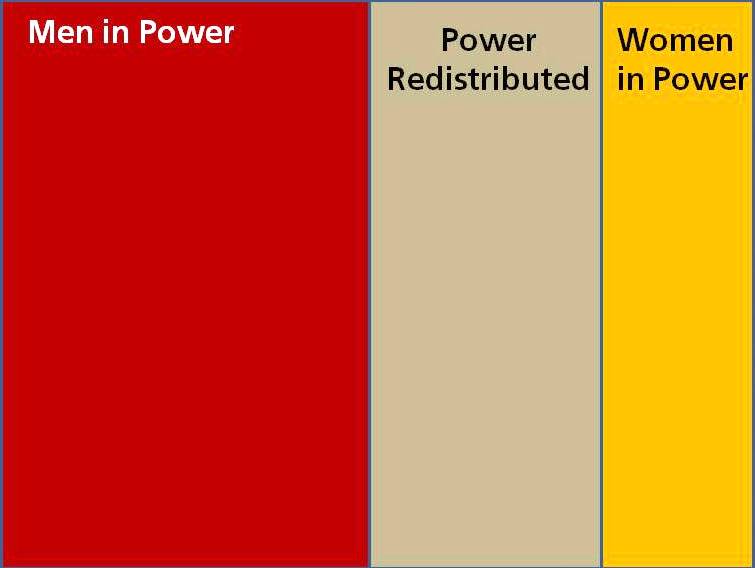
And if that power is redistributed in healthy ways, if we can discern a way to share power equally, the final picture could look like this:
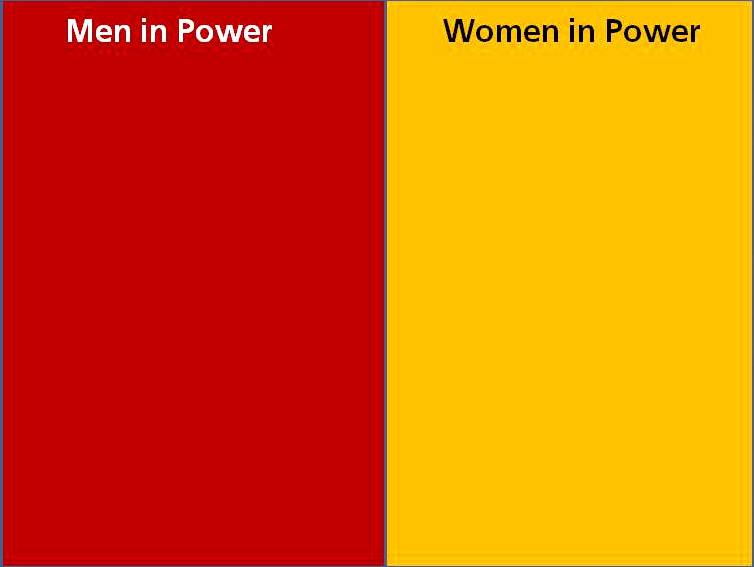
The bottom line, then, is that we need men to lay down power in order for women to take it up. And until that happens, there’s not enough social space or power for both genders to fully flourish.
Secondly–and this is the really good news for men–in the Kingdom of God giving up power is actually a good thing. I’ve written about this before, (here, here and here) and so let me repeat myself:
When Jesus invites us to surrender our male privilege, he’s inviting us into his story. He’s inviting us to use power his way and not the world’s. Seen this way, then, it’s an act of discipleship, as surrendering male privilege is one way to emulate Jesus’ surrender of his divine privilege.
So let me be clear: I do want women to enjoy the same privileges as men. In part, I just think that we get there by discipling men into joyfully and willing releasing power.
What about you? What resonates for you from this post? What doesn’t?
For Once, I Agree with Tertullian
 Deep down, I think Tertullian was one big softie.
Sure, Tertullian is the guy who said all sorts of misogynistic things about the women of his day. He did.
But then he also said this:
“How beautiful, then, the marriage of two Christians, two who are one in hope, one in desire, one in the way of life they follow, one in the religion they practice. They are as brother and sister, both servants of the same Master. Nothing divides them, either in flesh or in spirit. They are, in very truth, two in one flesh; and where there is but one flesh there is also but one spirit. They pray together, they worship together, they fast together; instructing one another, encouraging one another, strengthening one another. Side by side they visit God’s church and partake of God’s Banquet; side by side they face difficulties and persecution, share their consolations. They have no secrets from one another; they never shun each other’s company; they never bring sorrow to each other’s hearts. ” (Ad Uxorem II, 8, 7)
Pretty good, right?
Yesterday was Mother’s Day, in case you missed the millions of Mother’s Day memes posted on Tumblr. Or the mom and kid candids that graced facebook walls. Or the 140 character twitter tributes.
In that spirit, and in the spirit of Tertullian’s celebration of marriage, I thought I would use this space today to celebrate and honor the best mom we’ve here in the Dixon house. After all, not only was yesterday Mother’s Day, today is Amy’s birthday.
But when I went to her to ask if I could dedicate a post to how generous she is with others, how patient she is with our kids, how creative she is with her stories, how stinkin’ wise she is always, how humble she aspires to be, how serious she is about growing in her faith, how I love how we are constantly on the same page about the things that matter, how every morning I wake up thanking God that I get to be married to this amazing person…
…when I asked her if I could share these things, if I could shout them from the cyber rooftops…
…she said “no.”
So I won’t. I’ll take a pass. Instead I’ll just say, “When it comes to my marriage, I agree with Tertullian.”
Women’s Liberty Bell Blog
 What’s the best thing about blogging?
I’m going to call it a tie. On one hand, it’s tough to beat the actual process of writing. I love the moment when I sit down in front of the computer, search my mind, heart and soul and then try to wrangle words into a structure that will communicate what I’m processing. It’s a rush.
On the other hand, I’ve really enjoyed the interaction with others. Blogging has connected me in all sorts of ways. For instance, when something gender related goes viral in the news, my inbox explodes with people forwarding it to me. Or, the other day, I had a conversation with a blog reader who looked me up in order to ask a few questions.
And then there’s the Women’s Liberty Bell Blog.
Through a string of connections, on Tuesday I found myself posting on the Women’s Liberty Bell Blog. Here’s a bit about this blog:
“The purpose of the Women’s Liberty Bell Blog is to promote dialogue around how to more fully enlist our faith traditions in the ongoing work of uplifting girls/women around the world, not only in the form of charity/humanitarian efforts, but even more fundamentally to establish a very clear, spiritual framework for women’s human equality around the world.”
What about the Liberty Bell imagery?
“Katharine Wentworth Ruschenberger commissioned a replica of the Liberty Bell to help spread the cause of woman suffrage in Pennsylvania. The inscription on the bell likened the denial of votes for women to the tyranny of English rule which fueled the American Revolution. It differed from its brother only in that it lacked a crack and bore the inscription, Establish Justice. The 2,000 pound bell became something of a sensation. It toured 5,000 miles in a flatbed truck built specifically for this purpose, criss-crossing Pennsylvania. It eventually appeared at suffrage events in Chicago and Washington, DC. Its travels were marked by large crowds and band-led parades. Miniature versions of the bell were sold to defray the cost of its tour. It was a media darling. The bell’s clapper was chained into silence until the passage of the 19th Amendment. In a ceremony held in Independence Square in September, 1920, the bell was raised and rung by a woman dressed as Justice, signaling true liberty in the United States: suffrage for women. The Justice Bell now resides in the Washington Memorial Chapel at Valley Forge.”
Pretty cool. More on the Women’s Liberty Bell, also known as the Justice Bell, here.
So it was a delight to post yesterday, in response to a prompt about men’s experience in the movement toward gender equality. You can find my post here. Thanks to the folks at the Women’s Liberty Bell Blog for letting me “chime” in, and I look forward to coming back again sometime.
What Warren Buffett and I have in Common
 Over the last month or so, I’ve been meandering my way through Sheryl Sandberg’s Lean In. One quote, from early on in her book, caught my eye. It’s about Warren Buffett, the uber-wealthy “Oracle of Omaha.” Here’s Sandberg on Buffett:
“Legendary investor Warren Buffett has stated generously that one of the reasons for his great success was that he was competing with only half of the population.”
Now, Mr. Buffett and I don’t have a lot in common. He’s wealthy…we live simply. He’s got business acumen…I can pray, do some pastoring and I’m decent with email. He’s widely known and respected around the world…I’m widely known and respected…in my own home. You get the picture. We’re apples and oranges Warren and I.
But Warren Buffett and I on the same page when it comes to women in the workforce.
Intrigued by Sandberg’s quote, I recently came across this article that demonstrates that Warren Buffett is a man who is aware of his privilege. Check this out:
“The moment I emerged from my mother’s womb, however, my possibilities dwarfed those of my siblings, for I was a boy! And my brainy, personable, and good-looking siblings were not. My parents would love us equally, and our teachers would give us similar grades. But at every turn my sisters would be told — more through signals than words — that success for them would be “marrying well.” I was meanwhile hearing that the world’s opportunities were there for me to seize. So my floor became my sisters’ ceiling — and nobody thought much about ripping up that pattern until a few decades ago.”
Friends, that’s male privilege right there. And here’s Buffett’s call to action:
“Fellow males, get onboard. The closer that America comes to fully employing the talents of all its citizens, the greater its output of goods and services will be. We’ve seen what can be accomplished when we use 50% of our human capacity. If you visualize what 100% can do, you’ll join me as an unbridled optimist about America’s future.”
In one sense, Warren Buffett and are making the same argument, just from different perspectives.
Where Buffett argues from the perspective of economic resources, I’ve been challenging Tertullian from the perspective of spiritual resources.
So, allow me to paraphrase Mr. Buffet:
“Fellow males, get onboard. The closer the Church comes to fully employing the talents of all its members, the greater its spiritual output will be. We’ve seen what can be accomplished when we use 50% of our human capacity. If you visualize what 100% can do, you’ll join me as an unbridled optimist about Kingdom’s future.”
See? Who cares if we’re in different tax brackets, Mr. Buffett and I have more in common than I thought.
Koofi for President!
 In the last several American election cycles, we’ve seen women featured prominently on major party tickets. The results, however, have obviously been less than stellar.
This of course speaks to a larger problem. As I’ve said before, women are woefully under-represented on the American political landscape. For example, according to this document, less than 25% of elected positions nationwide are held by women.
In this country, politics is a cultural institution firmly gripped by male privilege.
A litany of factors hold women back. A lack of access. A lack of power. A lack of funding. The stubborn persistence of a “good, ol’ boys network.” Unhelpful, incorrect yet persistent stereotypes that hold that women cannot lead.
All of the above.
And then there’s a woman’s appearance. That’s right, what a female candidate wears matters. A lot. According to this study, when women are physically described in a new’s report, their approval rating plummets. Here’s a quote:
“Another study presented participants with profiles of ‘candidates’ Jane Smith and Dan Jones. If participants only read the profiles, the woman emerged with an edge. But that edge was eclipsed immediately, as soon as physical descriptors — like ‘Smith dressed in a brown blouse, black skirt, and modest pumps with a short heel…” — were added to a “news story.'”
Friends, this is America. In 2013.
Perhaps we can learn from…Afghanistan.
Afghanistan? Again? Yep. Consider the courageous story of Fawzia Koofi:
“Surviving an assassination attempt by the Taliban, Koofi continues to campaign for the 2014 Presidential seat. Because traditional Islamic culture views women as property, Koofi’s courageous campaign and leadership stirs tension among some Afghans – particularly the Taliban. Resigning herself to the idea that she might, one day, be killed by the Taliban, Koofi continues fighting for women’s rights and is undeterred on her journey to becoming the first female President of Afghanistan.”
How’s that for guts?
At the start of the new congress earlier this year, Foreign Relations expert David Rothkopf tweeted this:
“So glad we now have 20 women serving in the Senate. Only 31 to go until we have proportional representation. At this rate, that’ll be 2380.”
Not another 367 years of male privilege in the political world! Let’s hope for and work for a day when women can run for office on their merit as candidates, both here at home and across the world in Afghanistan.
Follow along with Koofi as she campaigns for the Afghani presidency here. Or follow her on twitter @FawziaKoofi77
Good News from the Magic Kingdom
 About two weeks ago I posted about Disney’s Avenger shirt line, one that perpetuates male privilege by reducing the relationship between the genders to one where men are heroes and women need heroes. I said:
So, listen up Princess. Sometimes Prince Charming will indeed come save you, but sometimes he’ll need you to save him as well. And as that time comes:
Be a heroine.
So how about an update?
According to this article from the folks at missrepresentation.org:
As a result of the pressure, today the “I Need a Hero” is no longer available on the Disney Store website.
Though they continue to sell the “Be a Hero” t-shirt only for boys (and a “I Only Kiss Heroes” t-shirt just for women) the removal of one t-shirt is significant in that it shows our voices are being heard. And that when we come together to talk back to sexist media we have tremendous power to influence change.
Keep the pressure on the Disney Store to stop using limiting gender stereotypes, and to begin creating t-shirts which empower ALL of us to be heroes.
Is it a small victory? Of course. But it’s a victory nonetheless.
So let’s celebrate a bit more empowerment for women and young girls.
Let’s celebrate a little bit healthier perspective for both girls and boys.
Lastly, let’s celebrate more baby steps that are leading in the right direction.
Male Privilege and the Movies
 Right now the top movie at the U.S. box office is the film Oblivion. A drone repairman assigned to work on Earth makes a reality-altering discovery. It looks great.
Oblivion stars Tom Cruise, all of 50 years old. He’s of course the male lead. The female lead? 32 year old Ukrainian actress Olga Kurylenko. Who, you ask? Right. It’s as if Universal, the producer, said to the casting folks: “We need a gorgeous, up-and-coming, cheap actress to play opposite Tom. Oh, and make sure she’s young.”
18 years younger to be precise.
The other day I came across this article, from vulture.com. It’s an interesting study on gender, age and Hollywood. And the results of the study are clear:
As leading men age, their love interests stay the same, and even the oldest men on our list have had few romantic pairings with a woman their own age (or even one out of her mid-thirties). If our actor was sharing the screen with an A-lister of commensurate star power like Julia Roberts or Angelina Jolie, the age difference would drop somewhat, but in movies that relied solely on our guy’s big name, the lesser-known love interests would nearly always be decades younger.
Evidently, for Hollywood, men age well and women, well, they just age.
At the risk of over-doing it, one more sample. This is the article’s verdict on Johnny Depp, now a spry 49:
Johnny Depp likes ’em young: Nearly all of his notable love interests have been 25 or under, and a few of them — including Winona Ryder, Juliette Lewis, Christina Ricci, and Keira Knightley (who shared a kiss with Depp in the second Pirates film) — would have been carded at the time they swapped spit with the star. In fact, the cradle-robbing Depp has only had two notable love interests in their mid-thirties, and all Juliette Binoche and Angelina Jolie had to do to make that cut is win an Oscar beforehand. Easy!
On one hand, it’s almost comical.
But on the other hand, there’s nothing funny about it. Because millions will watch Oblivion. And in and among all of the other messages that they’ll receive is this one:
It’s the male’s privilege to age well and to have his pick of beautiful, younger women.
And, it’s the women’s problem to age out into obsolescence and/or invest piles of cash in the attempt to look younger and fitter, all in a quest to remain the coveted object of an older man’s desire.
About the media in general and Hollywood in particular, it’s been said that “whoever tells the stories defines the culture.”
It’s time for this particular story to be finished.
Tour de Kabul
 Afghanistan is not an easy place to be a woman.
Indeed, though the situation is changing as the nation emerges from the Taliban era, today only 15% of women in Afghanistan are literate and only 37% of the nation’s grade school students are girls. Further, patriarchy is entrenched by laws that dictate that husbands can divorce their wives without her voice being heard and, of course, the cultural practice of women wearing burqas when out in public. To put it mildly:
Male privilege dominates Afghan culture.
Which makes the story of the Afghan women’s national cycling team all the more incredible. Enjoy the the story, excerpted from this article:
Challenging the long- held cultural belief that a woman cycling is offensive, these dedicated young athletes are standing up to social norms and becoming vehicles of change.
“Daily in Afghanistan, girls risk their lives to go to school, women risk their lives to work in government, the police forces, and even the army. Women activists march in the streets to fight for their rights, knowing that they are making themselves targets,” says Shannon Galpin, currently producing a documentary film about the team. “The women cyclists are doing something very simple that we take for granted, but making a huge statement in a country that doesn’t allow their women to ride bikes.”
In Afghanistan, it is very rare to see a woman on a bike other than sitting sidesaddle behind a man. According to Mountain2Mountain, there are currently only about 60 to 70 women cyclists in the entire country. However, the newly created women’s team has around 12 members who are passionate about their sport and about changing the lives of women in their country.
Currently, the women on the team train once a week, due to safety concerns. Riding at the risk of their own lives, members of the team train in the back roads and highways outside Kabul. They ride borrowed, donated, and scrapped-together road and sport bikes. Their gear is mostly donated. Their lone sponsor helps pay for their jerseys. Despite opposition and social taboo, however, these women ride their bicycles as a statement of freedom.
In 1896, Susan B. Anthony, iconic American reformer said: ““The bicycle has done more to emancipate women than anything else in the world. It gives a woman a feeling of freedom and self-reliance. The moment she takes her seat she knows she can’t get into harm unless she gets off her bicycle, and away she goes, the picture of free, untrammeled womanhood.”
Thankfully, step by step, this vision is becoming true in today’s Afghanistan.
In an NBC News piece here Shannon Galpin is quoted as saying: “If they are willing to take the risk, then the least we can do is support them.” Indeed. Let’s celebrate their story, and if you’d like to contribute to the cause you can do so here and here.
 Challenging Tertullian