Dixon in 2016!
 My family’s lot in life is to have a history major for a father.
So, among other things, this means that I’m at least tempted to stop at every roadside historical marker, park, museum and monument. And while much of the time–with a bit of, ahem, assistance–I manage to resist the temptation, sometimes you just can’t.
Which is why we found ourselves touring the Gerald Ford Museum in Grand Rapids, MI over lunch today.
Jealous?
Turns out Jerry Ford has a pretty nice museum that honors his 70’s era, partial term administration. In particular, we appreciated the oval office and cabinet room mock-ups. The section on Watergate was interesting too, of course. I found myself seriously questioning Ford’s decision to pardon Nixon. I mean, you can understand his impulse of wanting to spare the country the pain, but, you know, sometimes the best way to recover from pain is to go right through it.
In any event, another section that caught my eye was a piece on Betty Ford, Jerry’s activist wife. Cancer crusader, addiction confronter and, turns out, women’s rights champion. Here’s a shot of Betty proudly sporting her ERA pin:
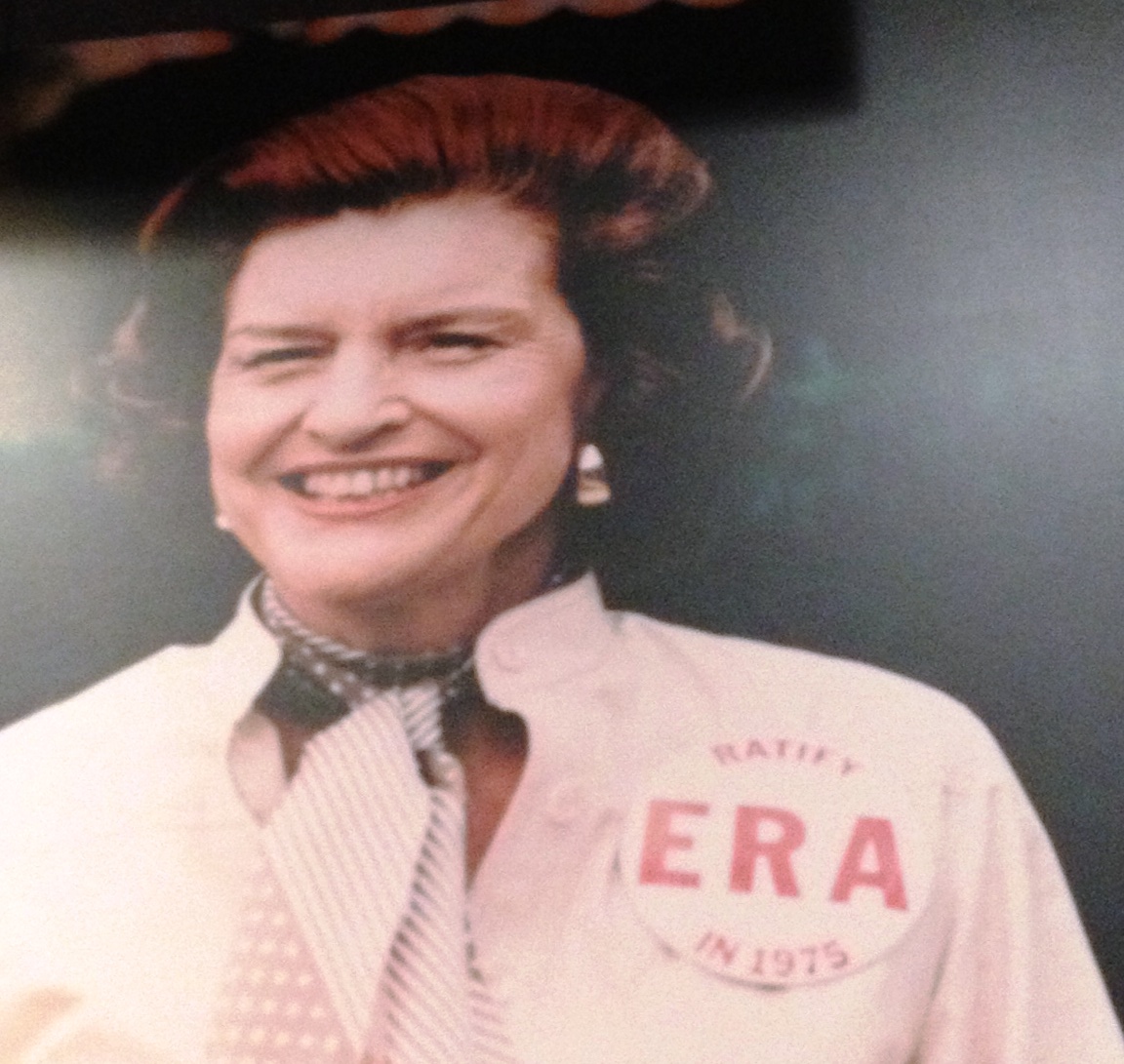
I absolutely love how Betty Ford levied her influence with regard to women in government:
“I used everything,” she admitted later, “including pillow talk at the end of the day, when I figured he was most tired and vulnerable.”
The First Lady’s pillow talk and otherwise resulted in a Ford presidency that had women in upper leadership and, most notably, a January 1975 executive order establishing the National Commission on the Observance of the International Women’s Year. That’s a mouthful, but an important one.
In a day and age where the United States ranks a pathetic 91st in women’s participation in the national legislature (a full 37 percentage points behind leader Rwanda and just behind the Slovak Republic, Indonesia and some country called Sao Tome and Principe), it’s time for more of a dose of that kind of influence.
At Jerry’s place, you couldn’t laze around in the oval office display, but you could sit in the cabinet chairs, which is how I found myself taking this picture:
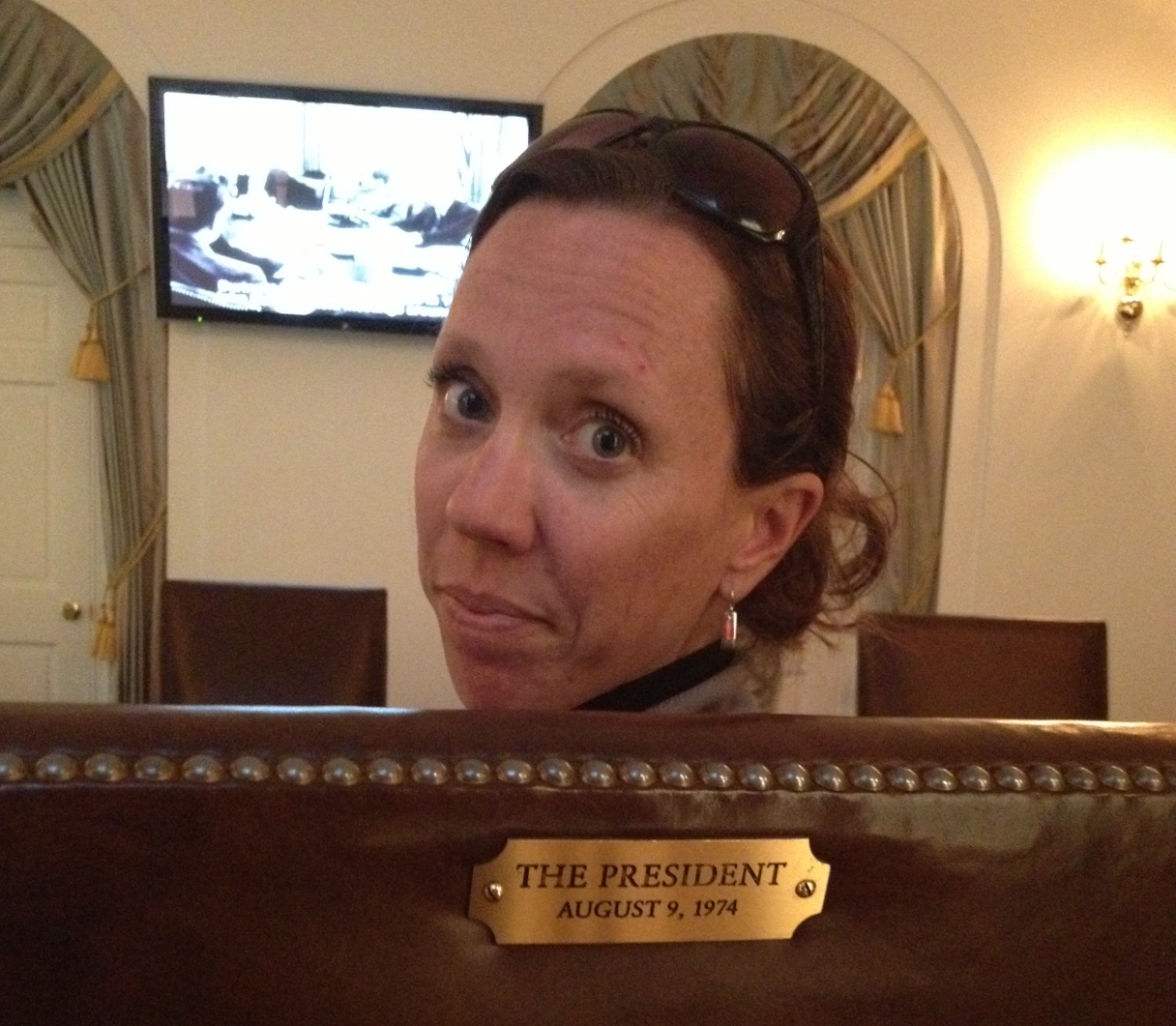
Trust me, if you could have any Dixon in the oval office, you’d want this one. So, join me. Make the country a better place.
Dixon in 2016!
When One Website Gets it Right
 Violence against women has no place in our culture, and that extends into the virtual world as well.
Kudos to the online project fundraising site Kickstarter for recognizing that fact and issuing this apology after it allowed a female “seduction guide” to get funded through its site. The whole apology is good, but here’s an excerpt:
Dear everybody,
On Wednesday morning Kickstarter was sent a blog post quoting disturbing material found on Reddit. The offensive material was part of a draft for a “seduction guide” that someone was using Kickstarter to publish. The posts offended a lot of people — us included — and many asked us to cancel the creator’s project. We didn’t.
We were wrong…
Let us be 100% clear: Content promoting or glorifying violence against women or anyone else has always been prohibited from Kickstarter. If a project page contains hateful or abusive material we don’t approve it in the first place. If we had seen this material when the project was submitted to Kickstarter (we didn’t), it never would have been approved. Kickstarter is committed to a culture of respect.
In a web that is tragically overfull with sites that degrade and demean women, it’s nice to have at least one site choose to not perpetuate the problem. Bravo Kickstarter for getting it right.
Extraterrestrial Parity
 When I was younger, I wanted to go to space.
I mean, it was tough not too. Whether it was watching The Right Stuff, reading astronaut books or catching shuttle launches and landings, it was all space, all the time. Where I grow up, if you played your cards right, you could hear (and feel) the sonic boom when the shuttle began its final decent across the country to Florida.
And as a young boy, it was easy to dream of becoming an astronaut. After all, all of my heroes looked like me. In fact, it wasn’t until Sally Ride’s 1983 voyage on Challenger that a woman flew in space with an American flag on her spacesuit. By the way, the Russians are the real extraterrestrial feminists; Valentina Tereshkova flew in space aboard Sputnik almost exactly 50 years ago today (interesting and brief article on Tereshkova here).
So I read this article with interest the other day. In NASA’s latest astronaut class, there is gender parity. 4 men, 4 women. According the article:
“NASA has selected another generation of astronauts to travel to new destinations in the solar system, including an asteroid and Mars, and for the first time in its history half of the new candidates are women.
Four out of the eight candidates are women, ‘making this the highest percentage of female astronaut candidates ever selected for a class,’ the US space agency said.
The new space explorers, drawn from among 6,000 applicants, are all in their 30s, according to NASA. New astronauts will begin with a two-year general orientation training and a flight mission to low-Earth orbit afterwards.
‘We have great female candidates in the pool this year. The selection is about qualifications. It has nothing to do with their genders,’ said Jay Bolden, public affairs officer at NASA.”
Bravo, NASA. If that’s true, it’s as it should be. Astronauts should in fact be chosen by their qualities. It would be great if one day that was the common practice across the culture.
It will be interesting to see what happens with this astronaut class and the ones to follow. Decades after Neil Armstrong landed on the moon, it’s entirely possible that the first words heard from Mars will be:
“That’s one small step for a woman…”
A Father’s Day Prayer
 Jesus, yesterday was Father’s Day.
And so I want to say that I love being a dad. Thanks for that blessing and privilege. Our four kids are treasures for Amy and I. We are profoundly grateful that you would entrust them to us to guide, grow and shape.
We’re grateful for that, and yet in the same breath, we exclaim “help!” Because for us parenting is difficult. It’s a joy, but it’s difficult. No doubt, we rely on you to show us the way as parents.
In particular, help us to raise kids who grow up to know you and follow you. Jesus, that ‘s our greatest plea as parents! That our kids would love you deeply with their lives, and live the abundant life that you both promise and deliver.
And, as that happens, help us to raise these kids to honor you in how they steward their power and giftings.
For Josh, I pray that he would grow to understand the power that culture gives him because he’s a man. Then help him to steward that power in a way that blesses those around him, particularly the women in his life. Make our son an advocate and an empowerer.
And for our girls, I pray that they would deeply know that they are loved by you, that they are gifted by you and that they are called to use those gifts to expand your Kingdom on earth. Encourage them in these things, especially as they bump into the ceiling of male privilege.
For all four, surround them with a community that blesses and affirms who they are and how they are wired. We’ll do our best to steer them in these ways, but Jesus, we need your help.
May all of this be so, for the sake of glory. Amen.
The above picture is from my seminary graduation last Saturday. Want to get to know the village that God put around me during my degree program? Here.
On Culture-Making
 Culture, it’s been said, is “roughly anything we do and the monkeys don’t.”
Indeed, there’s a certain broadness or vagueness to the idea of culture. In fact, in some ways, you only see culture when you are no longer in it. Culture is water to a fish. It’s soil to a plant. It’s air for a bird.
Simply put, culture is the sum of everything we encounter and interact with, day-in and day-out.
On Saturday, I’ll walk across a stage and graduate with my Master’s degree. In large part, my 2+ years in this program have been about thinking through the idea of shaping or creating culture.
Yes, culture can actually be made.
In his book Culture Making, Andy Crouch says this:
“Culture is what we make of the world. Culture is, first of all, the name of our relentless, restless human effort to take the world as it’s given to us and make something else.”
For the last paper of my program, I spent 25 or so pages thinking about that “something else.” Specifically, I was dreaming up what it would feel like to make an organizational culture where women and men were truly equal and in mission together. Here’s my list of five marks of such a culture:
1. Men and women are aware of and repenting of their gender brokenness. What if we lived in a culture where you and I were aware of our brokenness (past pain, flawed perspectives, etc.) and seeking to grow into wholeness?
2. Women and men pursue reconciliation, extending forgiveness freely to one another. In such a culture, not only are people aware of and growing through their brokenness, they are experiencing redemption as they extend grace to one another. Imagine a culture where women forgive men for their pornography addiction! That’s a culture that the world needs to see.
3. An organizational commitment to teach and train on gender dynamics. Let’s face it, for many organizations or groups, the silence on these topics is deafening. Particularly in the church. What if we had a culture where the groups we are a part of were proactively engaging issues of gender dynamics?
4. A more equal distribution of organizational power. In a culture marked by gender equality, men and women share power. Decisions about leadership are made by gifting, not by gender privilege. Consider how this might increase our effectiveness in mission!
5. Permission to lead with authenticity. What if everyone–men and women–could lead in ways that are comfortable for them? In particular, too often in today’s culture, women end up leading in stereotypically masculine ways. Imagine a culture where people could bring who they uniquely are and apply it to the leadership task. The qualitative difference in our leadership culture would be profound.
There’s my list so far. What about you? What would you add? Subtract?
Taking Credit Where Credit’s Due
 Women do good work, but too often you’d never know it. Why?
In large part, it’s because growing up in a culture marked by male privilege, women have been conditioned to not self-promote. Alternatively, women have been conditioned to defer credit-taking to men.
Indeed, according to this article, in mixed gender groups, women are more likely to underplay their contributions or achievements in the presence of men than in a single-gender group. Here’s a quote:
In a study recently published in the Personality and Social Psychology Bulletin, researchers Michelle C. Haynes and Madeline E. Heilman conducted a series of studies that revealed women were unlikely to take credit for their role in group work in a mixed-gender setting unless their roles were explicitly clear to outsiders. When women worked only with other women, they found, this problem of not taking credit disappears.
“Women gave more credit to their male teammates and took less credit themselves unless their role in bringing about the performance outcome was irrefutably clear or they were given explicit information about their likely task competence,” the study finds. “However, women did not credit themselves less when their teammate was female.”
Now don’t get me wrong. I’m all for humility. After all, Jesus calls for it. Philippians 2:3-4 reads like this: “Do nothing out of selfish ambition or vain conceit. Rather, in humility value others above yourselves, not looking to your own interests but each of you to the interests of the others.”
Lord knows, the world needs all the humility it can get.
And yet Jesus also calls for giving credit where credit is due. In Luke 10:7, in and amongst his list of directives for the 72 disciples that he is sending out, Jesus says, “the worker deserves his (her) wages.”
So, it’s good to be humble, but not to the point of not getting paid.
It strikes me that this context, the mixed-gender working group, would make a good case study. A couple of weeks ago, I posted about men needing to step back in order for women to have room to step up.
On one hand, women need to be bolder in taking their share of the credit when the group is working well. With humility, women need to rightly celebrate their successes and resist the urge to downplay their achievements. On the other hand, men need to be better about either encouraging women to take credit, singing their praises on their behalf, or not hogging the glory in the first place. The equation is simple:
Women step up as men step back.
And if that could happen, everyone wins.
When Privilege Goes to Far: A Follow-Up
 Since I posted last week about violence against women, folks have sent me a number of links to clips, resources and posts on the topic. Today I want to share two particularly quality clips with you.
First, enjoy this clip of actor Patrick Stewart (Star Trek’s Captain Picard). Stewart shares about his personal experience watching his mother suffer from domestic violence at the hands of his PTSD-suffering father. As a way to in some way redeem both experiences, Stewart now spends time with both anti-violence organizations and with pro-PTSD groups. Stewart’s testimony is terrific, and the hug at the end is just bonus.
Next, in this TED talk Jackson Katz calls for us to reconsider our perspective on gender violence issues. In particular, he invites us to think of gender violence issues as men’s issues instead of just women’s issues. One particularly insightful observation from Katz is that in our culture we tend to correlate the word “gender” with women. In that way, men essentially get locked out of the conversation.
The thing I appreciate about both Stewart and Katz is that they are calling for men, and particularly men in power, to step up in this area. Katz says, “there has been an awful lot of silence in male culture about gender violence.”
He’s right, and it’s time for that to stop.
Brave “Bookworm Beauty”
There I was, cooking up a Monday post, when I came across this blogpost. After I read it, I thought, “I can’t write anything more heart-breaking, illuminating, disturbing, sobering or profound than this.”
So please have a read. It’s one woman’s painful experience in the church, and it deals with how the evangelical church does (and doesn’t) talk about sexual purity. And to me it’s a picture of what happens when a culture of privilege creates a context where women are made to feel like they have to protect the purity of men without the opposite being true.
To whet your appetite, here’s one of the closing paragraphs:
It’s really no surprise that I have come to believe that my body is a shameful thing, meant to be hidden, covered up, backed into corners. It’s no shocker that my conditioned response to men, young and old, openly ogling my body, is to internalize that shame, blame myself, and remain silent. It’s not a surprise to me, either, that thousands of women brought up in the paradox of strict evangelical modesty/purity culture and the hyper-sexualization of American culture have developed such an unhealthy relationship with their bodies. Whenever I hear of someone else admitting that they’ve struggled with an eating disorder or self-harm, I don’t think How awful! I think how normal.
And how tragic. In the church and in the larger culture, we need new ways of talking about purity, ways that involve both girls and boys, women and men.
What about you? What feelings emerge for you as you read this?
Tertullian Goes to School
 On Tuesday morning, Amy’s writing career took us to another elementary school in our district. For two assemblies, she sang the virtues of literature and bestowed medals on kids who’ve read their eyes out this academic year. On a side note, I couldn’t believe it, but this school had a fourth grader who had read 4 million words since August.
Four. Million. Words. A fourth grader.
Anyhow, during the course of the morning, we encountered that school’s principal. Wow was she impressive. On the ball. Good with the kids. A schmoozer with the parents. All things you’d want for someone in that difficult job.
But amongst all those qualities, one thing in particular caught my attention: the woman was in control. I mean, if one kid was squirmy during the presentation, they got called out. Clapping out of turn called for silence. On the mic, she would wait, (im)patiently, until every one of the 300 children were “criss-cross-applesauce” before she’d utter another word.
Basically, you didn’t mess with that principal.
Later in the day, when I got back to our campus, I mentioned our visit to our principal, and I specifically talked about how tight a ship she was ran during the morning’s assembly.
His reply went something like this: “Of course she has to be strict. In fact, women principals have to be twice as strict. It’s the only way for them to gain respect.”
Well, hello there Tertullian.
By and large, the world of education is a “woman’s world.” For instance, we’ve now had 16 different teachers instruct our kids and only 3 of them have been men. Nationwide, according to this site, 76% of teachers in 2011 were women. In other words, in today’s educational landscape, you’re three times more likely to have a woman stand up in front of your kids every morning.
The situation is a bit different down the hall in the administration building. In 2009, the percentages were roughly equal. For the most part, you are just as likely to have a woman principal as you are to have a man.
And yet even though the numbers are roughly equal, when it comes to authoritative school leadership, men still enjoy the privilege of assumed and easier authority. What I mean is that men have to do less to earn respect. Authority is, for the most part, freely given. Friends, that’s privilege.
Being a principal is a tough job. Every day the “bad kids” end up across the desk from you. Regularly, you have to deal with school politics. When parents have a beef, it’s coming your way. For anyone, male or female, leadership in the principal’s position is a high and difficult calling.
But, here’s hoping that someday it will not be twice as tough for women.
When Privilege Goes too Far
 In a 2005 speech at a concert in South Africa, Nelson Mandela said this:
For every woman and girl violently attacked, we reduce our humanity.
Tragically, by this metric, we are in cultural free-fall. According to a 2011 Center for Disease Control survey, “nearly one in five women has been raped or has experienced an attempted rape. The results also found that one in six women has been stalked, and one in four have been reported being beaten by their intimate partner.”
Heaven help us.
Thankfully, most of the time our cultural bias toward male privilege does not result in explicit violence. And yet, it’s also true that because our culture permits privilege, the door is opened to violence against women. After all, if women are second-class citizens–if they are objectified and commodified for men’s entertainment–how long before they become the object of violence?
So whether it is the 71% of Ethiopian women who reported physical and/or sexual violence by an intimate partner in their lifetime…
Whether it is women murdered in my beloved Guatemala, where according to this post, 2 women are killed, on average, every day…
Whether it is sexual assault in the U.S. military, where it seems like a new story comes out every day that implicates U.S. commanders with allowing and perpetuating a culture of violence against women…
Or whether it is the gruesome kidnapping and 10-year imprisonment and assault of 3 women in Cleveland..
…it has to stop.
Jesus stands against violence against women. John 8:1-11 tells us the story of a women who is caught in the act of adultery and then dragged before Jesus to be a pawn in the Pharisee’s attempt to entrap him. For this poor woman, violence was likely behind her, and then violence is surely ahead of her if Jesus commands the men to stone her. On the other hand, if he refuses to issue the command, he comes off looking like he is against the Mosaic law. It’s a charged and difficult situation. What does Jesus do?
But Jesus bent down and started to write on the ground with his finger. 7 When they kept on questioning him, he straightened up and said to them, “Let any one of you who is without sin be the first to throw a stone at her.” 8 Again he stooped down and wrote on the ground.
9 At this, those who heard began to go away one at a time, the older ones first, until only Jesus was left, with the woman still standing there. 10 Jesus straightened up and asked her, “Woman, where are they? Has no one condemned you?”
11 “No one, sir,” she said.
“Then neither do I condemn you,” Jesus declared. “Go now and leave your life of sin.”
Advocate. Defender. Challenger of the status quo. Jesus puts violence against women, and male privilege more broadly, to rights.
In that same spirit, I want to offer this list of 10 things that men can do to stop violence against women. While it lacks an overtly spiritual lens, it’s nonetheless a valuable resource. In particular, I appreciate the exhortation to self-awareness and understanding.
Because condemning violence and redeeming privilege starts with admitting that as men we have both within us.
 Challenging Tertullian