People Watching
 They say airports are good for people watching.
Unfortunately, sometimes, when you watch people, you watch them mistreat others.
Case in point. At the San Jose, Costa Rica airport the other day, I was watching an airport employee doing his job. He was a baggage handler, and his job was to lug suitcases onto the conveyer built to begin their journeys into some aircraft’s underbelly.
So I was watching him and, all of a sudden, his eyes locked onto something. Or, more precisely, to someone. Because passing in front of this guy was a woman, another airline employee. She was walking from one station to the other, but she was not doing so unnoticed.
Because baggage guy’s eyes had a radar lock on her. As she was walking toward him, he was examining her chest. And, when she passed by, he took a good, long look at her rear. And it seemed like she had no idea.
I wish this was an isolated event, but of course it’s not. Sadly, my personal experience tells me it isn’t. And, in a vivid and eloquent way, so does the writer of this post over at Katie and the Real House. Here’s an excerpt from her post:
As I walked to my car after work, I was on edge. My heart was racing just a little bit and I felt agitated. I love my work and I’m usually happy and peaceful when I leave, so these feelings were baffling. Then I realized. PBR McStinkyshirt had done this to me.
Even though I was working, even though I was clearly about 40 years younger than him, even though I was certainly not displaying any feelings toward him other than employee-like hospitality, this man decided that none of those things mattered. He decided that his interest in me entitled him to interrupt my work and aim his creepiness at me, whether I wanted it or not.
I am still shaken and annoyed (mostly annoyed because ewww, you nasty man, you really messed up what was supposed to be a fun morning at work) when I think about this day. I am very, very (very!) tired of men and their ogling. I am tired of stares that last way longer than they need to. I am tired of words that make my stomach knot up, of men standing closer than they should, of having to keep my eyes straight ahead so I don’t appear to be inviting attention.
There are some charming humans who will say that the attention from these men is harmless (he was just looking!) or that it’s because of the way I was dressed (maybe I was asking for it) or that it’s because of the way that I look (you have to get used to that, Katie, it’s just because you’re pretty) but all of that is, as the French say, le bullshit. The implication is that it’s not a man’s fault when he does oglethings, that his hormones or a little pointy-eared devil on his shoulder or Rambo make him incapable of behaving in a civilized manner. Women are supposed to be cool with all kinds of unwanted attention because the men just can’t help themselves. They’re only men and besides, it’s all in good fun.
Guess what, guys. It’s not fun and it’s not good. Every time your eyes rest on a woman for more than a few seconds, you’ve gone too far. You’ve made her uncomfortable because you’ve barged your way into her life uninvited. Every time you hoot and holler on the street because you like the way she walks, or speed up in your car to get a better look, or do the sleazy “Goooood morning,” as you pass her in the hallway and stare at her chest, you’re forcing a little bit of yourself onto her without her permission and when it’s over, you take a little bit of her away with you.
Looking back to that experience in the airport, I wish I had gotten that guy’s attention and given him a shake of the head or maybe a finger wag. Because who else is going to stop him from doing that?
Only those people watching in the airport.
Want to read some edifying reflections on our time in Costa Rica? Go here to experience the trip along with us!
On Really Respecting Someone (re-post)
Note: As you read this, I’m in Costa Rica leading a team of college students on a 2 week service project. So enjoy this flashback post; it’s the #1 most shared post of all time on Challenging Tertullian.
 In case you missed it, and I’m not sure how you could have, yesterday was the Super Bowl. Every year the Super Bowl is a lot of things: championship football game, excuse to throw a big party, must-see commercial watching, a great time to shop in normally busy stores, etc.
Unfortunately, the Super Bowl also represents an annual crescendo in our culture’s habitual exploitation of women.
The folks behind the A21 Campaign are dedicated to abolishing sex trafficking and human slavery in the 21st century, and according to their website, the Super Bowl is “the single largest human trafficking incident in the United States.” Indeed, according to this Christian Post article, the 2010 Super Bowl saw an estimated 10,000 sex workers brought into Miami ahead of Super Bowl XLIV.
Sadly, in this the Super Bowl is not alone. I recently saw this report that describes how prostitutes in Brazil are taking English classes ahead of the 2014 soccer World Cup, in order to be able to service the clientele arriving for the tournament.
Clearly, we have a problem when the world’s greatest sporting events are linked with the exploitation of women though prostitution and sex trafficking.
But it’s not just prostitution that makes the Super Bowl so tragic in this regard. It’s also those famous commercials. You know, the ones where the women dress in skimpy frocks to essentially serve as the object of male desire. Yesterday, the people behind the Miss Representation film encouraged twitter users to call out sexism in the media by slapping the twitter hashtag #notbuyingit on on Super Bowl ads that they found to be offensive.
For instance:
Silly me, I thought women could be sexy and smart. Oh wait, they can!@GoDaddy, change all your ads to respect women or I’m #notbuyingit
Really disappointed with your Super Bowl ad, @CarlsJr. Please try to sell your burgers without selling out women and girls. #notbuyingit
Whether it’s through pornography, prostitution or the more subtle influence of advertising, the objectification of women is endemic in our culture, and it’s a key way that male privilege is propagated. Heck, while I’m at it, how these ads depict men isn’t so great either!
In John 8, Jesus faced a situation where a woman was being exploited. And I mean really exploited. The kind of exploitation that involves having her sexual sin publicly exposed in order to serve as a pawn in someone’s personal vendetta. Here’s the story:
2 At dawn he appeared again in the temple courts, where all the people gathered around him, and he sat down to teach them. 3 The teachers of the law and the Pharisees brought in a woman caught in adultery. They made her stand before the group 4 and said to Jesus, “Teacher, this woman was caught in the act of adultery. 5 In the Law Moses commanded us to stone such women. Now what do you say?” 6 They were using this question as a trap, in order to have a basis for accusing him.
But Jesus bent down and started to write on the ground with his finger.7 When they kept on questioning him, he straightened up and said to them, “Let any one of you who is without sin be the first to throw a stone at her.”8 Again he stooped down and wrote on the ground.
9 At this, those who heard began to go away one at a time, the older ones first, until only Jesus was left, with the woman still standing there. 10 Jesus straightened up and asked her, “Woman,where are they? Has no one condemned you?”
11 “No one, sir,” she said.
“Then neither do I condemn you,” Jesus declared. “Go now and leave your life of sin.”
Don’t you just love how Jesus turns this situation on its head?
The accusers become indicted. The accused becomes pardoned. The objectified becomes free.
It’s beautiful, isn’t it? When we talk about how Jesus treated women in his day, we have to talk about how he respected them, how he resisted allowing them to become objects, and how he defended their honor and removed their shame.
May it be so with us.
What about you? What did you think about the Super Bowl commercials?
This Stuff Matters (re-post)
Note: As you read this, I’m in Costa Rica leading a team of college students on a 2 week service project. So enjoy this flashback post; it’s the #2 most shared post of all time on Challenging Tertullian.
 This week, Tertullian and I are taking our show on the road. Together with a good friend and co-worker, I’m teaching a week long seminar on the topic of “Women in the Bible.” 14 college students will be taking the plunge with us.
So this week we’ll be opening the Scriptures, watching some videos and reading some articles. Along the way we’ll have some intense conversations I’m sure. All with the goal of helping these students think through what the Bible has to say about women in general, and the relationship between men and women in particular.
Last night we started by having a time to articulate our questions. And after listening to their questions, let there be no doubt:
This stuff matters.
Here’s the list of the questions that our students are bringing into the seminar this week:
Is there a hierarchy of gender in God’s eyes?
Why are men represented more than women in the Bible?
What exactly are the roles that each gender has in the church, in ministry and in the home?
Why is there God the Father only, if both men and women are made in God’s image?
How do men and women work together peacefully?
What are some common problems between men and women in ministry?
How do we figure out what is from God and what is influenced by culture?
Why don’t churches discuss this topic?
Simple, huh? Now to seek some answers! If you’re the praying type, we’d appreciate them! And I’ll give an update in the Thursday post.
Tour de Kabul (re-post)
Note: As you read this, I’m in Costa Rica leading a team of college students on a 2 week service project. So enjoy this flashback post; it’s the #3 most shared post of all time on Challenging Tertullian.
 Afghanistan is not an easy place to be a woman.
Indeed, though the situation is changing as the nation emerges from the Taliban era, today only 15% of women in Afghanistan are literate and only 37% of the nation’s grade school students are girls. Further, patriarchy is entrenched by laws that dictate that husbands can divorce their wives without her voice being heard and, of course, the cultural practice of women wearing burqas when out in public. To put it mildly:
Male privilege dominates Afghan culture.
Which makes the story of the Afghan women’s national cycling team all the more incredible. Enjoy the the story, excerpted from this article:
Challenging the long- held cultural belief that a woman cycling is offensive, these dedicated young athletes are standing up to social norms and becoming vehicles of change.
“Daily in Afghanistan, girls risk their lives to go to school, women risk their lives to work in government, the police forces, and even the army. Women activists march in the streets to fight for their rights, knowing that they are making themselves targets,” says Shannon Galpin, currently producing a documentary film about the team. “The women cyclists are doing something very simple that we take for granted, but making a huge statement in a country that doesn’t allow their women to ride bikes.”
In Afghanistan, it is very rare to see a woman on a bike other than sitting sidesaddle behind a man. According to Mountain2Mountain, there are currently only about 60 to 70 women cyclists in the entire country. However, the newly created women’s team has around 12 members who are passionate about their sport and about changing the lives of women in their country.
Currently, the women on the team train once a week, due to safety concerns. Riding at the risk of their own lives, members of the team train in the back roads and highways outside Kabul. They ride borrowed, donated, and scrapped-together road and sport bikes. Their gear is mostly donated. Their lone sponsor helps pay for their jerseys. Despite opposition and social taboo, however, these women ride their bicycles as a statement of freedom.
In 1896, Susan B. Anthony, iconic American reformer said: ““The bicycle has done more to emancipate women than anything else in the world. It gives a woman a feeling of freedom and self-reliance. The moment she takes her seat she knows she can’t get into harm unless she gets off her bicycle, and away she goes, the picture of free, untrammeled womanhood.”
Thankfully, step by step, this vision is becoming true in today’s Afghanistan.
In an NBC News piece here Shannon Galpin is quoted as saying: “If they are willing to take the risk, then the least we can do is support them.”Indeed. Let’s celebrate their story, and if you’d like to contribute to the cause you can do so here and here.
About that Time I got Called a False Teacher… (re-post)
Note: As you read this, I’m in Costa Rica leading a team of college students on a 2 week service project. So enjoy this flashback post; it’s the #4 most shared post of all time on Challenging Tertullian.
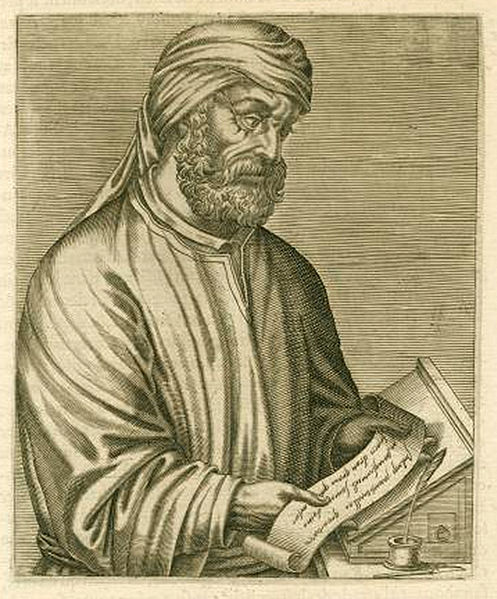 About 8 years ago now, I got called a “false teacher.” Yes, that still happens. A brother in Christ who barely knew me sat me down and told me that because I was allowing women to teach the Scriptures in the ministry I was leading, I would be held accountable for my false teaching.
Wow. The accusation was painful for me, and it sent me into a months-long quest to learn as much as possible about the theology around the topic of women in leadership. I read, studied, prayed, talked, debated and then read some more. And when I was done with that intense burst of learning, my reading of the Scriptures continued to lead me to the conviction that men and women are to be full partners together in ministry and, in particular, that women are to be free (better yet, empowered) to lead in the Kingdom according to their gifting.
But here’s the catch. When I emerged from this season of learning, I was militant. I mean, if you disagreed with me, I had no time for you. Looking back, I think the experience of being rebuked very nearly turned me into a rebuker! Pretty quickly, the issue of women in authority became a litmus test for me: if you agreed with me, we were cool. If you didn’t, we had problems.
Thankfully, God provoked a trusted mentor to challenge my posture. This guy sat me down one day and basically said, “Rob, I’m concerned that you’re headed toward becoming like that guy. You need to learn how to hold your convictions with humility.”
“Hold your convictions with humility.” That right there is a good word. Amen? Particularly when things are unclear or in dispute, we must be humble. Still further, we must remember that even if we disagree about something important, in the Kingdom we still called to fellowship together in the Lord, understanding that we have far more in common with a brother or sister than we have in dispute.
It’s in the spirit of that last statement that I want to introduce a new category on the blog, called “Throwing Tertullian a Bone.” You see, while it’s true that Tertullian had some really bad things to say about women, he also had a lot of great things to say about what it is to pursue Jesus. Don’t get me wrong; I’ll still throw him under the bus from time to time. And yet in the next keystroke, I’ll remind myself and my readers that though we may disagree on one thing, the reality is we agree about far more.
So, enjoy this quote from Tertullian. This is quoted by Josiah Hotchkiss Gilbert in his 1895 Dictionary of Burning Words of Brilliant Writers:
We worship unity in trinity, and trinity in unity; neither confounding the person nor dividing the substance. There is one person of the Father, another of the Son, and another of the Holy Ghost; but the Godhead of the Father, and of the Son, and of the Holy Ghost, is all one; the glory equal, the majesty co-eternal.
Pretty good, eh?
A Tale of Two Brands
 Chances are you’ve seen the “Like a Girl” Always ad somewhere.
I think it’s magically appeared maybe 10 times on my Facebook wall recently.
In case you haven’t seen it, the ad is an attempt by the company Always to help us think about what we mean when we say someone does something “like a girl.” It starts with adults offering sad and cliched impressions of throwing, running, etc. “like a girl,” before young girls come on the screen and do the same things…normally. Naturally. Like a girl.
What’s the point?
That somewhere along the way, culture convinces us that being “like a girl” is a bad thing. And that’s tragic.
As you might expect, it’s a convicting piece. To see the ad, and a brief article describing it, go here.
Among other things, for me the ad raises an interesting question. When does male privilege really kick in? Because one of the messages of the ad is that early on girls are not negatively impacted by the phrase “like a girl.” Indeed, for the first part of a girl’s life, it’s an empowering thing to be that way.
So when does that change? Junior high? High school? Different for everyone? It would be an interesting study. Perhaps for a post-doc…
The other thing that intrigues me is the giant corporation behind the proverbial curtain. Who would it be producing this ad? Always, sure. But who’s behind that brand?
Proctor & Gamble.
That’s right, Always is a member of the Proctor & Gamble stable of brands. Challenging Tertullian readers might remember Proctor & Gamble because they’ve been featured on these pages before, and not in a good way.
P&G is the company behind last Winter’s Old Spice “momsong” commercial, an ad campaign that essentially distilled manhood down to “having fun with women and misbehaving.” Commenting about this ad back in January, I wrote:
Reducing “manhood” down to merely the carnal instinct to chase women, especially with the connotation of inappropriateness, doesn’t serve anyone, male or female. Not only does it neglect every other aspect of what it means to be a man, it also perpetuates the man as hunter/woman as quarry narrative, one that too easily and often becomes toxic.
So, two ads from the same conglomerate. And yet two radically different, indeed diametrically opposite messages: one empowers women and the other perpetuates the problem of privilege.
What to make of that?
On one hand, we have to acknowledge the profit motive. To be sure, Always and Old Spice are trying to make money, and the different ads reflect each company’s target demographics. I think the “Like a Girl” campaign is excellent, but I know that at the end of the day it’s still about the bottom line.
But on the other hand, maybe there’s a bit of a parable or metaphor here. After all, aren’t we all simultaneously broken and redeemed? Don’t we all get it right one minute and blow it the next? Speaking personally, when it comes to dealing with male privilege, I know I do (examples here and here).
It would be much easier if people (or companies) were good or bad, one or the other. Instead, we live in shades of gray. Sometimes we’re Always and sometimes we’re Old Spice.
I’m reminded of the Apostle Paul’s words to the church in Rome, in Romans 7:18-20:
“I want to do what is right, but I can’t. I want to do what is good, but I don’t. I don’t want to do what is wrong, but I do it anyway. But if I do what I don’t want to do, I am not really the one doing wrong; it is sin living in me that does it.”
Ever feel like that?
So what do we do with this? For one thing, we acknowledge reality. We’ll get it right sometimes and other times our brokenness will get in the way. On this journey toward a male privilege-free and gender-equal church we must give ourselves and others some grace.
At the same time, we must continue working. We have to challenge ourselves to continue to grow, to mature, to develop.
To become more like Always and less like Old Spice.
Honored
First of all, for those of you new to Challenging Tertullian, a hearty welcome! Thanks for stopping by. My aim is to post every Monday and Thursday morning. To get more of a sense of what you can expect, check out the “About this Blog” page here. Enjoy!
So, there I was, casually reading the latest Junia Project post last Friday. At first glance, it looked interesting:

Scrolling down, I was pretty sure I could guess which blogs would make the list. For sure Rachel Held Evans. And probably Sarah Bessey. And, most likely, the good folks over at CBE.
But imagine my surprise when the list also included:
Me.
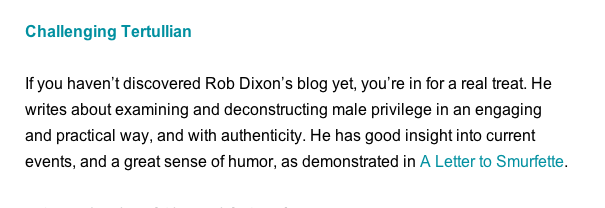
Wow. What an honor.
Reflecting a bit over the weekend, a couple of thoughts:
First, I’m reminded that I am a small part of something a lot bigger. Specifically, I’m a part of a community of Jesus followers who are trying to figure out how to do church in a gender-equal kind of way. Thanks for coming along with me as I wrestle with what that could/should look like.
Second, I certainly experienced a wide range of emotions. From elation (my phone ran out of power midday due to all the email, Facebook and blog checking), to curiosity (really? me?), to angst (holy cow, the posts better be good now!) to a whole lot of gratitude.
Third, I’m reminded of the power of advocacy. This blog got a lot of traffic on Friday, and it received a lot of new followers. In fact, the Smurfette post, one that I had forgotten, had more eyes on it than ever before! All of this because of the advocacy of Gail Wallace and the folks at The Junia Project. Again, I offer my sincere thanks.
Lastly, let me try to return the favor. If you’re a regular Challenging Tertullian reader who has not yet visited The Junia Project, please remedy that soon. And if you’re not sure where to start, and if you’re unclear on the origin of the name, go here.
Because Junia, someone who for too long has been “tertullianed” in the very printing of the Holy Scriptures, deserves your attention.
Thanks again.
Excommunicated
 As I’ve dived in to blogging and writing on gender equality issues, I’ve faced some level of pushback. Or, maybe, pushback is too strong. More like raised eyebrows, pointed questions and, too often, silence.
One thing I have not faced:
Excommunication.
But that’s exactly what a Mormon gender equality advocate named Kate Kelly has now experienced. According to this article, Kelly was recently excommunicated for encouraging others to rethink how the church handles gender and leadership. Her church ban is scheduled to be in place for one year.
The email she received contained the following proclamation:
“In order to be considered for readmission to the Church, you will need to demonstrate over a period of time that you have stopped teachings and actions that undermine the Church, its leaders, and the doctrine of the priesthood…”
“You must be truthful in your communications with others regarding matters that involve your priesthood leaders, including the administration of Church discipline, and you must stop trying to gain a following for yourself or your cause and taking actions that could lead others away from the Church.”
Though it sounds like something from medieval times, excommunication is a big deal in the Mormon faith. According to this article:
Mormons who are excommunicated lose all their ordinances, such as the one in which she and her husband were sealed for eternity in the Salt Lake LDS Temple in 2006. [Kelly] previously described excommunication as a kind of spiritual death. “You are being forcibly evicted from your eternal family.”
In response, Kelly sounds both grieved and resolute:
“Mormonism doesn’t wash off,” she said. “But it will seriously negatively impact my worship, my connection to the community, my participation in rituals.
“I think it’s a hideously painful blow to any woman has ever looked around her and recognized the plain and simple truth that men and women are not equal in our church.”
Indeed.
Though I am not a Mormon, I say keep it up Kate (and others). And here’s hoping the church revisits this decision.
Central Research Issue
 Everyday, I’m edging closer to clarity.
I’m talking about my doctoral program, and for the last 4 weeks I’ve been on a quest to focus in on what exactly I’ll be researching and working on over these next four years.
To be specific, I’ve been working to articulate something called a Central Research Issue. Looking for a nice summer beach read? Consider Introduction to Missiological Research Design by Edgar Elliston. It’s a hoot.
According to Elliston, a CRI is “the primary guiding and constraining perspective throughout the whole study…The goal of selecting a research topic is to have a topic that is narrow enough to be done well by the researcher but broad enough to be significant to the researcher, the constituencies with whom the researcher is affiliated, and to the related academic disciplines…[The CRI] is the most difficult sentence, by far, of the whole thesis or dissertation.”
So, drumroll please, right now my latest version of my CRI is this:
“To examine and evaluate the qualities and characteristics of flourishing inter-gender partnerships in mission throughout selected segments of the InterVarsity staff community.”
…and now you now how to pray for me!
From here on out, I will be all about understanding everything I can find about this CRI. In particular, for the first year, I’ll be all-in on a literature review. In fact, the goal between now and mid-October is to absorb and review somewhere around 90 different academic-level sources. I’m talking books or journals. I’ve parsed the lit review into three categories:
1. InterVarsity and the historical development of the value for inter-gender partnership in mission.
2. Qualities and characteristics of flourishing partnerships, in three contexts: in the Scriptures, in the evangelical church and in the secular world.
3. Contemporary theories of gender difference, because it will be important for me to understand the prevailing wisdom of the scientific community.
Now, I’m off to become a terrific researcher. It’s like a treasure hunt for sources.
Anyone have any leads for me?!?
World Cup of Privilege
 Around our house, we are World Cup obsessed.
We’ve got a poster with the brackets on the wall. We’re plotting a trip to the pub to watch England later today. We yell at the TV (OK, Amy does). And we’re watching the games with a critical eye (’cause, you know, coaching Under 10 soccer makes us experts in the Beautiful Game).
It also means that for Father’s Day, I scored the official FIFA World Cup trivia game.
Between matches, our family played the game on Sunday. Amy took our son and one of our daughters, and another daughter and I took up the challenge. Wow, was it difficult. I’m guessing that together we maybe answered 8 out of 50 questions correctly…and we were playing the easiest level! Here’s a sample:
“What innovation did the ball for the 1998 World Cup France present?”
Anyone?
If you guessed, “layers of foam rubber for more precision,” give yourself a round of applause.
Tough, right?
Anyhow, as I was looking through the game’s instructions and I noticed Tertullian:

Did you catch it?
Evidently, though this is a mixed gender game, the players that answer questions correctly will certainly be men. See the masculine pronoun?
Is it a typo? Sure. But, then again, perhaps the proofreader is revealing his/her bias in missing that one.
All I know is that, in our case, we bucked the trend. When all was said and done, when the trophy was awarded, the parent left standing was…
Not me.
 Challenging Tertullian