Becoming Colleagues
 It has been a pleasure to read through Carol E. Becker’s book Becoming Colleagues: Women and Men Serving Together in Faith.
In many ways, Becker has already walked down the road I am on right now with my research. Indeed, Becker’s text posits nine distinct criteria that must be present if a mixed-gender team is going to be effective in their work, and satisfying to those on the team.
Sounds like a familiar study!
And Becker breaks her nine criteria into two categories. Five are reflective criteria. For Becker, if a mixed-gender team is going to be effective and satisfying, it must have a regular pattern of pausing and reflecting. Now, stop right there, because this is genius. And unexpected, because I think most of us (and the teams we are on) jump right into active problem-solving. I mean, how many teams have you been on that actually stop and take a pulse of what’s happening in the community?!?
Becker’s five reflective criteria include reflection (yeah, it’s strange that the word governs both a category and a criterion), learning, believing (values matter!), naming (as in, understanding to the extent that you can rightly articulate what’s happening) and including.
And then there are four active criteria. The list includes communicating, working (too broad of a criterion, in my opinion), influencing (how a team manages power) and modeling. In these last sections, Becoming Colleagues is loaded with practical implications and action steps, many of which I will be borrowing from as a part of my own research.
All of that said, I’ll offer you one particular quote that caught my eye, from the introductory section on power. This being a blog about how power works in the Kingdom with regard to gender, it seems apropos to post here:
“To be effective partners, we need to know how to use our power positively and well so that we will be able to influence others toward constructive action. Effective mixed-gender teams do this. Because the ability to influence is the outcome of using power, I call the eighth criterion influencing.
This criterion is particularly important for men, almost always requiring a change in their view of power. The story of many failed mixed-gender teams might be different if the person in the position of power, often a man, viewed his role differently.
For women, the task is different but just as difficult. We women must stop fearing power and learn to welcome our own unique power as an ally. To do this, we have to overcome our tendency to rule out the use of power on the assumption that it’s always abusive. This is a skill we can learn from men, who are not afraid to use power as a leadership tool.
Before either gender can accomplish these tasks, both must understand a great deal more about power. There are many different kinds of power and there is a vast difference between power and the abuse of power.”
Want to read more? Either pick up a copy of Becker’s book…
…or wait 3 more years til I’m done with my research!
“Boob” on the Air
 “Would that be considered boobs on the ground?”
In case you missed it, that’s what Fox News (Host? Panelist? Pundit? In-House Misogynist?!? I’m not really sure what to call him, though I’ll offer one suggestion later on…) Eric Bolling had to say about the story of Major Mariam al-Mansouri.
If you can stomach it, the clip containing Bolling’s comment is here.
Major al-Mansouri’s story is fascinating. She’s a fighter pilot in the United Arab Emirates (UAE) Air Force. And, last week, she participated in a bombing raid against ISIS terrorist targets in Syria. For Major al-Mansouri, flying is the fulfillment of a dream, one that has seen her become the first woman to fly an F-16 in the UAE Air Force. And yet pursuing her dream has also come at a cost. According to this article, Major al-Mansouri’s family has disowned her since her mission.
So, if you’re scoring at home, this spat pits a heroic, sacrificial female fighter pilot versus a bombastic, misogynistic talk show contributor.
Who do you think wins that one?!?
Now, on one hand it’s easy to dismiss Bolling’s “Tertullianic” comments. After all, they’re clearly sexist. They’re misogynistic. They’re ridiculous. They make Bolling look like an ass. And don’t get me started on Bolling’s non-specific, all-too-brief apology (here).
Yes to all of the above.
On the other hand, we shouldn’t be too hasty to dismiss Bolling’s comment. Why? Because it reveals something about this male privilege-steeped culture we live in.
Specifically, I think Bolling’s comment reveals at least two false narratives embedded in our culture. If we’re not careful, we buy into these, in subtle ways, every day. Let me break them down here.
The first is this: Women are objects for male gratification.
Women are more than their bodies, but too often you wouldn’t know it from observing culture. As just one example, watching sports with my kids is a constant exercise in changing the channel during commercials. I mean, I feel like I have to use the bathroom during the game! Because almost every ad has a scantily-clad young woman selling beer. Or cars. Or deodorant. Or, God help us, domain names.
In her book, Equal to the Task, Ruth Haley Barton has a helpful chapter entitled “The Discipline of Honoring Sexuality.” Writing about the struggles men face with regard to their sexuality, she says:
“Many men I spoke with experienced sexuality primarily in terms of pain and struggle, guilt and fear rather than joy…they acknowledged that they have been conditioned to view women almost exclusively as sex objects, and so relating with women as multidimensional human beings requires conscious discipline.”
Tragic, right?
Honestly, it’s a miserable and painful reality for both genders. And when we buy into this false narrative, we only perpetuate the problem. So, let it be said: a woman is more than her body. Indeed, to quote Psalm 139, she is “fearfully and wonderfully made.”
The second false narrative revealed in Bolling’s ill-advised quip is this: Women are inferior to men.
For Bolling, it’s preposterous that a woman would be piloting an F-16. It makes no sense in his worldview. So much so that it’s laughable, worthy of being the object of an ill-advised joke. Why? Because, deep down, he believes that piloting a 15 million dollar aircraft capable of destroying a small city is the surely a job that only men are qualified for.
You know who does NOT believe that? The military.
In this open letter to Bolling, a collection of soldiers refute the suggestion that women are inferior to men, in this specific area:
As it turns out, women have been flying combat aircraft since before either of you were born. Over 1,000 Women Airforce Service Pilots (WASPs) flew during World War II. Seeing as U.S. Army Air Forces Commander “Hap” Arnold said “Now in 1944, it is on the record that women can fly as well as men,” we can probably guess he thought their parking was adequate. The WASP legacy reaches into the present day; on 9/11, then Lt. Heather “Lucky” Penney scrambled her F-16. Completely unarmed, she was ready to lay down her own life to prevent further devastating attacks on American soil.
There. My Grammy, a proud U.S. Marine, would be proud!
According to Genesis 1:26-27, women and men are both made in the very image of God. One is not better than the other. It’s not as if Adam was blessed with 51% of the divine DNA and Eve 49%. In fact, the emphasis in the Genesis account is on mutuality and equality.
Here’s what writer Gilbert Bilezikian has to say about this passage:
“In other words, the male/female sexual differentiation reflects realities contained within the very being of God and derived from Him as His image. Femaleness pertains to the image of God as fully as maleness. God is neither male nor female. He transcends both genders since they are both comprehended within His being.” (emphasis mine)
Friends, both women and men bear the image of God in equal measure. Neither gender is inferior. Neither is superior. As Paul says in Galatians 3:28, “all of you are one in Christ Jesus.”
In the end, let’s be clear. Eric Bolling’s unfortunate, sexist comment reveals the brokenness systematized in our culture. It demonstrates Tertullain’s effect.
That he did it on TV, in front of millions of people, reveals something else:
The only “boob” deserving of comment in this situation is the guy wearing the microphone.
Repentance and the Journey
 As I’m in my DMiss cave this week, I’ve been having my heart stirred by a number of insightful writers. One such writer, Rosalie de Rosset, put her finger on the importance of repentance in the journey toward gender equality.
So I invite you to join me in sitting with the following quote. It’s from de Rosset’s chapter in a 2002 book entitled Building Unity in the Church of the New Millennium, edited by Dwight Perry:
In the foreword to a recent book, Women as Risk-Takers for God, well-known author and speaker Evelyn Christenson goes so far as to say, “The greatest need on Planet Earth, especially among Christians, may not be racial—but gender—reconciliation.”
It is possible to suggest that such reconciliation has to begin with repentance in the body of Christ for the way in which the church has trivialized women. This has happened by seeing women’s interests and needs as unimportant or secondary, by confining them to narrowly appointed tasks, and by falling to educate them about their responsibility to develop their individual gifts as a part of their obedience to Christ. Women are also trivialized when they are kept voiceless and afraid through neglect and condescension, unbiblical attitudes supported by a misuse of the biblical text.
Change will involve a deliberate and concerted plan by the church and the Christian community to view women first as human beings, instead of simply in terms of their gender. Such vision will inevitably involve taking women seriously as valuable assets in the whole ministry of the Church.
Until this happens, women in leadership will continue to pay a high price; they will be, in Brent Staples’s words, “suspect” when not invisible.
DMiss Update
 In between doing loads of laundry and watching soccer, I spent part of the morning yesterday before church charting the way forward with my DMiss program.
For those of you scoring at home, I now have just 26 days until my annotated bibliography is due, and just 54 days until the first draft of my 50 page, 100 source literature review is due.
Writing that, I may have just soiled myself a little…
As you know, I’m focused on inter-gender partnerships in mission, and it’s time now to dive deeper into what others have written about the qualities and characteristics that make such partnerships work well.
So in the name of keeping you updated, at the same time providing some accountability for myself, here are the next five books in my DMiss queue. The plan is to digest these this week.
1. Partnership: Women & Men in Ministry by Fran Ferder and John Heagle. From the back cover: “the authors develop a cogent rationale from scripture, theology and the social sciences for changing the dominant male-female stereotypes in order to construct a viable structure for collaboration in ministry.” Good thing, because I always like my rationales cogent…
2. Equal to the Task: Men and Women in Partnership by Ruth Haley Barton. I read this ages ago, but it’s time for a fresh look.
3. Bound and Determined: Christian Men and Women in Partnership by Jeanene Reese. Incidently, when you input that title into amazon, you should also input the author’s name. Otherwise, you’re in for quite an interesting selection of romance novels…
4. Becoming Colleagues: Women and Men Serving Together in Faith by Carol Becker. From the amazon page: “Through stories of mixed-gender teams in religiously affiliated settings-including congregations, agencies, educational institutions, and other faith-based nonprofit organizations-this book explores nine change factors critical to ensuring that men and women work together in mutually supportive ways.” Sounds fantastic.
5. Building Unity in the Church of the New Millennium edited by Dwight Perry. This one looks interesting. It’s a collection of articles about how the church can overcome barriers ranging from race to class to gender.
There you have it. Now either get copies and read them along with me, or cheer me on this week!
From Anne Graham Lotz
 In the church, one of the primary places were Tertullian’s chokehold is felt and experienced is in the pulpit, as every Sunday morning, our collective gender disparity is put on display.
Now, you might think that Billy Graham’s daughter might be an exception to the rule on this. That, somehow, the old evangelist’s unction, aura and mantle would ease the way for his rhetorically gifted children.
Not so.
In a post from last March, Billy Graham’s daughter, Anne Graham Lotz, talked about her experience with discrimination in the pulpit (and beyond). The whole post (here) is worth reading, but here’s an excerpt:
I have experienced this discrimination firsthand. I am a woman. And I am a preacher. That combination has cost me privileges and position in the man’s world in which I have moved. I have stood up to speak and had men turn their backs on me. I have been offered a seminary professorship, only to have the offer revoked when I refused to sign a statement that said women were to submit to men. I have had invitations withdrawn because of the threatened furor my presence on the platform would create. Multiple times, I have been directed to speak from a microphone positioned on the sanctuary floor of a church because I was not allowed into the pulpit.
Further, Lotz identifies human sin as the root cause of this discrimination:
The hardness, hatred, anger, cruelty, arrogance and meanness that erupt in rejection and discrimination of women are sin. While various religions may justify discriminating against women, and even defend and promote it, religion is not the cause. Sin is.
And sin is not confined to religion. It is found in agnostics and atheists as well as in priests and imams. It is in every nation and every culture and every generation. Because sin resides in the human heart. The only solution is to have sin removed and our hearts made clean, then filled with God’s love and compassion for others.
If you doubt that sin is the root of the discrimination of women, look at Jesus. He was raised in a religious culture where people were taught that women, at the very least, were much less then men. As a rabbi (as his disciples called him), he should have discriminated against women as every other man did. But there was a significant difference between Jesus and everyone else. He had no sin in his heart.
As a result, we see him. . .
honoring women as he did when Mary anointed him with oil during a dinner in Simon’s home,
singling women out for praise as he did the widow who placed her “mite” in the temple treasury,
caring for women as he did the desperately ill woman who reached out to touch the hem of his garment,
protecting women as he did the one caught in adultery who was in danger of being stoned to death,
giving women new purpose and elevated status as he did the ones who were the first to encounter him after his resurrection and were commissioned by him to go tell the men what they had seen and experienced.
The solution to discrimination against women is to be like Jesus. And to be like Jesus, the sinful condition of the human heart has to be acknowledged and dealt with according to the way God has prescribed.
Strong words. Hard words.
Right words.
On John 8
In a word, it’s breathtaking.
I’m talking about the Getty Museum, in Los Angeles. Even though I live relatively near there, I’d never before visited the Getty until yesterday. It’s phenomenal, and I wish I had had more time.
I went into the Getty praying for God to speak to me through the art. And, given that I was going to spend a good chunk of the day working on and thinking about my DMiss, I was asking God for a word about inter-gender partnerships in mission
Here’s one thing I found:

It’s a piece, by Valentin de Boulogne, called “Christ and the Adultress.” It dates back to the 1620s and it exposits, in a visual way, the events of John 8:2-11. To stand in front of the painting is to be overwhelmed by its drama.
Allow me a couple of reflections.
First, the darkness. Honestly, my camera makes it too bright. Its darker than that. It’s as if the artist is representing the depravity of the moment. Of the attempt to entrap Jesus. Of the indignity being perpetrated upon the woman. It’s a grim scene.
Next, the guards. The John 8 text talks about the religious leaders present; namely, the scribes and the Pharisees. It makes no mention of armed guards. Their presence in the painting serves to underscore the threat to the woman. Her life weighs in the balance.
Third, the woman. Scantily clad, under duress, possibly (the darkness of the piece makes it difficult to tell) bound at the wrists. For me a word to describe the woman is “vulnerable.” Dragged from having been caught in the act of adultery, she’s utterly out of control. Or maybe “exposed” is better. Perhaps the fact that she is the brightest, most visible part of the scene underscores her vulnerability before her captors.
Finally, Jesus. Though he is writing in the sand, he is the only one not looking down in the entire canvas. Instead, he looks at the woman. Yesterday I spent a lot of time trying to read Jesus’ expression. Here’s a close-up. What do you see?

What I want to read is compassion. Or mercy. Or tender care. But I don’t really read those things.
Instead, I read something different. I can’t express it in a word, but I think it’s a look that says something like, “I’m taking you seriously.”
How so?
Jesus takes the woman seriously as a victim. After all, she’s a pawn in someone else’s evil game. And that matters to Jesus. She matters to him. And he’s going to free her from her plight, by turning the situation around and indicting her accusers. Off they will go, oldest to youngest.
But it’s not just that. Because Jesus also takes her seriously as a sinner. As someone in need of the forgiveness he alone can provide. And as someone who deserves and can handle the concluding admonition to go and sin no further.
When we take someone seriously, we respect them. We communicate worth. When we engage with them–the good, the bad, their situation, their future, and more–in an intentional way, we communicate their fundamental human value.
Yesterday, as I reluctantly turned away to leave the gallery, I wondered if, for this woman, Jesus was the first person to do these things, the first person to take her seriously.
It was breathtaking.
He is breathtaking.
We Need a New Pattern
 In my DMiss program, I’ve been thinking a lot about flourishing.
I’ve blogged before about flourishing, and to sum it up, the idea connotes someone being able to fully be themselves, as God intends them to be. For me, it’s akin to the Hebrew notion of shalom.
And when I speak of flourishing in the context of my academic program, I’m thinking about men and women each being able to fully be who they are in the context of missional partnerships. In other words, I’m interested in articulating a model where men can lead as men and where women can lead as women, and where both styles are appreciated and celebrated by the other and by the community.
Last week, for class, I read an article entitled “A Rethinking of Theological Training for the Ministry in the Younger Churches Today” by C.H. Hwang. Hwang, writing in 1962 in the South East Asia Journal of Theology, is credited with helping to launch the “contextualization movement.”
In this excerpt, Hwang is cautioning the so-called “younger churches” of South East Asia against embracing an imported “male pattern” of ministry. In the process, he’s really calling for a culture of flourishing. Enjoy!
One of the glorious aspects of modern mission is that there has been an unprecedented number of women involved in this world-directed ministry. How world-directed it has been can be seen by the fact that one of its most glorious achievements, directly or indirectly, has been that it was instrumental in the liberation of women in Asia and Africa from their age-long bondage of one kind or another, and in the enhancement of womanhood in these lands.
All the more, it is not only astounding that this missionary experience was never taken into consideration in the reformation of its pattern of ministry, but it is also a good example of the way in which the traditional pattern has been exported to the younger churches. For while the missionary impact on the womanhood of these lands was indeed revolutionary, yet, so far as the role and place of women in the ministry is concerned, the younger churches just repeat and imitate more or less the ‘male-dominated’ pattern. So much so that we find the new nations are more revolutionary in this matter today than the churches themselves!
True, in some cases, the younger churches are more advanced in accepting women into the ministry; but soon then the ministry is based on the ‘male’ pattern. That it does not work well is not to be wondered at, as the inherited pattern was only conceived from the ‘male’ point of view. The question is how can the ministry of women work well, when it is clothed in the male pattern!
Unless we can be liberated from this ‘mono-tary’ and ‘male’ pattern, we shall not be able to appreciate the true significance of the ministry of women in the body of Christ. Our attempt just to fit women’s ministry into the strait-jacket of our imported pattern may well be the main cause of our present predicament: to allow the women to go into the ministry and then find that it does not work too well!
Pressures both from within and without are compelling us to reconsider the pattern of the ministry so that it may include the special role and function of women in the ministry in our world today.
Women Leads
 Two weeks ago, our son started junior high.
Junior high, people. Heaven help us!
And so we’ve been adjusting to this new experience, including the academic step (or two) up. For instance, last week he brought home his English reading list. And let’s just say it’s full of some pretty fun books. Like Lemony Snicket. Or The Maze Runner. Or a couple of Lois Lowry titles. Heck, forget the DMiss, sign me up English Composition!
One other book on the list bears mention:
The Hunger Games.
It’s where he wanted to start, so we recently hit up the library for a copy.
And, of course, he’s been eating it up. The other day we drove from our house to Jamba Juice, a trip of all of 3 minutes. Yep, he brought the book. Or the other day the family van suffered a blowout on the side of the freeway. The wait for AAA was at least 55 minutes. Did Josh notice? I think not. His head never surfaced from the pages. In fact, I think 8 tributes died while we waited for the tire change…
One of the distinctive things about The Hunger Games is the female lead Katniss. Actually, maybe that’s not particularly “distinctive.” After all, there’s Tris from Divergent and Cassia from Matched. Come to think of it, if you’re going to endure a dystopian future, you probably want to be a young woman!
The other day a friend sent me the following meme depicting Buffy the Vampire Slayer creator Joss Whedon:
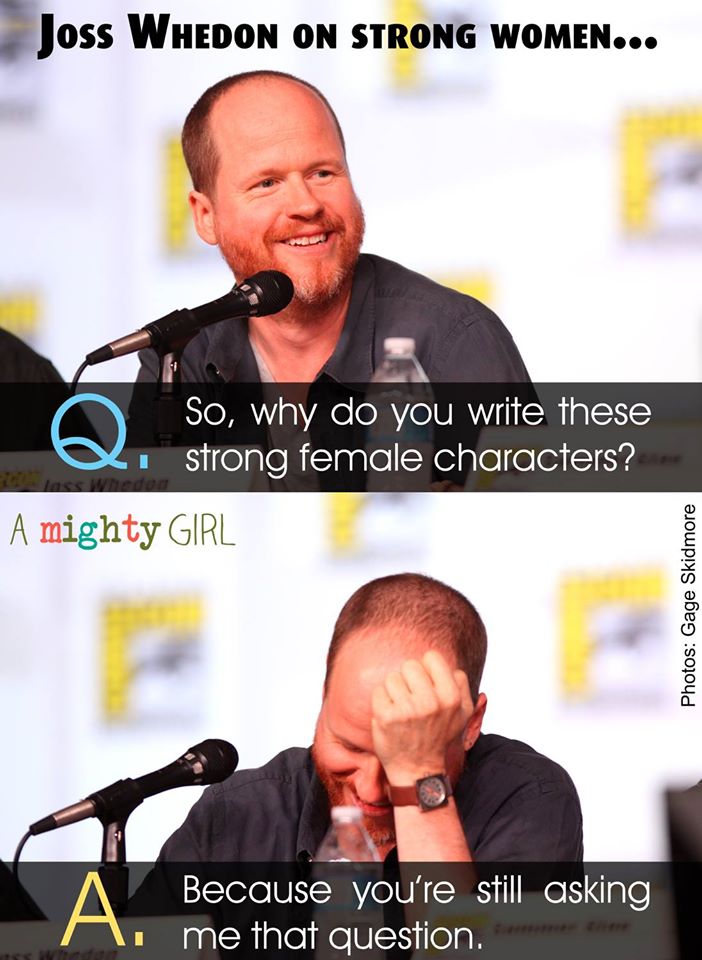
I like the answer. Perhaps because it’s similar to my answer to the question “why are you blogging about male privilege all the time?”
And here’s the caption, from A Mighty Girl:
Although there has been some progress, the need for prominent female characters in TV and films is still huge. According to a study by the Geena Davis Institute on Gender in Media, only 29.2% of 5,554 speaking characters in 122 family films they recently analyzed were female — the same 3 to 1 male/female ratio that existed in 1946.
Friends, that’s not good enough.
In the end, I’m grateful for strong women in media, in books and on the screen. For our girls for sure.
But also for our junior higher.
Want a bit more of Joss Whedon on writing strong women characters? Try this link.
Gender Roles and Tumbleweeds
 Don’t know if you saw it the other day, but now the Washington Post is wondering about ol’ Tertullian.
Citing the recent, high-profile events involving Mark Driscoll and Mike Fariss, in tandem with an evangelical youth movement trending towards an egalitarian theological position alongside an increasing ideological polarity, the Post posits this notion:
“The heart of U.S. evangelicalism may be heading for a gender showdown.”
A showdown!
Now, if you ask me, a “showdown” seems a bit hyperbolic. What, are we going to draw Bibles in the street while tumbleweeds blow in off the plains?!?
But I get the idea. The writer is suggesting that two ideas are colliding, and, with it, the people that hold those ideas are in unprecedented tension. Or, if I may, I think the tension has been there all along; it’s the public aspect of the “showdown” that’s novel.
In the piece, the writer quotes Tim Fariss, the prominent leader of the national home-school movement, who recently publicly advocated for an egalitarian position. About Fariss, she writes:
“In sum, ‘patriarchy’ teaches that women in general should be subject to men in general. The Bible teaches no such thing,” he wrote.
In an interview Tuesday, Farris said dramatic social change has left more Americans pushing for explicit answers to the questions: How do I run my marriage? How do I raise my children so they turn out well? The more conservative part of evangelicalism has pushed to the right, he said.
“The patriarchal view has moved dramatically such that men in general should be dominant over women in general,” he said. “That’s neither Biblical nor wise. What the Bible says about general roles is more modest.”
I don’t know about you, but I say, “bring it on.” Let’s talk, or start talking.
Women are overdue for these conversations.
Men are overdue for these conversations.
Marriages are overdue for these conversations.
Our churches are overdue for these conversations.
The culture is overdue for these conversations.
In short, let’s talk. Let’s debate. Let’s seek the Lord.
And, together, let’s watch out for those tumbleweeds…
Cracks in the “Stained Glass Ceiling”
 Sometimes, I read something that think “maybe we are moving in the right direction.”
Case in point, this article, which tells the story of three women now leading three prominent churches, Rev. Shannon Johnson Kershner in Chicago, Rev. Amy Butler in New York and Rev. Ginger Gaines-Cirelli in Washington D.C.
As the article recounts, and as you would expect, each of these women have faced significant hurdles in arriving in their current roles:
In June, Butler used the hashtag “nevergetsold” when she tweeted about how a funeral director didn’t believe she was a minister. She once had to get an emergency room security guard to log on to her former church’s website to show him her photo there so she could pay a late-night visit to a sick congregant.
“Look, I know you’re his girlfriend,” the guard told her before she convinced him otherwise.
Kershner said that early in her ministry when she was a hospital chaplain, she often entered rooms where she was rebuffed because she wasn’t a “real minister.”
In every place she’s served as the first woman pastor, Gaines-Cirelli has heard a variation on this theme: “I was so worried that we were getting a woman, but I think that you’re going to be just fine.”
In light of the obstacles, I say good for these three for overcoming Tertullian.
As you might expect, the article also sounds a down note. After all, three pastors is good, but they represent the proverbial drop in the bucket.
Sociologist of religion Cynthia Woolever said the movement of first-career women to these significant sanctuaries is occurring in the isolated realm of mainline Protestantism, where about 20 percent of congregations are led by clergywomen.
“If you look at conservative Protestant churches you find very few; in the Catholic church: zero,” said Woolever, editor of The Parish Paper, a newsletter for regional offices of mainline denominations.
“It’s wonderful that women are being given those kinds of opportunities to serve in those very large churches, but it’s a very small slice of the pie.”
To be sure, there remains plenty of work to be done.
Yet on this Labor Day, let’s acknowledge that at least in pockets of the church, we seem to be moving in the right direction.
 Challenging Tertullian