An Inclusive Community
 This week, I’m (briefly) emerging my the DMiss cave in order to visit the InterVarsity ministry at UNLV, and tonight I’ll be preaching. Can’t wait.
Last Spring, I had the joy of speaking here, on the topic of what the Bible teaches about women and men in leadership. For tonight’s talk, the topic is different yet similar. Tonight I’ll be helping the students understand the Bible’s call to be racially reconciled in the context of mission.
This means that, once again, I’ll be sharing Paul’s revolutionary and inclusive words to the church in Galatia from 3:26-29:
For in Christ Jesus you are all children of God through faith. As many of you as were baptized into Christ have clothed yourselves with Christ.
There is no longer Jew or Greek, there is no longer slave or free, there is no longer male and female; for all of you are one in Christ Jesus.
And if you belong to Christ, then you are Abraham’s offspring, heirs according to the promise.
This text has also made my literature review, as I’m working on tracing a theology of inter-gender partnership in mission. And, in the literature, the crucial issue with this passage is whether Paul is intending the text to have social implications in addition to salvific ones. In other words, in the work of Jesus on the cross, are we only equal before the Lord, and/or are we equal in our relationships with one another?
Those who see limitations on women’s roles in the church see only “vertical,” or salvific, implications. (Looking at you Tertullian). Others, like me, see both.
Here’s how Philip B. Payne sees it, writing in his excellent book Man and Woman, One in Christ:
“It is clear that Gal 3:28 carries important social and practical implications. Ethnic-religious, socioeconomic and gender barriers are overcome in Christ. Paul’s repeated insistence on the practical implications of spirituality throughout Galatians necessitates that the equal standing that Christ has opened up to Jews and Greeks, slaves and free, male and female not be divorced from a corresponding equality of social standing in the practical life of the church.”
In concert, here’s how Gordon Fee sees it, from the book Discovering Biblical Equality:
Paul asserts that in the fellowship of Christ Jesus significance and status no longer lie with being Jew or Greek, slave or free, male or female. The all-embracing nature of this affirmation, its countercultural significance, the fact that it equally disadvantages all by equally advantaging all—these stab at the very heart of a culture sustained by people’s maintaining the right position and status. But in Christ Jesus, the One whose death and resurrection inaugurated the new creation, all things become new; the new era has dawned.
Thank God that in Christ Jesus a new era has indeed dawned, one marked by freedom and equality, for women and men and with race and ethnicity as well.
Awash in a Sea of Literature
No post this morning, due to this:

On Wrangling Words
 As you know, I’m in the middle of a significant writing project, as my DMiss literature review is due in just 11 days in “fair draft” mode.
As a result, I’m up to my eyeballs in words, and in wrangling them into something clear and compelling. Honestly, I find writing to be a schizophrenic process.
On one hand, it’s exceedingly difficult. Quoting Hemingway: “There is nothing to writing. All you do is sit down at a typewriter and bleed.” Exactly.
On the other hand, at the same time the writing process is wildly exhilarating. Quoting Flaubert: “The art of writing is the art of discovering what you believe.” Amen. It’s a rush.
Anyhow, to help supplement the vocabulary, and to have a little fun, I asked some friends on Facebook to help me freshen up my word list. The result was a beautiful (and offbeat) collection of words. Here’s the list:
Inveigle
Robust
Extricate, extrapolate, acquire
Fortitude
Bloviate (I’m committed to finding a place for this one!)
Obfuscate
“Inextricably linked”
Skullduggery, etiolate, salubrious, circumambulating
Harness
Cromulent, embiggen
Disenfranchise, opine, run/ride roughshod, ameliorate
Obfuscate, recurse, traverse
Delimit
Absquatulate, bowdlerise, fletcherise, hornswoggle, lollygag, peculate, skedaddle, subtilize, yaff
Eviscerate
Now to see how many of these I can wrangle into an academic paper! And you’re more than welcome to add to the list in the comments!
Way to Go Iceland!
 I came across this gender equality map the other day. It ranks every country in the world based on data obtained via the World Economic Forum. Take a look at the map itself here:
http://widgets.weforum.org/gender-gap-2014-01/
(Sorry, it’s supposed to magically appear in the post…grr.)
If you’d like to just skip to the bottom line, here’s the article’s conclusion:
Despite the vast discrepancies between, say, Iceland (the #1 country) and Pakistan (bottom of the list), the WEF stresses that no country has fully closed the gender gap. It has been publishing these rankings since 2006.
The report’s authors say that gender equality is improving worldwide, overall, boosted by growing numbers of women being allowed access to jobs and building a stake in their country’s political life. “Much of the progress on gender equality over the last 10 years has come from more women entering politics and the workforce,” the report’s lead author, Saadia Zahidi, told the Associated Press.
But more regressive realities remain — with women struggling for access to education and adequate health care in a host of developing countries, and wage inequities persisting virtually everywhere.
The United States improved a few spots this year, ranking 20th, ahead of fellow Anglophone countries such as Australia and Britain. But it still lags behind far poorer nations such as Nicaragua and Rwanda.
“Both rich countries and poor countries can afford gender equality,” Zahidi told Fortune magazine. “Gender equality doesn’t have to only come along once a country is fully developed.”
Embracing the Prophetic Blessing
 November is an anniversary month for me.
In November of 1996, after about 10 months of full-time fundraising and part-time Junior High study hall proctoring, I started getting paid to do ministry. It’s still mind-boggling to me that what started as a 3 year “blip” between college and the “real world” has now lasted 18 years.
Indeed, somewhere along the way, vocational ministry became the real world!
And when you’ve been doing this 18 years, you’ve learned a few things. For instance, I’ve learned how I’m wired (and how I’m not). I am an introvert. I love to write. Put me in charge of a conference, or a system, or a project, and you’ll be in good shape. And, for the love of God, let’s have fun while we’re doing our ministry work.
I’ve also learned how I’m gifted. Like spiritually gifted. And, for the most part, my gifts are in the “behind the scenes” things. I’m a director/administrator. I like to help new things happen. I have a passion for service.
Truth be told, at least in my contexts, this gift mix makes me somewhat unique. Because many of the ministers around me are gifted in different, “louder” areas. Like preaching. Or evangelism. Or discernment. Or healing. Or pastoring.
Which is why my initial reaction to being blessed to be a prophet caused me to recoil.
There I was, two weeks ago now, in a corporate prayer time, when a good friend of mine came over to me, laid his hand on my shoulder, and whispered this in my ear:
“I think God wants me to anoint you to be a prophet in your DMiss work.”
Me? A prophet?!? Heck no.
I mean, have you read the Old Testament? As a group, prophets strike me as ornery and cantankerous. They probably smell bad. They eat locusts. No one likes them. It’s like they’re permanently pissed off and in turn want to piss others off.
If that’s what the prophetic blessing entails, I’ll pass.
But, as I’ve received that prayer blessing and pondered it a bit, what if there was room for a different kind of prophetic ministry? Maybe one that involves writing. Or blogging. Or a certain DMiss program? What if you could speak truth into the culture–into the church culture–by doing excellent research, reading and writing?
Several months ago, I introduced you to F. Pierce Beaver, missiologist, professor, and prophet. In writing about the profession of missiology, my chosen field of study, Beaver wrote this:
“The missiologist is called to be the pioneer and to blaze the trail. The missionary will not escape from his (or her) uncertainty until the missiologist points the way, and the church will not move ahead in mission unless the missiologist sounds a ‘prophetic call.’”
Today I’ll start writing my Literature Review in earnest. The idea will be to enter the “conversation” that other authors, theologians, sociologists and historians have been having about my topic of inter-gender partnerships in mission. Over the course of some 50 pages, I’ll hope to discern what could make such partnerships flourish, in my organization and, more broadly, in the church.
And, in all of it, I’ll hope to be prophetic.
So, this introverted, fun-loving administrator is going to take his prophetic unction out for a test spin. We’ll see how this goes. I’m all in.
Well, except for the locust-eating part…
Scaffolding
Yesterday, I had a fruitful morning working on scaffolding, or outlining, my literature review, due in first draft form on November 14th. Basically, I worked on forming my main headings and then slotting my 85 sources where I think they belong. The goal is to provide a context for the sources to engage one another.
And one thing that struck me this morning is just how multi- (or inter-) disciplinary my field of missiology really is.
For instance, the first section of my lit review is theological, as I trace the theme of inter-gender partnerships in mission through the Scriptures. Then, my second section feels more sociological, as I’m looking for qualities and characteristics (“Q and Ch”) that mark flourishing partnerships. Then, my third section is essentially historical, as I’m tracing InterVarsity’s organizational journey with gender.
On one hand, I love the diversity of this process. It feels great to examine my problem through multiple lenses. On the other hand, my head is spinning, and I am finding that I need to refocus as I move from one section to the next.
Anyhow, here’s a pic of the outlines thus far. Thanks for cheering me on with this!

Thinking About These Things
 I love Paul’s exhortation to the Philippians in chapter 4:8-9 of his letter:
Finally, beloved, whatever is true, whatever is honorable, whatever is just, whatever is pure, whatever is pleasing, whatever is commendable, if there is any excellence and if there is anything worthy of praise, think about these things. Keep on doing the things that you have learned and received and heard and seen in me, and the God of peace will be with you.
The older I get, the more this verse hits home. Because, more than ever, I understand that what I willfully allow in my head makes all the difference in my thoughts and, ultimately, in my actions and words. I think it was some brilliant computer scientist that coined the adage of “garbage in, garbage out.” When it comes to spiritual maturity and character development, that’s really a true statement.
In this spirit, I want to offer three select quotes from my journeys this past week through an absolute mountain of literature about inter-gender partnerships in mission. Specifically, I’m going to pick some quotes from Genesis, since, when it comes to gender equality, for most commentators and writers the heavy theological lifting begins right at the beginning of our Bibles.
Enjoy, and may your “thinking about these things” bless your theology, but also your view of the men and women partners that God has put around you.
From Equally Yoked, by Rick McKinniss;
“God made the man and the woman to be full and equal partners one with the other. They are called to share the blessings and the responsibilities of fruitfulness and of exercising dominion. Though the operation of this ideal was seriously disrupted by the fall, it has not been lost beyond the reach of the redemption in Christ. The New Testament church operated in this perspective, and the New Testament teaches the recovery of this idea of full and equal partnership.”
From Equal to Serve, by Gretchen Gaebelein Hull:
“Our creation in God’s image is a truth that transcends gender. Our re-creation as new creatures in Christ Jesus is a truth that transcends gender. God’s call to His individual servants transcends gender. When we examine the Bible carefully, putting down our cultural baggage, we find that the Bible does not teach that biology is destiny.”
From Women Leaders and the Church, by Linda Belleville:
“Although there is a great deal of debate about what creation in ‘God’s image’ means, the Genesis account is unequivocal in affirming that women and men equally share it. There is also equality in the social realm. Both male and female are commanded to exercise dominion over creation. Although some claim that male headship is intrinsic to the creation accounts, quite frankly the only time this kind of language appears is when it is used of the joint dominion of male and female: ‘Let us make human beings in our image, in our likeness, and let them rule over the fish of the sea’ (Gen. 1:26). There is no division or distinction of the roles here. The woman is given the same task and level of responsibility as the man.”
Who Wants to Annotate?!?
We interrupt this regularly scheduled blog post because, well, this annotated bibliography isn’t going to write itself!
And did I mention it’s due…tomorrow?!?
Wish me luck!

You Go McKenna
 Honestly, I cannot understand why anyone would name their store “Dicks.”
Not to be crass, but, come on, that name just invites sophomoric comments. Right? According to the company website, the founder was a gentleman named Dick Stack. Isn’t “Stacks” a better name? Or, the current CEO is Stack’s son Ed. How about “Eds”?!?
Perhaps we should borrow a page from J.K. Rowling, and go with The Sporting Goods Store that Shall Not Be Named?!?
Yeah, I like that one.
But I digress, because I want to tell you about McKenna Peterson.
Meet McKenna. She’s a 12-year old from Arizona, and she’s got an issue with TSGSTSNBN. What’s McKenna’s issue? Well, she picked up the latest edition of the TSGSTSNBN catalog, only to find that all of the women were relegated to the background.
In her own words, from a letter that her father posted on twitter:
There are NO girls in the catalog! Oh, wait, sorry. There IS a girl in the catalog on page 6. SITTING in the STANDS. Women are only mentioned once in the catalog on page 5 for some shoes. And there are cheerleaders on some coupons.
Why is this a problem for McKenna?
It’s hard enough for girls to break through in this sport as it is, without you guys excluding us from your catalog. Girls buy stuff from your store. In fact, my last two pairs of basketball shoes were purchased at Dicks, as well as my hoop and practice equipment.
And her parting shot?
Maybe my dad will take me to some other store that supports girls to actually PLAY basketball and follow their dreams and not sit on the sidelines and watch the game to get my next pair of shoes and equipment.
That she ends her letter with “Sincerely, McKenna Peterson, The Fabulous Basketball Player” is just icing on the gender equality cake.
Because here’s the thing. Tertullian would have us believe that athletics is the domain of men. That it’s only Lebron James, or Leo Messi, or Peyton Manning, that deserves our attention, adoration, and emulation.
So good for McKenna for not believing Tertullian’s lie, for being perceptive enough to see the subtle, almost hidden message she was being fed, and for speaking out against it.
According to the CNN article, at first TSGSTSNBN responded with a disappointing form letter. Later, they called, and McKenna’s father reports that:
They said that they liked her letter and that in future publications they will consider putting more women in the catalog. They also pointed us to a commercial that they are running that apparently has a girl in it. It was a very nice conversation that McKenna re-stated her opinion that there needs to be more girls represented.
McKenna, don’t let them off the hook.
Let’s hope that someday, thanks to McKenna, more than “the season” will start with TSGSTSNBN.
Want a better slogan? How about
“Gender parity in sports starts with TSGSTSNBN.”
Remembering Yami
If you’d had the chance to know her, you surely would have loved her.
Last week, Yami, a wonderful 56 year-old widowed grandmother, went to be with Jesus. The details are sketchy, but evidently someone drove up outside her house on a motorcycle, lured her to the garage gate, and gunned her down in her driveway. As to the motive of what would cause someone to murder someone like that, the Costa Rican police are still investigating. But I have an idea:
Evil. Pure evil.
This summer, my family and I had the joy of spending two weeks in Yami’s house, as a part of our missions trip to Costa Rica. This news has hit us hard. We ache. For Yami. For her family. For her community. And we ache for our kids, who someday will have to hear the news that their sweet Yami was killed.
And so I want to remember Yami today. As a tribute. As a way to honor a hard life well lived. And as a way to celebrate a woman beloved by Jesus.
We’ll remember Yami’s all-out, unbridled hospitality. Sometimes, when you stay with someone you feel like a hotel guest. In Yami’s house, you felt like one of her children. In short order, our kids started calling her “Yami the Mami.” She was relentless with everything from doing our laundry to making sure we had enough to eat to having us debrief our day. On the last day of the outreach, when it was time to leave, she completely out-gifted us. At one point, after another lunch that was just too much food for us to eat, we gently, in my halting Spanish, asked her to throttle back on the portions. With reluctance, she complied, adding that she was looking forward to the group that would follow us as guests in her home. Why? Because they were four adult men, and she knew they would eat.
We’ll remember the way Yami loved our kids, and especially Lily. When Lily would walk in the house, Yami’s eyes would light up. And with cries of “oh, mi amor!” she would come over and pretty much attack Lily with kisses. In fact, Yami was so effusive with her affection that Lily began to be slightly reluctant to come in the front door! Yami loved kids, and especially her grandkids. We are devastated to know that they will grow up from here on without their loving grandmother.
We’ll remember Yami’s love for her country. It was our good fortune to arrive in Costa Rica with a week to go in the World Cup. And even though Costa Rica had been eliminated on penalties two days prior, the country’s successful campaign continued to reverberate throughout the land. It was estimated that a quarter of the population traveled into San Jose for the team’s welcome home rally. Yami’s daughter was at the rally, and we watched it on TV with Yami in her living room. I’ll never forget the tearful pride on Yami’s face as she watched the players file to the podium, one by one. And when team captain Bryan Ruiz got on the mic, he said something like “Que lindo ser Tico,” which translates to “it’s beautiful to be a Costa Rican.” It’s a sentiment that Yami shared.
Finally, we’ll remember Yami’s love for Jesus. One night in the second week, after the kids went down, Yami shared her testimony with us. It took a solid hour, and it might just have been the best hour of my trip. In rapid-fire, staccato Spanish, she told us about her hard life. Her son had been in a car wreck. She had had heart problems. She had been attacked at knifepoint in her own kitchen. She had endured the loss of her husband. And more. Given the language barrier, I think we understood only 50-60% of what she actually said, but one thing was clear: through it all, God is good. In fact, had she survived the vicious attack that took her life, she would surely have said it again:
God is good.
Yami, rest in peace. We love you. Dios te bendiga.
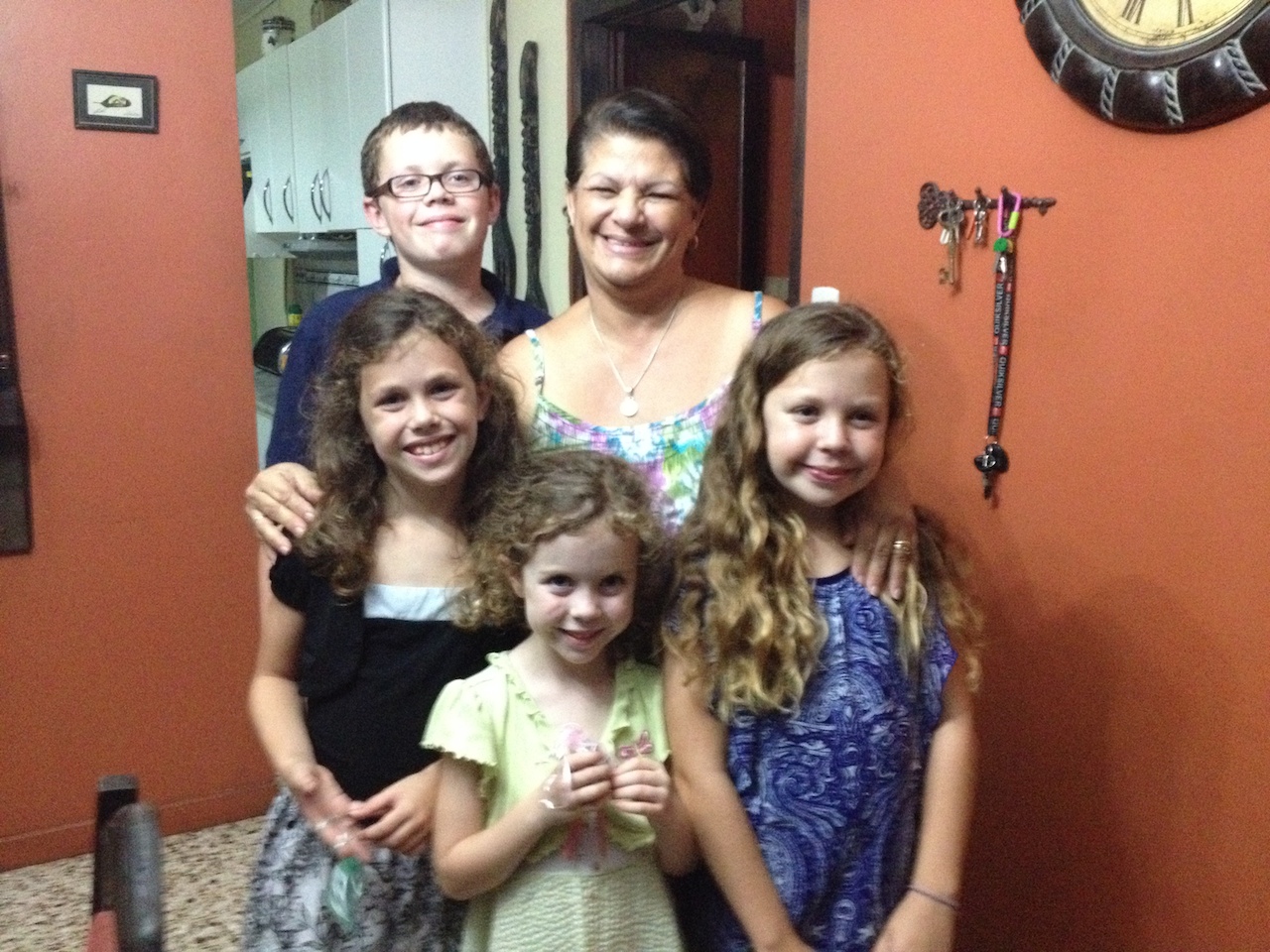
Here’s a picture of our kids with Yami the Mami:
 Challenging Tertullian