Tertullian in Latin America
 Another lifetime ago, my wife and I led several missions trips to Guatemala.
Oh what a joy those trips were! Sure, we helped others. We planted some corn, we vaccinated some chickens. We taught classes. And we ran the health clinic.
But, most of all, those trips changed us and our students.
Considering a short-term missions trip? GO. But, first and foremost, go because you want Jesus to change YOU.
One of the ways that God used those trips in my life is to help me care about the world. About injustice. About the poor. About marginalized people that I’ll never meet but am nonetheless called to love. And while it’s true that over the years God has enlarged my concern to include many other countries around the world, it started in Guatemala.
To put it simply, my heart beats for Guatemala.
Because of this, when it’s in the news, Guatemala catches my eye. And the other day, I read this piece about the tragic trend of not counting indigenous girls in Guatemala.
Imagine not having a birth certificate. Or a Social Security Card. Or a passport.
As the article says, “what if you didn’t know when your birthday was? What if your government didn’t know you existed? What if you weren’t counted at all? Counting means a lot of things but mostly ‘I count’ means ‘I matter.'”
The tragic thing is that this is ubiquitous around the world. It’s not unique to Guatemala. Whether it’s women living life without identification or sex-selective abortion and infanticide as exemplified by China’s one-child policy, in many places of the world…
…to be born a girl is to be born in jeopardy.
In their book Half the Sky, Nicholas Kristoff and Sheryl WuDunn write:
“The global statistics on the abuse of girls are numbing. It appears that more girls have been killed in the last fifty years, precisely because they were girls, than men were killed in all the battles of the twentieth century. More girls were killed in this routine ‘gendericide’ in any one decade than people were slaughtered in all the genocides of the twentieth century.”
This summer, my family and I will be back on the front lines, leading a team to Costa Rica. We’re looking forward to partnering with local ministries to serve the poor in and around San Jose. More than that, we’re looking forward to Jesus shaping us as we do that.
Costa Rica gets a lot of press for being Western friendly. I think what that means that is that you find your favorite restaurants, not have to speak Spanish and, heck, they’ve got a “blue zone” in Costa Rica.
Sadly, even a brief search shows that Costa Rica is not immune to the oppression of women. This article talks about how in many ways it’s better to be a woman in Costa Rica than it is in Guatemala, or even in the United States (lower wage gap, more representation in politics, etc.). And yet there’s also this:
“The National Institute for Women is particularly active on issues relating to violence against women, providing services to victims as well as advocating for better legal and practical protection. Sex work is legal, but pimping is against the law. Sexual violence remains a problem, with some evidence that rates have increased in recent years. Trafficking in women and even children is a growing concern.”
Time to ask the Lord to open my heart to a new country.
“Life as a female is about more than finding the perfect outfit.”
 Lest anyone think that I’m on this mission solo, today I want to share a bit of my wife Amy’s perspective on what we’re doing with regard to gender bias and raising our kids, particularly our three girls.
Amy is a writer. And a good one. Don’t believe me? Buy this and you’ll see!
#shamelessplug
She’s also a blogger. And she writes a book review every month for the good folks at Kidville.
This month, the theme was “A Book for Your Creative Thinker,” and Amy profiled the book Rosie Revere, Engineer. The whole post is a worthy read, but here’s the part about parenting and gender:
“How to use this book with your kids: Having three girls means that I am always looking for books that can counteract the Disney Channel culture they love so much. Life as a female is about more than finding the perfect outfit. In this book, we see a girl who is passionate about building, constructing, inventing…things that our culture has traditionally classified as male attributes. So I like being able to point to Rosie as someone who is pursuing a dream that is outside of gender boxes. There are also a ton of historical references in this book, being that Rosie is an obvious nod to Rosie the Riveter. So if you are feeling especially ambitious, you can talk with your kids about the role of women in World War II, as well as women who played a key part in the evolution of the airplane and flight.”
Good, right?
I love challenging Tertullian together!
Every Advocate Needs an Advocate
 These two things are true:
I love to advocate for others.
I’m less able to receive advocacy from others.
So, really, I’m trying to grow in both of these things. I want to be a better advocate, particularly for the women in my life. And, I want to receive someone else’s advocacy with grace.
In that spirt, I want to thank my friend and colleague Jessica Fick for her generosity in hosting me on her blog yesterday, with a post about…advocacy. And what’s in it for me.
I’d love it if you’d head over to Jessica’s blog here and take a look. To whet your appetite, here’s the few paragraphs:
Over the years, it has been my joy to advocate for women around me, both in my life and in my ministry context. Indeed, using the power, privilege and access that culture gives me because of my gender to advocate for women has been a transformational experience, both for me and the women around me.
For me, advocacy has meant empathizing when a colleague has been hurt because of negative gender stereotypes.
Advocacy has meant theological engagement with people who are asking women in my life and ministry to take back seat because of their gender. One time, I endured a 2 hour debate highlighted by me being repeatedly called a “false teacher” because of my position on the issue.
Advocacy has meant intentionally investing in women, mentoring them and developing their leadership gifts.
Advocacy has meant hiring women into leadership roles in my organization, leveraging my positional power to gain for them some measure of such power. For instance, when I started leading my current ministry team, there was one woman. Last Fall, during a meeting, I looked around and realized I was the only man in the room.
The bottom line, then, is that I see advocacy for the women around me as a key part of my ministerial calling. After all, advocacy is a Biblical idea. Proverbs 31:8 reads like this: “speak up for those who cannot speak for themselves, ensure justice for those being crushed.”
But here’s the thing…I’m no hero….
Click here to find out why!
Theologizing
 Have I mentioned that I’m seeking to enroll in a doctoral program?!?
It’s true. I’m applying right now for the Doctor of Missiology program at Fuller Theological Seminary. The DMiss is a four-year missiology degree. It’s designed for in-service leaders; as such it’s primarily online with yearly residencies in Pasadena. The big idea is to tackle a missological problem, with an eye toward practical and concrete solutions.
Sounds like a hoot, huh? More about this later on, but if you’re interested you can check the program out here.
Turns out that part of the application process is reading three missiology texts (this one, this one and this one), and then writing a 10 page paper that summarizes, compares and evaluates. It’s quite a project.
The other day I was reading one of the texts, and I came across this passage, about gender, equality and God’s nature:
“Human beings are sexually differentiated. It is significant that the only specific explanation of the image of God is that it exists as ‘male and female’ (Gen. 1:27). ‘The primeval form of humanity is the fellowship of man and woman’ (Jewett 1975:36)
In other words, the dynamic interaction and fellowship between men and women is a fundamental reflection of the divine image. We cannot conclude that the woman was inferior, either by nature or by function. That she was created to be man’s ‘helper’ (Gen 2:20) does not mean that she must be ‘subject’ to him. The word helper is used elsewhere of God as Israel’s ‘help and shield’ in time of trouble (e.g., 1 Sam 7:12 and Ps. 33:20). ‘It describes a relationship of mutual interdependence, rather than the woman existing for the male’s convenience, or as his underling’ (Kuhns, 1978:17).
God’s ideal is that human beings enjoy positive social interaction and ongoing cooperation with one another in spontaneous obedience to the will of God. Only thereby can they truly incorporate the image of God.” (emphasis mine)
Taken from Announcing the Kingdom: The Story of God’s Mission in the Bible, by Arthur Glasser, p. 35.
On Wading into the Mess
 Have you ever stopped to think about how, well, messy the Incarnation was?
In Jesus Feminist, Sarah Bessey writes:
“We keep it quiet, the mess of the Incarnation–particularly at Christmas–because it’s just not churchy enough, and many don’t quite understand. It’s personal, private, and there just aren’t words for it–and it’s a bit too much. It’s too much pain, too much waiting, too much humanity, too much God, too much work, too much joy or sorrow, too much love, and far too messy with too little control.”
I think she’s spot on. And anyone who has witnessed a birth knows it! The birthing process is a lot of things, but it’s certainly not clean, controlled, measured and clinical.
Instead, it’s messy. Very messy.
Beautiful, but messy.
And it seems to me that this is how it is when God breaks through. It’s beautiful and it’s messy.
Last year around this time, I wrote the following about Christmas:
“Let’s face it, for Jesus the Incarnation was a messy journey from power to powerlessness. Think about it. It’s a long way from the awesome trappings of Heaven to the sordid confines of Earth. In fact, Christmas marks the largest power exchange in human history.”
This year, I’m reflecting a bit more on the mess that comes with the Incarnation. Because the more I dig into this stuff, the more clear it becomes that this process of exchanging power is anything but clean and easy.
Here’s what I mean:
I open my eyes more fully to the injustice perpetuated every day against women…and it hurts. It’s hard to read the stories, and the solutions feel elusive and beyond me. I feel powerless. It would be much easier–much less messy–to remain blissfully unaware.
Or I willingly and even joyfully release my male privilege, intentionally choosing to release power so that others can flourish, only to be left with…what? I’m not sure. After all, paradigm shifts are often messy.
Or twice a week, every week, I write about male privilege, sending off my post and then wondering what you all think. That’s rarely an comfortable experience. Challenging Tertullian means it’s messy in my soul sometimes!
Or, lastly, I press into relationships across gender lines, trying to figure out how to have deep friendships and meaningful partnerships with the women in my life. Sometimes it feels like one step forward, two steps back.
All in all, it’s a messy business. Thankfully, it’s also a beautiful business.
Just like the Incarnation.
The Idealism of Youth
 In his book Start, Jon Acuff recounts a story of his kids discussing the famous writer Roald Dahl:
“I heard L.E., my 9-year-old, say to her little sister, McRae, ‘Did you know that the guy who wrote The Twits also wrote James and the Giant Peach?’
I heard McRae respond, ‘I know! I love that guy. He’s got a great imagination, like me.’
Like me.
What a powerful declaration.
Roald Dahl has been called the greatest storyteller of our generation…He’s sold millions and millions of books. And in McRae’s little 6-year-old mind, his imagination is on par with hers. He’s her peer.
You used to believe like that too. You used to turn sticks into swords or dirty flip-flops into glass slippers. You climbed trees and made forts and thought being a doctor wasn’t out of reach. Nothing was out of reach.
Then, somewhere along the way, you lost it.”
I think there’s a lot of truth to this dynamic, or at least there is in our house.
Last week, our eldest daughter submitted a story to an online writing contest. Basically she’s the youngest entrant by decades, and she’s certainly the least experienced. But neither of those things stopped her from immediately beginning to speculate about which prize she’ll choose when she wins. (the story is here, if you’re interested)
Or our son, just a month into his first foray into organized basketball, debates which team he’ll be playing for when he makes it into the NBA. The NBA. My kid has no idea how to box someone out, but that’s not stopping him from deliberating about which number he’ll wear when he plays for the Lakers.
As a parent, I just shake my head.
I mean, I cannot shoot them down. On the other hand, I should let them down gently. Right?
Right?!?
Sometimes I’m prone to despair about this gender stuff. Like, we’ll never get to the point where men and women are freely and joyfully sharing power. We’ll never balance the ledger such that God’s church will be a welcoming place for women to use their gifts as well as men. Or this blog. Is it making an impact? Should I just pack it in and find something else to do twice a week?
And when I get like that, I remember a conversation my son and I had one Friday afternoon. He was traveling with me to speak to a room full of college students on the topic of gender reconciliation. And while we drove to campus, I was practicing my talk while he played his Nintendo in the back seat.
Finished practicing, I took and breath and, on a whim, asked him what he thought. I figured he’d be so zoned out that I’d get a “good, Dad.”
Instead, he said this:
“Dad, I heard you talking about feminists in your talk, but it just seems like the goal should be for men and women to work together as equals. So shouldn’t we all just be genderists?”
Genderists.
Sounds good to me. Who’s in?!?
2 Reasons Why I’m Coaching Girls Soccer
 When I started, it was mostly about need.
As in, my daughters’ team of under 8 girls needed a coach, and I needed some venue to express my love of all things soccer. Somewhere along the way, need morphed into, well, a calling of sorts. Like, I feel called to coach soccer. Even more to the point…
I feel called to coach girls soccer.
There are more than this, but here are two key reasons why:
First, I see coaching these girls as a way to make a tiny dent in the largely anti-female culture of American (and global) sports. I’ve blogged about sports culture before (here, here and here), but in case you need a reminder, we live in a world where boneheaded talk radio jocks say things like this:
“I enjoy many of the women’s contributions to sports — well that’s a lie. I can’t even pretend that’s true. There are very few — a small handful — of women who are any good at this at all. That’s the truth. The amount of women talking in sports to the amount of women who have something to say is one of the most disproportionate ratios I’ve ever seen in my freakin’ life. But here’s a message for all of them … All of this, all of this world of sports, especially the sport of football, has a setting. It’s set to men… It’s a man’s world.”
I wish this sentiment was an aberration, but I’m afraid it’s not. And while we rarely experience sports as this overtly and verbally sexist, Tertullian is still there, lurking in the shadows. Recently I read this article, about a group of elite women cyclists and their supporters, who are seeking to create a Tour de France for women. The litany of legal, financial and attitudinal barriers they are facing is staggering and depressing.
So, by choosing to coach girls, perhaps I can punch a small hole in a long-established male-favored sports culture.
Second, coaching the girls gives me an opportunity to try to be a healthy male role model. To be sure, I don’t know the full stories of each of the girls on my team, but I know enough to know that many of them could use a positive and encouraging male role model in their lives. And, sure, I’m only with them 3 hours a week, but I am acutely aware that I when I am, I have an opportunity to bless and encourage them, in a way that they might not get consistently at home.
That’s right, what I’m saying is that soccer coaching can be ministry.
Both of these reasons–culture shaping and role modeling–are ways that I’m trying to leverage my male privilege to bless others. In the overall scheme of things, there are small, almost token acts.
And yet, at the end of the day, I don’t live in the overall scheme.
I live in my neighborhood, with these girls and their families, coaching and playing soccer.
Women at War
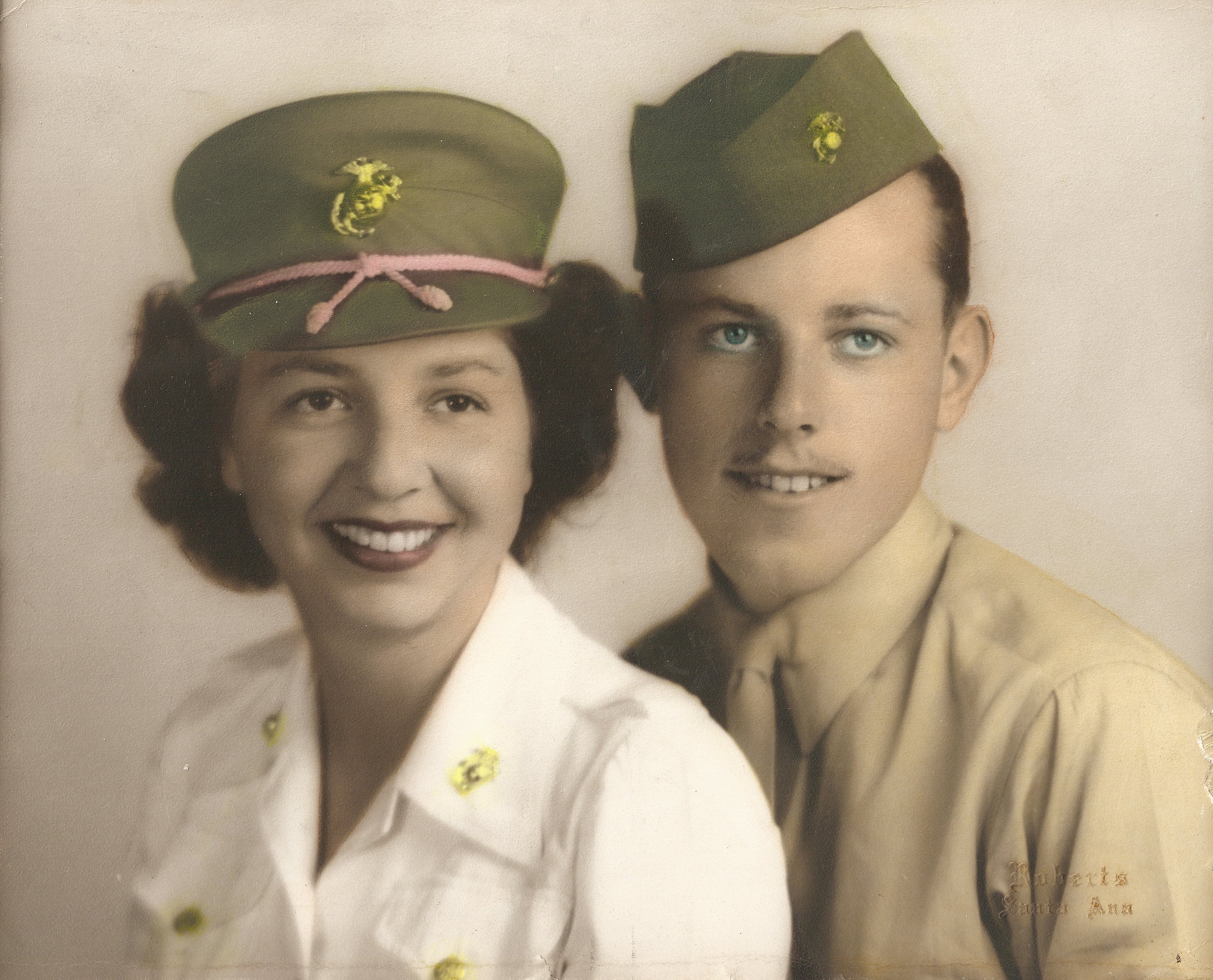
My Grammy was a proud Marine.
I mean, of all the amazing things she did in her life, serving her country as a U.S. Marine was right at the top of the list. Grammy enlisted on August 2, 1943, and family lore says that she was the first enlisted female Marine from the state of New York. She went through Basic Training at Parris Island, SC and, later, she graduated from the Corps’ Motor Transport School.
Assigned to serve at the Marine Corps Air Station El Toro in Orange County, CA, she worked as a truck driver and dispatcher. One day, she met my grandfather, an aircraft mechanic who saw action on Guadalcanal and the Solomons, at a street corner on post. In the end, she was discharged in 1945, after she became pregnant with my mom.
A good buddy of mine is in Washington D.C. this week, and today he sent me the following picture. It’s taken at the World War II memorial on the national mall, and it commemorates and honors the military service of women. In fact, it reminds us that it wasn’t just men that sacrificed and served.
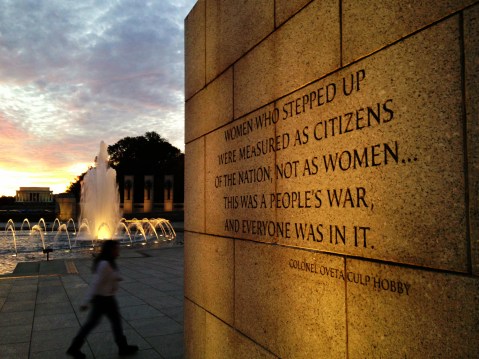
It’s fitting to get this just days before Veteran’s Day, a day where honor the men and women who have served our country.
Last year, I saw the memorial in person, and I know my Grammy would have been proud.
As I am of her.
You want the Dodger score, you get…cleavage.
 Our family is a sports family.
For one thing, we play sports. Mom and Dad are runners. Our son and oldest daughter race cross country and play soccer. That same daughter is right now in a basketball program. Our two younger daughters are also on soccer teams. That’s right, on any given weeknight, you’re liable to find us shuttling from a cross country course to a practice soccer pitch to a sweaty gym with bathroom and water breaks in between.
But wait, there’s more…
In our family, we also coach sports. This year Mom started a 100 Mile Club at our elementary school. As such, she’s spending the year inspiring, rallying and cajoling dozens of kids through their quest to run 100 miles by year-end. On top of that, both Mom and Dad are coaching soccer teams. So, to bookend our weekdays, you can find us starting our day at school before the bell helping kids run laps and the finishing our day trying to wrangle a bunch of little girls into soccer players.
Hold on. There’s still more…
Because our family is also a sports watching family. In person and on TV. In fact, when it comes to TV, Dad is pretty well addicted. If someone’s competing and we get the channel, I’m predisposed to watch it. Especially if it’s English soccer. And particularly if Manchester United is playing.
So you can imagine my joy this year when our son caught the sports watching bug. In fact, he’s become a rabid sports fan. Honestly, it’s made us closer, and I cherish that. When asked the other day at school what his favorite TV show was, he answered, of course, “SportsCenter.”
So last night, when we went online to check the score of the Dodger game, imagine my chagrin and frustration when I saw this:

Now I’m no fool. I realize how the system works. ESPN signs on advertisers in order to generate revenue. On top of that, I also know that certain ads appeal to certain target groups. And, yes, it makes sense that sports fans are also Grand Theft Auto V game fans, and that the way to their wallets is through massive, cartoonish cleavage.
It makes sense, but that doesn’t make it right. After all, I want to talk to my boy about baseball, not boobs. I want us to check out the scores, not a woman’s chest. And when I go to ESPN, I want to help my son learn about the games I love, not our culture’s obsession with objectifying women.
Honestly, its exhausting to continue to have this conversation. Yet have it we shall. Because, in the end, our family is more than a sports family.
We’re also a family who stands for what’s right.
An Unwanted Conversation
 Recently, our daughter had a question for my wife:
“Mom, when will I be allowed to dress sexy?”
It’s a devastating question. Because little girls shouldn’t want to dress “sexy.” Heck, because little girls shouldn’t even know the word “sexy.” And, most of all, because our daughter is so young.
In fact, she just turned 9.
As it turned out, our little girl has no idea of what dressing sexy actually means. For her “sexy” is more of a synonym for “grown up.” You see, in her mind, she’s ready for the earrings, the heels, the straps and the skirts. She wants to look like the girls she sees on TV.
And, for the most part, the girls on TV dress to impress the boys on TV.
In her article “A Grown-Up, Not Sexed-Up, View of Womanhood,” writer Tish Harrison Warren explores the question of whether the church can provide an alternative paradigm to the one that suggests that female adulthood is equated with romantic or sexual availability.
Clarifying the dominant cultural model of womanhood she writes, “In order to be seen as an empowered adult in our contemporary society, we can’t just be mature sexual beings; we must be sexually available. As females, we often demonstrate adulthood by using our sexuality in ways that invite, in fact that practically beg for, the male gaze. It is a sort of post-sexual revolution version of the debutante coming out.”
As I said in a recent post on “Mileygate,” “for the most part, in Tertullian’s reductionistic world, when it comes to sexuality men are there to be serviced. It’s our privilege.” It’s tragic, and, too often, so is the church’s response.
Warren’s diagnosis reads as follows: “The church…must offer another way to attest to our adult womanhood. If we do not, when we encourage young women to remain chaste and value modesty, it will inadvertently be a message of juvenilization–to remain good “little girls.” In order for celibate adults to be acknowledged as adults in evangelical churches, our understanding of adulthood needs to be clarified and decoupled from sexual activity or marital status.”
Simply put, the church right now has no category for unmarried women who are too old for youth groups. After all, not every women will one day be married; as my friend Steph helpfully noted this week, it’s more of an “if” than a “when.” So what’s the alternative?!?
Warren sees a confirmation rite as one way to celebrate a girl’s transition to womanhood. She writes, “Unlike baptism, confirmation is not a sacrament and does not have the theological import thereof. But if we want our young women to feel valued, welcomed into adulthood, and affirmed as strong, independent women without having to reject modesty and chastity or twerk with Robin Thicke, then we need meaningful, communal rites of passage. Maybe celebrating confirmation like we mean it is a step in that direction.”
In the end, I’m not sure if some sort of initiation rite will suffice. We need wholesale culture change.
We need the kind of change that tells women and girls that their identity is in Jesus, not in men and boys. We need the kind of change that affirms women of all ages for who they are, not who they could someday become. We need the kind of change that empowers women and girls with a vision for who they can become in Jesus’ church.
Closer to home, most of all, we need God’s grace to parent our kids the best that we can.
 Challenging Tertullian