Sunday Prayers
 Last year, I reported on male privilege and the Super Bowl after the game.
This year, how about a preemptive strike?
Tragically, the Super Bowl is more than the biggest football game in the world. According to many, it’s also the biggest human trafficking event in the world. Last year, commenting on the objectification of women manifest in both trafficking and in those famous commercials, I called the Super Bowl “an annual crescendo in our culture’s habitual exploitation of women.”
This article, which includes one trafficked woman’s story, reports on the reality of Super Bowl trafficking:
Exact numbers are in dispute and hard to quantify, but according to the New Jersey Coalition Against Human Trafficking, “The Super Bowl attracts tens of thousands of fans to the host city … But it also attracts a sector of violence, organized criminal activity that operates in plain sight without notice including human trafficking in both the sex and labor industries.”
There are several reasons why sex trafficking may increase around a huge event such as this. As hundreds of thousands of people (mainly men) flock to the New York City metro area for the week’s festivities, the primary motivator for increased prostitution is increased demand for it. According to Dorchen Leidholdt, adjunct professor at Columbia University who teaches about violence against women, “The demand for prostitution will drive trafficking. … It’s supply and demand.” According to documentary filmmaker Jane Wells, who produced a film on the topic, “There is corporate entertaining, parties, alcohol, corporate-sponsored parties, people away from their families, anonymity. It’s kind of like a perfect storm.”
This year could be worse. CBS reported, “Many believe the state’s sprawling highway system, proximity to New York City and diverse population make it an attractive base of operations for traffickers.”
Horrific.
So, what to do about this perfect, tragic storm?
How about we pray?!?
The organization I work for, InterVarsity Christian Fellowship, is all about developing world changers. And alum Francis Socorro fits the bill. Francis went to our New York Urban Project in 2010, and she wants to put a stop to trafficking around the Super Bowl. She’s serious about it. Here’s what she and her friends are doing, from this post here:
“For about a year now, my five friends and I have weekly prayer meetings via conference call. The Super Bowl was one of the topics we would continuously pray about. The Super Bowl is commonly known as the single largest human trafficking incident in the United States. Now that the Super Bowl is a week away, and in our backyard, we have to do something about it. Numerous organizations are doing awesome things like approaching motels before this year’s Super Bowl and offering them free bars of soap with the National Human Trafficking Hotline phone number. Since we couldn’t help physically, God has laid on my heart to pray for the hotels that surround MetLife stadium.
So I mapped out hotels near MetLife stadium. I assigned each friend a hotel that they will pray for this week. Joanna will pray for Econo Lodge Meadowlands. Kat will pray for Hampton Inn Carlstadt-At the Meadowlands. Michelle will pray for Fairfield Inn East Rutherford. Sandy will pray for Holiday Inn Express Hotel & Suites Meadowlands Area. April will pray for Homewood Suites by Hilton East Rutherford. And I will pray for Renaissance Meadowlands Hotel. We will first research our hotel. Then we will gather information about previous super bowls and how human trafficking was linked to that. As we go about our week, we will keep that hotel in prayer and be open to whatever God wants to share with us. Then this Sundaywhen we gather for our Super Bowl party, we will talk about our week of prayer and intercede for the event. And of course, watch the Super Bowl!
We may not be like IJM rescuing victims on the front lines, but we can stand in the gap and intercede with Jesus for His people. Prayer moves the hand of God.”
Indeed!
Friends, this Super Bowl Sunday, may God’s hand move in concert with our prayers to make this forecasted storm disappear. Lord, change the world!
Asking the Pope for More
 Like many protestants, I have loved the papacy of Pope Francis.
How could you not love a pope who lives not in the lavish papal apartments, but in the Vatican guesthouse? How could you not love a pope who randomly calls parishioners who have dropped him a note? Heck, how could you not love a pope who rides a Harley? And then sells it to bless the poor?!?
He’s amazing. And in large part he’s been amazing for women. Though he hasn’t seen fit to erase the Vatican’s historic bias toward men in the priesthood, he has made it a point to elevate women. In fact, when the pope affirmed the fundamental value of women, I blogged about him here.
So I read this article yesterday with a hearty helping of sadness.
Because on Saturday, Francis addressed a room full of Italian women. Here’s a bit of what he said:
Francis told his audience that he had stressed “the indispensable contribution of women in society, in particular with their sensitivity and intuition toward the other, the weak and the unprotected.” He said he has been heartened that “many women share some pastoral responsibilities with priests in looking after persons, families and groups” and he said he had hoped that “the spaces for a more diffuse and incisive presence in the church be expanded.”
In some parishes, women visit parishioners too frail to come to church, run prayer groups and outreach programs to the poor, as well as help distribute communion to the faithful at Masses, especially in churches with large congregations.
“These new spaces and responsibilities that have been opened, and I strongly hope that they can further be opened up to the presence and activity of women, both in the church environment as well that of the public and professional” spheres, Francis said, “cannot make us forget the irreplaceable role of the woman in a family.”
A couple of comments in response.
First, in that last sentence, I’m tempted to read a bit of “a woman’s place is in the home” into Francis’ words. Can you see it too?
I mean, of course a woman’s place is in the home.
But so is a man’s.
If I’ve learned anything on my parenting journey, it’s that it takes two to tango. In fact, it takes more than that, as help from family and friends is crucial. Honestly, I’m really not sure how single parents do it.
Let’s be clear. Both women and men have irreplaceable roles in the family. And, to go a step further, I would say that husband and wife are called to share the leadership role in the family, with specific roles being assigned by gifting/personality, not by gender. This week, blogger and writer Sarah Bessey beautifully described her egalitarian marriage (here), a marriage where she and her husband share leadership.
That’s the kind of marriage Amy and I are after too.
Second, I appreciate the fact that the pope is valuing and even calling out the particular gifts that women bring. And he is right. Women do bring sensitivity, intuition and pastoral skills to the work of the Kingdom. Elsewhere in the article, Francis is quoted as saying that women bring “gifts of delicateness, special sensitivity and tenderness.” I’m sure he’s right about women bringing those things too.
But that’s not all that women bring.
What about decision-making? Discernment? Peace-making? Administration? Faith? And a hundred more things. Heck, what about women bringing…
Leadership?
Furthermore, it’s not just women that bring the gifts that Francis is noting. Men do so as well.
The bottom line here is that I will continue to cheer on the pope, particularly as he relates with women.
And yet at the same time, I long for the day when there is gender parity both in marriage and in ministry, not just the Catholic Church, but in any church.
Come to think of it, maybe Pope Francis will call me sometime and we’ll have a chat. Clearly, I’ve got a few things I’d like to share with him.
“Life as a female is about more than finding the perfect outfit.”
 Lest anyone think that I’m on this mission solo, today I want to share a bit of my wife Amy’s perspective on what we’re doing with regard to gender bias and raising our kids, particularly our three girls.
Amy is a writer. And a good one. Don’t believe me? Buy this and you’ll see!
#shamelessplug
She’s also a blogger. And she writes a book review every month for the good folks at Kidville.
This month, the theme was “A Book for Your Creative Thinker,” and Amy profiled the book Rosie Revere, Engineer. The whole post is a worthy read, but here’s the part about parenting and gender:
“How to use this book with your kids: Having three girls means that I am always looking for books that can counteract the Disney Channel culture they love so much. Life as a female is about more than finding the perfect outfit. In this book, we see a girl who is passionate about building, constructing, inventing…things that our culture has traditionally classified as male attributes. So I like being able to point to Rosie as someone who is pursuing a dream that is outside of gender boxes. There are also a ton of historical references in this book, being that Rosie is an obvious nod to Rosie the Riveter. So if you are feeling especially ambitious, you can talk with your kids about the role of women in World War II, as well as women who played a key part in the evolution of the airplane and flight.”
Good, right?
I love challenging Tertullian together!
Shame on Old Spice
 Yesterday was a football watching day in the Dixon house.
For the record, we were pulling for San Diego and Green Bay. #mixedresults
But of course watching football games means watching the commercials that attend the broadcast. And, unfortunately, this too often means enduring gender bias and sexism. I’ve made this observation before (here and here), but this time, the Tertullian Award for Inappropriateness in Commercial Advertising goes to (drumroll please):
Old Spice.
And specifically to its “Momsong” commercial, part of its “Spray Goodbye to Boyhood” campaign.
If you dare, the commercial is here.
When this ad came on, my first response was to head out to the living room, where our 11-year old son was watching the game on a different TV. As has become our practice when he and I debrief these kinds of things, I asked him this question:
“Josh, what do you think that commercial trying to tell you?”
He thinks then says, “What it means to be a man.”
I reply, “And what does Old Spice say is involved in being a man?”
Pause. Uncomfortable look. “Ummm. Kissing girls?”
Kissing girls.
Or, more to the point, according to the commercial, “when our sons have fun with women and misbehave.”
Needless to say, we won’t be buying Old Spice any time soon. Heck, maybe we need to avoid any of the 50 or so Proctor & Gamble brands.
Because here’s the thing:
There’s more to being a man than chasing (or having fun with) women.
Say it again. There’s more to being a man than chasing women.
Reducing “manhood” down to merely the carnal instinct to chase women, especially with the connotation of inappropriateness, doesn’t serve anyone, male or female. Not only does it neglect every other aspect of what it means to be a man, it also perpetuates the man as hunter/woman as quarry narrative, one that too easily and often becomes toxic.
It’s the last thing I want my son to see!
Yesterday, I tweeted at Proctor & Gamble and Old Spice three times to no avail. I’ll keep trying. When the game was over, I breathed a sign of relief, glad that we wouldn’t have to worry about that commercial any longer, and then it dawned on me.
There are more games next week.
Duck Disaster
 On Sunday, I came across this story, which featured Duck Dynasty Founder and star Phil Robertson saying some pretty brutal and sexist things about women.
You’ve probably heard about Phil and his Duck Dynasty crew. In the last couple of weeks, they have come under fire for Phil’s comments in GQ about homosexuals and African-Americans. If your Facebook wall is anything like mine, you’ve seen a lot of Duck Dynasty stories flying back and forth lately, many throwing Phil under the bus and others defending either his right to free speech or his views on faith.
To be honest, at first I was reluctant to write this post this morning. Why? Well, first because I am a complete Duck Dynasty rookie. I’ve never watched an episode. Next, because lots of people I know, respect and love really enjoy Duck Dynasty. And last because, come on, after reading what Phil said in GQ was there really any question what his views were or are about women?!?
But I thought I would post here because the Duck people are popular, because Phil’s quote in that article needs to be addressed and because the Duck Dynasty crew of perhaps the most visible professing Christians on TV right now.
And Christians seem to be overwhelmingly pro-Phil. One faith-based petition to reinstate a suspended Phil to his show garnered 250,000 signatures. And thousands of people liked a Facebook page entitled “Phil Robertson of Duck Dynasty-Christians Boycott A&E.” When Phil was reinstated to the show last week, the status read:

Wow.
To be clear, here’s what Phil is quoted as saying about women:
“Make sure that she can cook a meal, you need to eat some meals that she cooks, check that out,” he said. “Make sure she carries her Bible. That’ll save you a lot of trouble down the road. And if she picks your ducks, now, that’s a woman.”
“They got to where they’re getting hard to find,” Robertson remarked. “Mainly because these boys are waiting until they get to be about 20 years old before they marry ‘em. Look, you wait until they get to be 20 years old, the only picking that’s going to take place is your pocket.”
The Duck Commander company founder added: “You got to marry these girls when they are about 15 or 16, they’ll pick your ducks. You need to check with mom and dad about that of course.”
Disturbing, right? Of course.
To his followers and maybe to himself, Phil represents Christianity and Christians in the public arena. Increasingly, he’s the (bearded) face and voice that culture associates with Jesus.
But here’s the thing:
At least in this area, Phil does not represent me.
I’ve blogged about these kinds of things before. When it comes to faith I’m sure I share plenty in common with Phil. But not everything. And, if what he says in this video clip accurately represents his perspective, we certainly don’t agree on this.
In fact, when it comes to women, I strenuously oppose his view. I think it’s narrow, short-sighted and, yes, sexist. It’s wrong, demeaning and, I believe, un-Biblical. It’s the modern day voice of Tertullian.
So when it comes to issues of faith and women, Phil Robertson may well speak for lots of Christians.
Just not this one.
Tertullian in the Church
 I’m continuing to enjoy (and be challenged by) Sarah Bessey’s Jesus Feminist. Yesterday, I came across the following description of male privilege, from Bessey’s journey with the evangelical church:
“A woman managed the children’s ministry. Her role was almost identical to my husband’s role as youth pastor: she preached, prepared sermons, organized programs, counseled, loved kids, trained leaders, attended strategy meetings, and managed a budget, among other staff duties such as prayer meetings and hospital visits. And yet the church called my husband Pastor Brian, and she was just Lisa. I couldn’t figure out why her official title was director instead of pastor. I was told the omission of ‘Pastor’ from her title was ‘for appearances’–to avoid a direct challenge to certain passages of Scripture about women being silent in the church, or ‘You know–how women can’t be pastors.’ One person told me that it was also because if she had the title of pastor, she would automatically be part of the executive team, and the team needed to be only composed of men because a woman would change its dynamic. It was believed that her presence in their meetings would mean that the guys couldn’t be as honest or open; she would upset the delicate accountability structure and honest dialogue of the inner sanctums of church leadership. Lisa did not let her lack of a title hold her back from building a complex and strong ministry centered on discipling kids in the ways of Jesus. Semantics and titles weren’t her worry; she pastored those kids and their parents, whether anyone wanted to call her pastor or not.
Upon my introduction to the larger Church culture, I discovered that the way I grew up, particularly in terms of ‘women in ministry,’ was not common. Everywhere I turned, evangelical sermons on marriage were filled with ‘Oh, you know women’ jokes. Generally speaking, women were perceived as soft, emotional, and naturally nurturing, while men were positioned as natural leaders, hating to talk about relationships, and requiring more sex. Male and female relationships were framed as fairy tales where women are encouraged to be passive receivers and men are the heroic rescuers or as a contest and exercise in combat and negotiation. There was a lot of talk in those days of the ‘feminization of the church’ and how guys needed to step up and be men, which apparently resembled the ideal of benevolent dictators, rather than the Son of Man.”
More Tertullianized Advertising
 Sometimes, you write a post that riles people up.
Monday’s post on Carl’s Jr. and their sexist advertising was one of those posts. Many replied on Facebook affirming that they too are (or have been) avoiding Carl’s Jr. Others sent me similar advertising tales of woe. So as a follow-up, I want to share two reader-generated ad fiascos.
First, there’s this company, Bottom’s Up Espresso, your Starbucks alternative…with a side helping of hypersexualized flesh and a liberal sprinkling of in-your-face sexual innuendo. This one hits close to home, as there are stores just two hours away from me.
Next, I came across this set of vintage ads. In case you’re tempted to think that male privilege themed advertising is a recent phenomenon, check these out and let your stomach turn. Here are a couple of examples:

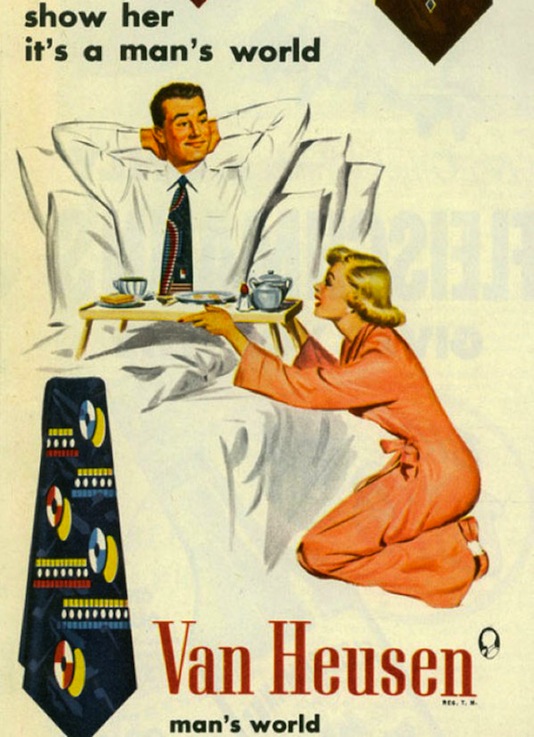
And, just for continuity’s sake, note the star on this one:
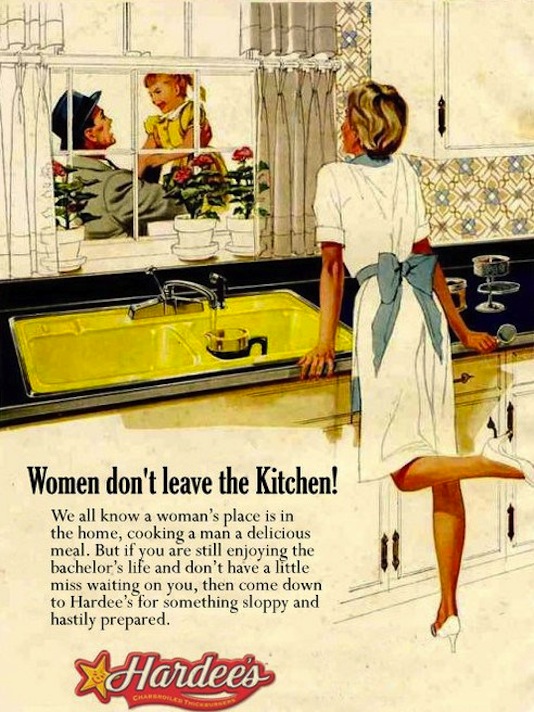
Friends, we have a problem, and we’ve had a problem for awhile. Lord have mercy.
And the Bummer is that I Really Like Those Western Bacon Cheeseburgers…
 Our son Josh and I have been watching a lot of sports lately, which of course means that we’re also watching a lot of commercials. The other day, we were watching yet another round of commercials during a Lakers game, and I had a moment of parental clarity:
This is my moment to pull back the curtain on American materialism.
Now I forget what the commercial was, but it doesn’t really matter, because they’re all the same. Simply put, the message is “buy this, and your life will be better in some way.” Buy this new Lexus and you’ll end up with a mansion, a fleet of new cars and, yes, a cute black puppy. Buy a Subway sandwich and become successful, since of course Subway “is where winners eat.” And–you guessed it–buy some little blue pills and your marriage will never be better.
The reality is that commercials preach the gospel of materialism and comfort. They make the promise that if you plunk down some cash, you’ll get what you want…and more.
And in the case of Carl’s Jrs., that evidently means sex.
I mean, have you seen a Carl’s Jr. commercial lately?!? If I was to sum up their corporate advertising philosophy, I think it would be scantily clad women eating burgers with dripping sauce. Heck, on the Carls Jr. website right now, you can watch a video of a woman eating a burger, you can buy “Eat Like You Mean It” boxers (huh?), and on the main page, you are greeted with this visual:

Subtle, eh?
In our family, we don’t eat a lot of fast food, but in light of their evident determination to equate their product with sex and with the objectification of women, we’ve definitely crossed them off the list. Feel free to join us!
This week, I came across this video. Entitled “How the Media Failed Women in 2013,” it illustrates the persistently sexist advertising and media coverage from the past year. May we do better in 2014.
On Being Part of a What I Hope is a Movement
 Sometimes it seems like things are never going to change.
What I mean is that when it comes to gender equality in the culture and the church, I’m tempted to feel like we’re either not moving at all, moving backward, or if we’re moving forward, it’s at a glacial pace.
As I’ve said before, when people ask me if I think this situation is getting any better, my answer is always a qualified yes. As in, “we’ve come a long way, and we have a long way to go.”
On the other hand, perhaps that’s just my cynicism talking.
This morning I started reading Jesus Feminist by blogger and writer Sarah Bessey. I’m only one chapter in, but so far, so fantastic. And to read Bessey and her forward writer Rachel Held Evans…
We’re in the middle of a nothing less than a movement toward gender equality.
Here’s Evans:
“These stories are followed by groans, by laughter, by tears, by commiseration, by celebration, and often by sacred silence. They are being told in living rooms, sanctuaries, Sunday school classrooms, coffee shops, campsites, rural villages, city streets, and chat rooms all around the world. In the company of one another, women are finding their voices, telling untold stories, and singing freedom songs. A movement is underfoot, a holy rumbling. And things will never be the same.”
Wow. Now here’s Bessey:
“The Table may be loud and dominant , but love and freedom and spreading like yeast. I see hope creeping in, destabilizing old power structures. I feel it in the ground under my feet. I hear it in the stories of the people of God living right now. We’re whispering to each other, eyes alight, ‘Aslan is on the move.’ Can’t you feel that? The kingdom is breathing among us already.”
All things considered, I like the thought of being part of a movement.
In fact, forget the glacier. Maybe we’re in an earthquake.
Just over a year ago, in this post, I reported that the church of England had tragically voted against ordaining women as bishops. Using that as an example of the gender bias entrenched in the church, I wrote, “In other words, we’re not just talking about a problem in the larger culture. It’s in our house as well. Indeed, in the clerical (church leadership) world in particular, male privilege continues to thrive.”
Now let me use the Anglicans for a different kind of example. As reported in Christianity Today several weeks back,
“The Church of England has voted to draft new legislation that would allow women to be ordained as bishops.
The church will draft its new measure to approve female bishops by November, but any language likely will not receive final approval until November 2015, Reuters reports. Still, Anglicans have been awaiting this vote to re-start the process since the Church narrowly rejected the appointment of women bishops by just six votes in the House of Laity, one of the Synod’s three chambers, last November.
Archbishop Justin Welby says the mood within the church has shifted since then, and the Belfast Telegraph reports that he is ‘extremely optimistic’ about the promise of moving forward.”
It’s important to note that this isn’t the end of the road for the Church of England. There is more process to come. But, one year removed from the no vote, it’s a significant step in the right direction.
Come to think of it, maybe it’s more than a step.
Maybe it’s a movement.
Pastoral Privilege
 I’m not a church pastor by vocation. But Erik Parker is. And he’s written an insightful post entitled “12 Reasons Why Being a Male Pastor is Better.” I’m going to excerpt his whole list here:
Like all the advantages of being white and male in North America, there are advantages when it comes to being an ordained pastor. Here are some of the obvious ones:
- No one ever defines my ministry by my gender. No one says, “wow a male pastor or a man in ministry, good for you.” I always get to be just a pastor. I don’t have to constantly live with a qualifier in front of “pastor”, and I am not forced to bear someone’s inappropriate shock that I am my gender and I am a pastor.
- People expect me to be direct and tell them what I think. They want me to lead them somewhere. I am rarely challenged or expected to defend or make a case for my ideas. I don’t have to apologize for having strong opinions or constantly defend my ideas.
- People think twice about fighting with me. I always have a leg up in conflict, bullies find it harder to push my buttons because I have fewer to push. I am never automatically second class because of my gender, so conflict is on equal terms or tipped in my favour. I don’t have to suffer being called “boy” or “son” as way of dismissing my point of view, and I am not accused of being divisive if I disagree with something or anything.
- People are used to pastors of my gender. There are no congregations that are unsure of male candidates for ministry, no parishioners who think it is alright to say something like, “I will never be buried by a man.” I don’t have to endure questions about whether I will take paternity leave, or what will happen when I have kids.
- People almost never assume that I have a particular gift for ministry before they know me. They don’t automatically think that my gender is suited to particular areas of ministry like preaching or administration. No one assumes that I am not good at pastoral care or being nurturing. People don’t say that I have the gift of speaking with a voice that men can relate to.
- I don’t have to worry about my safety. I don’t think twice about being alone in the church or if I am safe on my own. If a man asks to meet with me one on one, I don’t have to question my physical safety or his motives. Men don’t try to share the peace with me by hugging me (or grabbing my ass).
- No one assumes that I am the church secretary or the pastor’s spouse. I am never told, “You don’t look like a pastor or you are took young to be a pastor” even thought I am built like a football player and at times have had long hair and a beard like a hell’s angel. And I have a tattoo. And I am 30 (two decades younger than the average age of pastors in our denomination).
- Churches are built for men. Pulpits, altars, pastor chairs, vestments are all designed my size and body type in mind. I don’t look ridiculous because the standard garb of my profession is made for my gender, and I don’t look like a cross dresser in a clergy shirt.
- All the pronouns are for my gender. God is a he. Jesus is a he. Pastors are almost always referred to as he or him or his. I don’t have to correct people because they never use the wrong pronoun to refer to me.
- Being male is the norm in the church. I didn’t have to take classes in seminary about men’s issues, there is no post-modern male theology, male pastors where never brought in to speak about being male pastors as if it was special or odd or a novelty.
- I could join the Old Boys Club if I wanted to. Leadership in the church is still overwhelmingly male, and there are no glass ceilings for male pastors in the church. No one pretends it is, “all in good fun” to make sexist jokes about my gender, and none of my colleagues treats me like I am second class because of my gender.
- I don’t have to walk on egg shells in ecumenical situations. I don’t have to justify my position and call to my conservative colleagues, because they all have male pastors in their denominations. I am not an oddity or the token male at ministerial events.
I’m not a church pastor by vocation. But if I was, I think I would write up a list a lot like this. Thanks Millenial Pastor.
What about you? What on this list resonates for you?
 Challenging Tertullian