Women and Money
 Off and on, I’ve been catching installments of the CNN series “Finding Jesus.”
It’s interesting to see CNN’s take on Jesus, as they seek to determine what to make of him. They have 3 options: “faith, fact, forgery.”
The other day, I saw a section about the women that surrounded Jesus’ ministry, and for more information I googled a supporting article at cnn.com. Specifically, the article asks the question about where the funds for Jesus’ work came from. The answer?
Women.
From the piece:
The Gospel of Luke gives us a glimpse of how Jesus’ ministry functioned on a practical level:
“Soon afterwards he went on through cities and villages, proclaiming and bringing the good news of the kingdom of God. The twelve were with him, as well as some women who had been cured of evil spirits and infirmities: Mary, called Magdalene, from whom seven demons had gone out, and Joanna, the wife of Herod’s steward Chuza, and Susanna, and many others, who provided for them out of their resources.”
So, according to Luke, women whom Jesus had healed in turn provided for him out of their “resources,” with Mary Magdalene and Joanna capturing our attention — one by virtue of her husband, and the other, by her stature in the story of Jesus.
I’ve known this for awhile, but haven’t spent a lot of time reflecting on it. And yet it’s an interesting detail in the Jesus story.
To me it speaks in part to Jesus’ appeal to the marginalized. If you were on the outskirts of the culture, you had an ally in Jesus. You were seen. You were empowered. And apparently, as a result, you were devoted.
And perhaps that’s for the better. In an interesting juxtaposition, I noticed this article the other day. The headline: “For Business, More Women in Charge Means Bigger Profits.”
There’s a lot in the article, but here’s the part that caught my eye:
In a survey last year of 366 companies, consultancy McKinsey & Co. found that those whose leadership roles were most balanced between men and women were more likely to report financial returns above their national industry median.
Companies with more balanced leadership do a better job recruiting and retaining talented workers, reducing the costs associated with replacing top executives, McKinsey found. They also have stronger customer relations because management better reflects the diversity of society, and they tend to make better business decisions because a wider array of viewpoints is considered.
I think there are plenty of reasons to seek a level gender playing field. Some are theological, others are sociological and let’s not forget the whole idea of justice.
And then there’s economics. Over and over, the evidence is that an equal gender corporate culture is good for business.
But, then again, it seems like Jesus already knew that.
A Re-Post from Down Under
 Just a quick post today to say “thanks” to Australian blogger Marg Mowczko and her new life blog for re-posting my recent take on the egalitarian nature of Count Zinzendorf and the Moravian revivals.
I’ve appreciated Marg’s thoughtful work for the last couple of years, and I recommend her as an able theologian and thinker on gender equality issues. In addition, I’m compelled by Marg’s personal story “Towards Equality,” which you can find here.
To read the Count Z post on Marg’s blog, go here. When you do, just make sure you read it in an Australian accent!
(Re-Post) The Social Dimension of Easter
A couple years back I reflected on the social dimension of Easter, and how the cross impacts the relationship between men and women. Enjoy!
 Yesterday churches around the world celebrated the most pivotal event in human history, the resurrection of Jesus from the dead. It’s the resurrection that brings life, hope and the promise of eternity. It’s miraculous and glorious, unprecedented and unparalleled.
As our pastor put it, “after Easter, death is dead.”
And I’m sure millions of lives were changed yesterday. According to a 2010 Barna Group survey, some 40 million Americans pledge to invite a non-believing friend to church for Easter Sunday. If even a tithe of that number follow through, that’s quite an attendance surge. And no doubt, many of those new attendees leave closer to Jesus.
For this I rejoice.
And yet I’m also bothered by how we do Easter. Because if I’m honest, I think we only get Easter partially right. And here’s the part we miss:
There’s a social dimension to Easter.
What I mean is that while the resurrection does create a way for an individual to come back to God, it also creates a way for individuals to come back, well, to one another. Indeed, resurrection power reconciles us to God, and it also reconciles us to others.
Here’s how the apostle Paul puts it in Galatians 3:23-29:
23 Now before faith came, we were imprisoned and guarded under the law until faith would be revealed. 24 Therefore the law was our disciplinarian until Christ came, so that we might be justified by faith. 25 But now that faith has come, we are no longer subject to a disciplinarian, 26 for in Christ Jesus you are all children of God through faith. 27 As many of you as were baptized into Christ have clothed yourselves with Christ. 28 There is no longer Jew or Greek, there is no longer slave or free, there is no longer male and female; for all of you are one in Christ Jesus. 29 And if you belong to Christ, then you are Abraham’s offspring,heirs according to the promise.
Over the years, some commentators have only seen a vertical reality to this passage. The thinking goes that Paul is saying that when it comes to salvation, God sees no difference.
The problem with this reading of the text is that it’s incomplete, that it fails to properly acknowledge that in the passage Paul chooses to use the three primary social divisions of his day: race, class and gender. It’s a rhetorical choice that brings with it horizontal implications to go along with the vertical.
Walter Hansen is a New Testament scholar at Fuller Seminary, and here’s how he interprets this text:
“the new vertical relationship with God results in a new horizontal relationship with one another. All racial, economic and gender barriers and all other inequalities are removed in Christ. The equality and unity of all in Christ are not an addition, a tangent or an optional application of the gospel. They are part of the essence of the gospel.”
At church this weekend, the kids learned the bridge diagram. I’ve used the bridge diagram for years. Indeed (and Hallelujah!), Easter helps humanity cross back to God.
But let’s not miss the fact that Easter also helps humanity cross back to one another. Spiritually speaking, the resurrection removes sin’s social consequences and replaces them with wholeness and reconciliation. And when it comes to the genders, there’s no room for male privilege when men and women are “one in Christ Jesus.” Join me in saying “hallelujah” for this as well!
Perhaps it’s time for a new diagram?
Count Z and an Egalitarian Revival
 Who doesn’t love a good revival story?!?
You know what I mean? Revival stories are tales about miraculous and divine interventions, where the human spirit is stirred with an unmistakable and intense hunger to know God more fully. Most of the time, revival stories simultaneously strengthen and stretch me. On one hand, I’m reminded of the unparalleled power of the almighty. On the other hand, I’m reminded of my all-too-frequent dullness toward God.
In some ways, the revivals recounted in the book Count Zinzendorf and the Spirit of the Moravians are familiar. As ever, the descriptions are vivid, compelling and even a bit, well, crazy. For example, here’s one description of a Moravian revival:
“While they were singing this hymn, a powerful wave of emotion swept over the congregation. The awareness of the holiness of God was like a purging fire, leading them to a deeper repentance. People began to weep so profusely that their loud cries drowned out the singing. Some began to pray fervently with intense voices. New vigor and passion to worship filled their hearts as the power and the glory of the Holy Spirit descended upon the assembly. The presence of the Lord was so overwhelming, some reeled, some sank down to the dust before God. As time went on, the sweetness and joy of tasting the Lord’s presence was so intoxicating, they did not want to leave the church grounds.”
Amazing, right?
But, in one particular other way, Zinzendorf’s revivals were unique. How so?
The women were preaching.
Here’s how the Count put it:
“When you visit the ‘Quakers’ you will soon notice that the women will talk and preach. Rightly so. If we put women in the corner we will lose a Kleinod, a jewel. It is peculiar that when the Holy Spirit says your daughters will prophesy, we tell them ‘no.’ How can you explain Galatians 3:28? In Christ we are all equal, and I have always encouraged our sisters to teach and preach in our congregation, and I have put gifted women in key leading positions. When Paul talked about women being silent, he was telling a specific boisterous group of Greek women not to interrupt a service.”
Clearly, Zinzendorf was no Tertullian. Here’s what the author notes regarding the above quote:
“This was revolutionary in the 18th century, and Zinzendorf was attacked by his opponents for establishing a Weiberwirtschaft, women dominance.”
I bet he was.
So let’s celebrate Count Zinzendorf and the Moravians, a community of saints who fervently sought and subsequently encountered God.
Further, let’s celebrate the fact that they did it together, as men and women.
A Shot of Hope
There I was, sitting in church during the missions moment, when it dawned on me:
I see only women up front.
Yep, from my vantage point, I could count 5 women, the missions pastor, two worship team members and then two on banners. I thought, “this is what I want my kids to see.”
And so I snapped a picture:
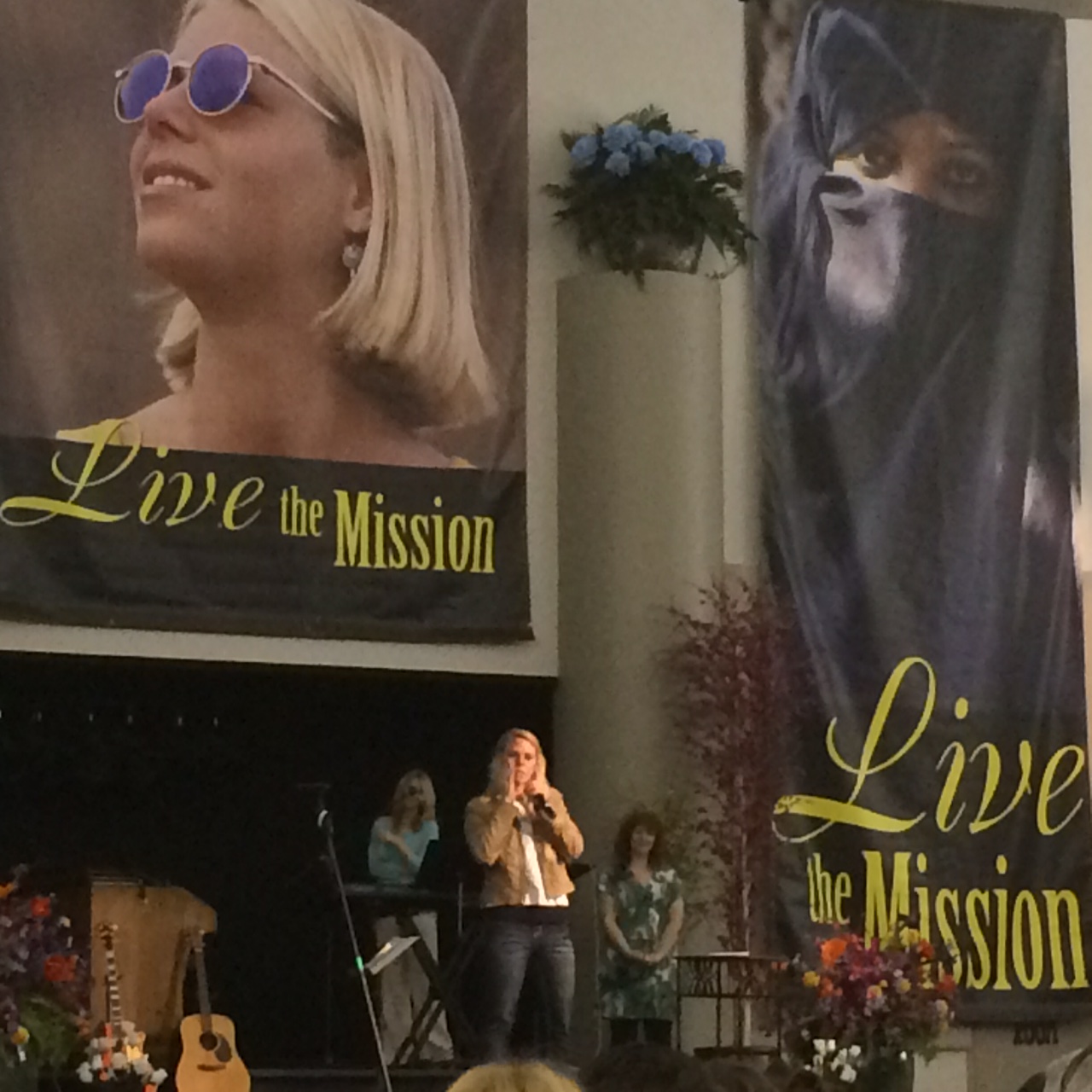
For the record, a man preached on Sunday, and another man lead worship.
But this picture represents a moment of hope for me. Because it shows women in leadership. And because it articulates a vision for partnership between men and women.
“Lord, get us to the point where pictures like this become normal in our congregations! Amen.”
Changing Tide
 As a campus minister with InterVarsity, I’m always curious about shifting trends in higher education. And when it’s about gender trends, even better. So this article caught my eye this morning.
It turns out that women are beginning to significantly outnumber men on university campuses around the world.
From the piece:
Girls’ educational dominance persists after school. Until a few decades ago men were in a clear majority at university almost everywhere (see chart below), particularly in advanced courses and in science and engineering. But as higher education has boomed worldwide, women’s enrolment has increased almost twice as fast as men’s. In the OECD (a French think tank) women now make up 56% of students enrolled, up from 46% in 1985. By 2025 that may rise to 58%.
Here’s what it looks like visually:

Among other things, this changing reality underscores the importance of conversations about power, partnership and reconciliation on campus.
It’s also points to a looming crisis. We’re going to need more men on campus! This quote from the article struck me: “In just a couple of generations, one gender gap has closed, only for another to open up.”
And, of course, it will be fascinating to see what happens in the broader culture as more and more women graduate and begin to seek vocational avenues where they can put into practice what they learned on campus.
On Quotas and Monocultures
 Maybe you’ve heard of the Rooney Rule.
Named after former Pittsburgh Steelers owner Dan Rooney, a noted advocate for diversity, the Rooney Rule “requires National Football League teams to interview minority candidates for head coaching and senior football operation jobs.” By and large, the consensus is that the Rooney Rule has been only partially successful; as a result, revisions are being considered.
Basically, the Rooney Rule is a form of a quota.
To be honest, I don’t like the idea of quotas. To me, something feels off about the whole notion of such things, and I think it’s this:
Our need for quotas reflects the presence of biased and broken systems.
Why do we need a Rooney Rule? Because something about how the NFL coach selection system is constructed can’t seem to give potential minority football coaches a fair shot. And because the system is slanted, we need quotas to offer a correction.
Basically, quotas exist because equality doesn’t. Or can’t. And that bugs me. It offends my sensibilities.
In fact, something about needing quotas violates my understanding about how the world, as created by God in Genesis 1:27 and affirmed by Paul in texts like Galatians 3:28, is supposed to work. You see, I think God set the world up in such a way that quotas should be fundamentally unnecessary.
Simply put, in an ideal world, we just wouldn’t need quotas.
And I wish that were the case, because it would mean that everyone had a fair and equal shot.
And so I read this article with interest last week. It chronicles the German Parliament’s decision to establish a gender-based quota for Board of Directors seats in large companies, to the extent that 30% of Board seats would have to be held by women or else remain vacant.
Let’s put aside my immediate reaction of “well, why not 50%?!?” Because, evidently, 30% would represent a pretty drastic change. From the article:
“The executive boards of the 200 largest companies in Germany remain a male monoculture,” according to the study by the German Institute for Economic Research (DIW). “Only around 4 percent of the 906 executive board positions [are] filled by women.”
Clearly, Germany has a long way to go to get to a place where quotas won’t be necessary. But here’s the hope, expressed by Germany’s family minister Manuela Schwesig:
“A change in culture has started. Simply the debate surrounding the law has triggered a rethinking process in society, in the industry and in the public sector.”
A change in culture in this area sounds good to me. And may it be so, in Germany and in other countries, including our own. Someday, may the playing field be so level that artificial assistance is no longer needed.
Until then, it seems to me that a quota like this is better than nothing.
RE-Post The Thankful List
 Yesterday was the International Women’s Day, or #IWD2015 for the cool kids. In honor of the day, I thought I would re-post a list of women that I am thankful for. First published in November of 2012, this list offers a glimpse of some of the women that God has used in my life. I was then, and am now, deeply grateful for each one of them!
In my 40 years on this planet, I’ve been blessed to be shaped by many amazing men and women, but on this Thanksgiving morning, I want to specifically acknowledge a few of the women that have formed who I am.
Nina Dixon and Betty Hughes, my grandmothers. There they are, flanking that handsome junior high devil there in the picture, with Betty on the left. When in 2 Timothy 1:5 Paul reminds Timothy of his faith tradition that begins with his grandmother, I really resonate. Betty, my maternal grandmother, came to faith later in life and showed us how to press into Jesus through some really difficult life circumstances. Nina, my paternal grandmother, taught her family the value of being steadfast in prayer.
Ann Dixon, my mom. Really it’s tough to narrow down what I’ve learned from my mom. For sure the list includes generosity, service and perseverance in suffering. Also, I first learned the importance of Kingdom hospitality watching my mom bless the foster kids and international students that we hosted in our home as I was growing up.
Una Lucey, my staff mentor. I’m the campus minister I am because Una signed up for a mentoring role in my life way back in my junior year of college. My 16+ years of fruitful ministry are Una’s as well.
Pat Sexton, my mother-in law. Steadfast, resilient, generous and hopeful. That’s Pat. Plus, she always has my favorite cereal on hand when we come visit!
Dr. Carolyn Stefanco, my college professor and adviser. Dr. Stefanconurtured in me both a love for writing and a concern for gender issues. In particular, she guided me through my senior project, a study on this amazing woman.
Ruth Haley Barton, author. If you are in ministry and you haven’t read Barton’s Strengthening the Soul of Your Leadership, do so now. Kingdom leadership does not have to lead to burnout!
The Bleeding Woman, from Mark 5:24-34. This unnamed woman has been a companion on my spiritual journey, especially as I have sought Jesus for healing in my life. I love her risk-filled faith, first expressed as she pressed through the crowd to touch Jesus’ cloak but then taken to another level when she came forward publicly in response to Jesus’ question.
Enisa Dedic, General Secretary of the Bosnian IFES movement. What do you do if God calls you to lead a ministry that doesn’t yet exist? You say “yes,” you pray a lot, and then you start it from scratch! Enisa is a woman of courage and perseverance. I love planting new things, and Enisa’s example has inspired that passion in me.
Tina Loveridge, co-worker. I work with an amazing group of women, and Tina is one of them. In particular, Tina has become a partner as I’ve started to think about gender issues in the church. From Tina I’ve learned how to advocate, and she’s opened my eyes to the global injustices that women endure.
And last but in no way least…
Amy Dixon, the amazing soul who married me. 15+ years ago Amy took on this crazy and I’ve been learning ever since. If I’m more patient, less moody, more loving, less angry and more/less a million other things, it’s because God has used Amy to shape me, in word and by example.
What about you? Which women are you thankful for this morning?
More Thoughts on Humor from the Pulpit
 Remember my Junia Project post about gender-based humor in the pulpit? It still blows my mind that almost 17,000 people have read the piece.
But one thing that has been weird about the process has been having no idea about outcomes. In other words, I know a lot of people have had their eyes on the post, but what is the fruit of that? Are pastors telling fewer offensive jokes? Are churches talking about these things? Are our churches becoming more thoughtful about issues of gender?
I sure hope so.
In light of this, one particular post caught my eye this morning. It’s a blogger using my post as a launching pad to think more broadly about humor in the pulpit. Yes, let’s do humor well in our sermons!
I’m quoting his piece below, but please read the full post in context here.
Humor is a must for good preaching. It disarms, engages and reinforces a good preacher’s points. But only good humor. What do I mean by “good humor” (insert ice cream joke here)?
Humor that clarifies (rather than confuses)
I love wordplay. I enjoy humor that makes me think. But some humor can be so “sophisticated” (or obtuse) as to confuse or—even worse—make the listener feel stupid, which is always a failed attempt at humor. Inside jokes (that only someone in your denomination or someone who’s been around your church for a while would understand) almost always confuse rather than clarify.
Humor that builds bridges (rather than burning them)
This is why self-deprecating humor is the best. It helps people identify with you. It helps them like you. And, at its best, helps them laugh at themselves because they are a little bit like you.
Humor that unites (rather than dividing)
I once used a metaphor in a message, saying that something was as “rare as a Baptist in a liquor store.” I thought it was a safe reference, as most people could appreciate that Baptists don’t (or shouldn’t) frequent liquor stores. But one woman in the room took offense at the mental image of a Baptist in a liquor store. Upon reflection, I had to admit she was right. I wasn’t a Baptist; she was (though attending my church … perhaps until that moment).
Humor that respects (rather than ridicules)
This is another reason self-deprecating humor works. However, even when telling stories on ourselves, there is a limit. “Good” humor in a sermon is that which doesn’t ridicule or disrespect anyone—including the preacher, if he or she is the butt of the joke.
Humor that makes the point (rather than the joke) the point
In both of the sermons I heard yesterday, I took notes. And I didn’t note the humor, I recorded the excellent points—and supporting scripture and ringing statements—the preacher made. As the Junia Project blog post said, if people talk about your humor on the drive home or around the dinner table, your humor failed; you want them to talk about the life-changing truth you shared, not the momentary laugh they enjoyed.
Words Per Minute
Last Friday night, I had the opportunity to speak on the topic of sex to a group of students from Fresno State University and Fresno City College. The goal was to articulate God’s creative vision for sex from Genesis 1 and 2.
One of the things that struck me from the experience was how engaged students were. They were with me the entire talk. I find this every time I speak on gender, sexuality and other similar topics. To me this reflects a hunger in students to talk about things that are important, and it also exposes the historic (and tragic) silence about topics like these in our families and in our faith communities.
I started the talk with a warning. I said, “you’re going to have to get used to me saying the word ‘sex’ often tonight. It may seem like I’m getting paid a quarter each time I use it, but I assure you I’m not.”
As I walked off the stage, one student held up his iPhone. He had spent the 35 minutes I was speaking tallying the number. Any guesses?

If you picked 123, you win a prize!
 Challenging Tertullian