Hope From Piplantri
 Evil sucks.
As someone who has run a marathon or two, it’s certainly been a difficult week. The marathon bombing is tragic on so many levels. And, while there is hope in the stories of survivors and heroic responders alike, make no mistake about it, evil won that day.
For too long, evil has won more than its share of days when it comes to the treatment of women in the country of India. You’ve probably heard the headlines, of women gang-raped on buses, of short-term “contract marriages,” and of women unable to succeed due to deeply entrenched cultural patterns of male privilege.
Evil sucks, but evil doesn’t always win.
Consider the village of Piplantri in northwestern India. The people of Piplantri are pushing against the tide of privilege that’s expressed in the abandonment of unwanted girl babies. Here’s the story:
For the last several years, Piplantri village panchayat has been saving girl children and increasing the green cover in and around it at the same time.
Here, villagers plant 111 trees every time a girl is born and the community ensures these trees survive, attaining fruition as the girls grow up.
Over the last six years, people here have managed to plant over a quarter million trees on the village’s grazing commons- inlcuding neem, sheesham, mango, Amla among others.
On an average 60 girls are born here every year, according to the village’s former sarpanch Shyam Sundar Paliwal, who was instrumental in starting this initiative in the memory of his daughter Kiran, who died a few years ago.
In about half these cases, parents are reluctant to accept the girl children, he says.
Such families are identified by a village committee comprising the village school principal along with panchayat and Anganwadi members.
Rs. 21,000 is collected from the village residents and Rs.10,000 from the girl’s father and this sum of Rs. 31,000 is made into a fixed deposit for the girl, with a maturity period of 20 years.
But here’s the best part.
“We make these parents sign an affidavit promising that they would not marry her off before the legal age, send her to school regularly and take care of the trees planted in her name,” says Mr. Paliwal.
It’s poetic, right? Instead of abandonment, there is celebration. Instead of an forgotten child, trees are planted. Instead of evil, there is a commitment to the communal good.
In the aftermath of the Boston heartbreak, a meme of Mr. Rogers has been making the rounds on facebook. It’s a shot of Mr. Rogers accompanied by one of his quotes:
“When I was a boy and I would see scary things in the news, my mother would say to me, “Look for the helpers. You will always find people who are helping.”
It’s a good word. Thank God for the helpers, for the brave men and women of Boston, and, a half a world away, for the counter-cultural people of Piplantri.
What about you? How can you help someone today?
What About Princ-ess Charming?!?
 Don’t get me wrong, we certainly have princesses here in the Dixon house.
After all, with three little girls growing up in a princess-ized world, it’d be tough to avoid the phenomenon. And so it’s not out of the ordinary to have Belle, Cinderella and Snow White bounding around the house yearning for their hoped-for salvation at the hands of some mythical prince. Around here, sometimes the princesses need their heroes.
The question is: Is this a good thing?
I’ve thought a lot about this, and here’s where I’ve landed:
There’s nothing fundamentally wrong with the princess narrative. You know, the captured princess, pining away for her virtuous and brave savior. As a story, Prince Charming, he’s not so bad.
But what is bad is only telling that one story. Or with over-emphasizing that story. Or with setting that story up as the ideal.
Prince Charming, you’re not the only show in town.
Several readers sent me a link to this story, about a new line of shirts from the folks at Disney. Rather than recap the story, I want to share a screen shot:

The message here is pretty clear. Disney is letting our kids know that boys are heroes and girls are not. In the process, Disney is reinforcing the presence of privilege.
Tertullian would tell my kids that Disney is right and that the princess narrative is the only the only true gender story, that a girls’ lot in life is to be the saved, the protected, the pursued.
Because of this, around our house, we’ve realized that it’s up to Amy and I to tell different stories, or at least to tell additional ones. Stories where women are the heroines. Stories where women are tough. Stories where women save others. Stories about women that Jesus values, stories like these.
I’ve been enjoying Sheryl Sandberg’s new book Lean In. In her first chapter, Sandberg describes what she calls the “leadership ambition gap,” a term that describes how men are more eager for influence than women. She writes:
“Professional ambition is expected of men but is optional–or worse, sometimes even a negative–for women. ‘She is very ambitious’ is not a compliment in our culture…Men are continually applauded for being ambitious and powerful and successful, but women who display these same traits often pay a social penalty. Female accomplishments come at a cost.”
So, listen up Princess. Sometimes Prince Charming will indeed come save you, but sometimes he’ll need you to save him as well. And as that time comes:
Be a heroine.
Baby Steps
 Change is hard. That’s true when you’re talking about starting an exercise program, controlling your temper, working on a relationship, or, as I well know, wrangling your adorable children into picking up after themselves.
And it’s certainly true when it comes to rethinking a system. What I mean is that cultural systems are so vast, complex and embedded that they defy easy answers.
After all, how do you change something that just is?
So when it comes to overturning the unequal system of male privilege, the watch word must be baby steps. Baby steps are small yet significant. They are real and purposeful. At the risk of being a bit cliche, I’ll quote Chinese philosopher Lao-tzu:
“A journey of a thousand miles begins with a single step.”
For the guys in our seminar two weeks ago, baby steps include grieving the reality of an unjust patriarchal system, learning the stories of their female peers, displacing themselves and learning from women pastors and looking around them to understand the privilege they enjoy.
Baby steps. But vital ones.
This week two stories caught my eyes, two stories that may indicate that some baby steps are being taken. I say “may” because sometimes only time tells whether baby steps will lead to change.
First, the new pope made news for stressing the “fundamental” value of women in the church. In particular, he noted the presence of women as witnesses in the resurrection narrative. Here’s how one theologian interpreted the effect of his words in this article:
“The fact that the Pope acknowledges that the progressive removal of female figures from the tradition of the resurrection … is due to human judgments, distant from those of God…introduces a decidedly new element compared to the previous papacy.”
Staying in the world of religion, there were potential baby steps in the Mormon faith this past week, as Jean Stevens offered the closing prayer for the recent LDS general conference. According to this article, it was the first time that a woman has prayed in that important gathering.
Here’s hoping that these baby steps combine with others to produce wholesale change in these contexts.
And here’s also hoping that the baby steps we all take now will get us a thousand miles down the road one day.
That Sound You Hear is a Paradigm Shifting…
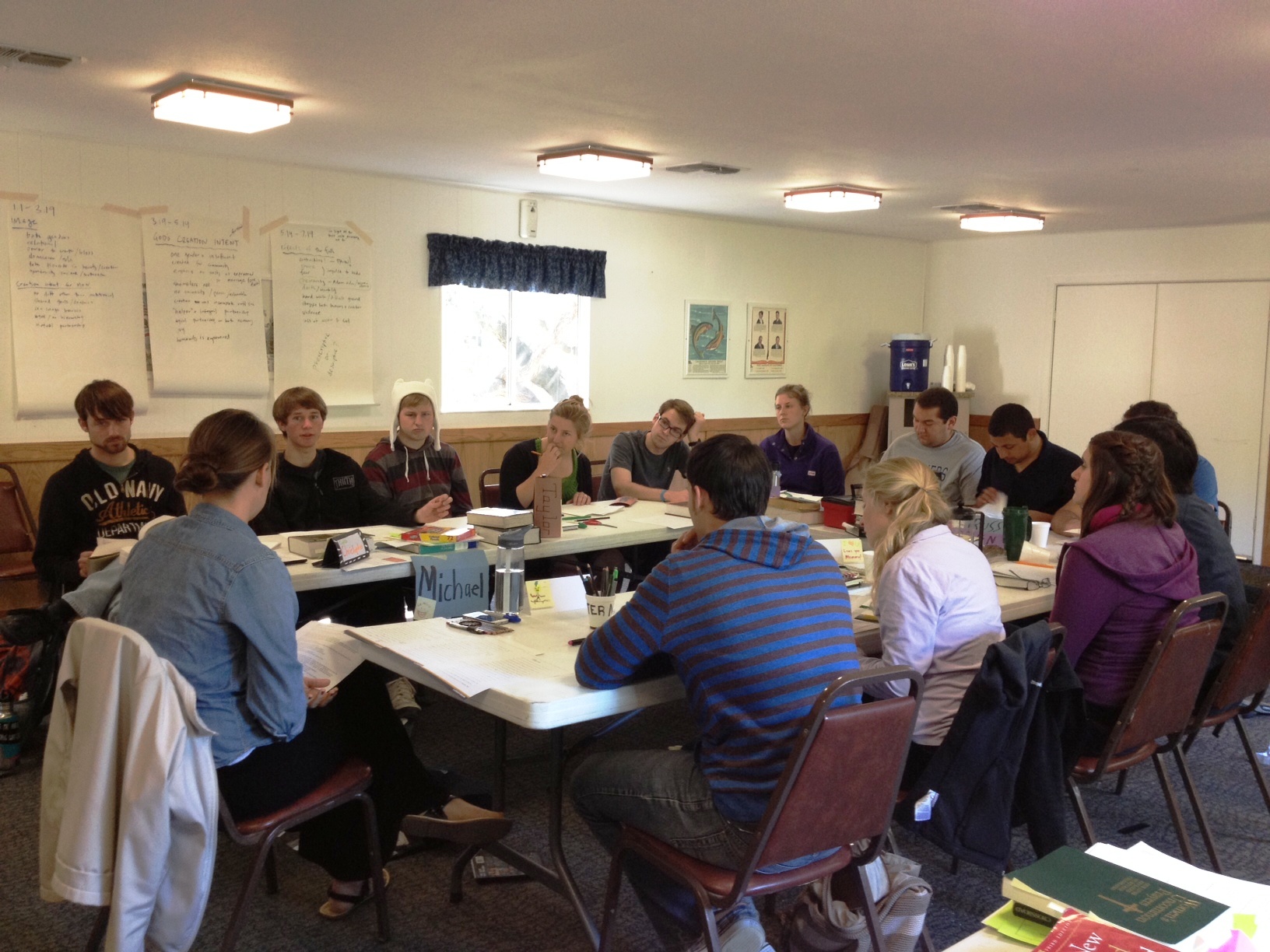
 Two weeks ago now, together with a friend and staff partner, I had the privilege of leading 14 college students through a week-long seminar entitled “Women in the Bible.”
Our main goal was to help students explore the Scriptures in order to understand God’s intent for the relationship between the genders. Along the way we hoped to see students experience healing, equipping and, of course, a shift in their preconceived paradigms.
By and large, mission(s) accomplished.
In particular, for many of the men in the room the week was an opportunity to have their theology challenged. Like Tertullian, these men have been breathing the air of male privilege long enough to have their worldviews firmly pegged with patriarchy as their default setting. So praise God with me that after last week they are on a different journey.
Two of the men are poets, and with their permission I’m going to share their pieces. Read and enjoy the sound, the sound of a paradigm shifting.
Here’s Darren’s piece:
Disconnect
A chasm? A Valley? A Wall?
Yes a Wall
Firm and smooth
Cold and calculated
Strong…Perfected by years of patient building
Piece By Piece
Formed to fit me tight and close.
Familiar…But there are cracks
They are small now
Reminders of past failures in design
Weakness…Spider-webbed like glass struck with a blunt object
But these walls are not naturalI didn’t start out this way
I was taught to build
Taught to be strong
Strong for my family
Strong for my friends
Strong for my job
Strong to provide
I was taught by the men around meBut these walls muffle the world around me
I hear it
It is faint
An echo of the true sound
The sound of waves that crash against my walls
The waves of injustice, of women’s plight, of passing of family members,
The cries of shame
The echo’s of the true sound
Rich and vibrant
But the walls whisper of calm and peace
These walls are strong.
I should know I built themBut my heart is stirred by the echo’s
They vibrate at the same frequency
So my heart flutters
But no matter how much it is magnified it is still small
Dampened by the walls themselvesWhy did I build these walls?
To support others?…
Sounds good
To protect myself?…
Sadly more likely
But my heart’s flutters hint at a design flaw.
These walls are permanent …
Built to withstand brute force and slow erosion
What now?Darren Roan
One mans attempt to describe
the emotional barriers
he feels sometimes
And you’ll find Jason’s here.
My Most Important Posts
 This is officially post #52. Let’s have a party!
Because I’ve been regularly posting twice a week, this post marks a full 6 months of challenging Tertullian. I’m realizing that 6 months is no slouch when it comes to blogging.
According to a 2008 New York Times article, 95% of blogs ultimately get abandoned. And, according to this article, 60-80% of them get abandoned in the first month. When you consider that there are now over 181 million blogs worldwide, that’s a lot of cyber-carnage!
Here at Tertullian, it’s so far, so good.
To mark this milestone, I thought I would offer a top 5 list. Not counting the initial post, these are the 5 posts that I consider to be my most important. What does “most important” mean? I’m not exactly sure. Maybe they’re the ones I’m proudest of. Or maybe they’re the ones I think you need to read. Or maybe I just think I did a good job with the writing.
However it is that they came to be–in my view–important, enjoy the list!
“About that Time I got Called a False Teacher…” (10/18/12): This post, my 4th ever, makes the list because I continue to see the sentiment behind it–the idea that you hold convictions with humility–as fundamental to how we engage around this conversation. When Jesus-loving and well-meaning Christians disagree, it’s critical that we figure out a way to stay at the table and be civil. Too much discourse just doesn’t go this way.
“In Our House as Well” (11/26/12): After spending two whole months examining male privilege in the broader culture, with this post I turned the microscope on the church. I remember that pushing the “publish” button felt scary with this one, like it was the proverbial point of no return. Here was my main point: “Male privilege is firmly and tragically entrenched in the offices and pulpits of the American church.” See what I mean?
“Christmas and Power” (12/24/12): This journey of reckoning with male privilege has me thinking a lot about power: who has power, what are they doing with it and how power can be better distributed. Looking at the Christmas story through the lens of power was a significant revelation for me last Christmas. If Jesus so freely gives away power, how can I not?
“On Really Respecting Someone” (2/4/13): There I was, just minding my own business and posting on how Jesus related with the women of his day, when the internet floodgates broke wide open. That day I got 464 views, for me a record, which goes to show that I really have no idea which posts are going to strike a chord and which ones won’t.
“Will You Join in My Crusade?” (3/11/13): This post was conceived in anger. Really. In my 6 months with Tertullian, I’ve been sort of “reluctantly OK” with posts gaining a wider audience; with this one, I wanted the post to go viral. It did pretty well, and I’m proud of it, but I’d be OK if more people read it. Please feel free to pass it on.
There you go, my 5 most important posts. Now here’s to another 6 months duking it out with Tertullian!
What about you? Which posts have been important to you?
The Social Dimension of Easter
 Yesterday churches around the world celebrated the most pivotal event in human history, the resurrection of Jesus from the dead. It’s the resurrection that brings life, hope and the promise of eternity. It’s miraculous and glorious, unprecedented and unparalleled.
As our pastor put it, “after Easter, death is dead.”
And I’m sure millions of lives were changed yesterday. According to a 2010 Barna Group survey, some 40 million Americans pledge to invite a non-believing friend to church for Easter Sunday. If even a tithe of that number follow through, that’s quite an attendance surge. And no doubt, many of those new attendees leave closer to Jesus.
For this I rejoice.
And yet I’m also bothered by how we do Easter. Because if I’m honest, I think we only get Easter partially right. And here’s the part we miss:
There’s a social dimension to Easter.
What I mean is that while the resurrection does create a way for an individual to come back to God, it also creates a way for individuals to come back, well, to one another. Indeed, resurrection power reconciles us to God, and it also reconciles us to others.
Here’s how the apostle Paul puts it in Galatians 3:23-29:
23 Now before faith came, we were imprisoned and guarded under the law until faith would be revealed. 24 Therefore the law was our disciplinarian until Christ came, so that we might be justified by faith. 25 But now that faith has come, we are no longer subject to a disciplinarian, 26 for in Christ Jesus you are all children of God through faith. 27 As many of you as were baptized into Christ have clothed yourselves with Christ. 28 There is no longer Jew or Greek, there is no longer slave or free, there is no longer male and female; for all of you are one in Christ Jesus. 29 And if you belong to Christ, then you are Abraham’s offspring,heirs according to the promise.
Over the years, some commentators have only seen a vertical reality to this passage. The thinking goes that Paul is saying that when it comes to salvation, God sees no difference.
The problem with this reading of the text is that it’s incomplete, that it fails to properly acknowledge that in the passage Paul chooses to use the three primary social divisions of his day: race, class and gender. It’s a rhetorical choice that brings with it horizontal implications to go along with the vertical.
Walter Hansen is a New Testament scholar at Fuller Seminary, and here’s how he interprets this text:
“the new vertical relationship with God results in a new horizontal relationship with one another. All racial, economic and gender barriers and all other inequalities are removed in Christ. The equality and unity of all in Christ are not an addition, a tangent or an optional application of the gospel. They are part of the essence of the gospel.”
At church this weekend, the kids learned the bridge diagram. I’ve used the bridge diagram for years. Indeed (and Hallelujah!), Easter helps humanity cross back to God.
But let’s not miss the fact that Easter also helps humanity cross back to one another. Spiritually speaking, the resurrection removes sin’s social consequences and replaces them with wholeness and reconciliation. And when it comes to the genders, there’s no room for male privilege when men and women are “one in Christ Jesus.” Join me in saying “hallelujah” for this as well!
Perhaps it’s time for a new diagram?
Prophetic Picture?
 Well, we’re in the thick of it now!
Our “Women in the Bible” seminar has been profound. Together we’ve journeyed from Genesis to Judges to John to 1 Timothy. We’ve explored egalitarianism, complementarianism and like 5 other -isms. On Tuesday we went head to head with patriarchy. Our students are learning about roles, rules and the cultural misrepresentation of women. God has been present in the a-ha moments and in the tense times when nothing seems clear.
Through it all, there’s a sense that these are exactly the kind of conversations that the church desperately needs to have.
And so I’m grateful.
As a teacher/leader, I’ve been processing lots of things as well. My paradigms have been challenged. I’ve been asked questions for which I have no answers. And, let’s face it, a week of coming face to face with people’s pain, anger and fear will wear anyone out!
But one particular thing that God has had for me this week is something I’ve blogged about before:
For me this stuff is deeply personal.
Of course I mean that as I guy who is cares about these issues. But today I mean it more as a dad of three girls. Because for me to talk about how male privilege binds, inhibits and oppresses women is to look at my three girls and partially understand, and therefore grieve for, what lies ahead of them.
So all the more reason for seminars like this one. All the more reason for creating contexts to dialogue about the Bible. And all the more reason to have the hard conversations, face our fears and seek the Lord together for an end to privilege. Because, in the end:
We need a church where both men and women can flourish.
We need that as a church. I need that for my kids.
So if someday she’s been called by God to use her teaching gifts to draw a crowd of men and women into deeper, more reconciled fellowship with God and with one another, somebody remember to roll out this prophetic picture:

This Stuff Matters
 This week, Tertullian and I are taking our show on the road. Together with a good friend and co-worker, I’m teaching a week long seminar on the topic of “Women in the Bible.” 14 college students will be taking the plunge with us.
So this week we’ll be opening the Scriptures, watching some videos and reading some articles. Along the way we’ll have some intense conversations I’m sure. All with the goal of helping these students think through what the Bible has to say about women in general, and the relationship between men and women in particular.
Last night we started by having a time to articulate our questions. And after listening to their questions, let there be no doubt:
This stuff matters.
Here’s the list of the questions that our students are bringing into the seminar this week:
Is there a hierarchy of gender in God’s eyes?
Why are men represented more than women in the Bible?
What exactly are the roles that each gender has in the church, in ministry and in the home?
Why is there God the Father only, if both men and women are made in God’s image?
How do men and women work together peacefully?
What are some common problems between men and women in ministry?
How do we figure out what is from God and what is influenced by culture?
Why don’t churches discuss this topic?
Simple, huh? Now to seek some answers! If you’re the praying type, we’d appreciate them! And I’ll give an update in the Thursday post.
It’s All About the Mission
 Note: OK, we’re back to the Trinity! In this short series, we’ve had 4 different posts (here, here, here and here) that explore the relationship between a trinitarian understanding of God and the relationship between the genders.
Let’s be clear about something: the Trinity doesn’t exist without a purpose. That is, God, Jesus and Holy Spirit aren’t eternally bound together in intimate fellowship just for the sake of themselves. After all,
We’re not talking about some never-ending cosmic tea party here.
Instead, the God of the Bible very much has a purpose, and that purpose is reconciling all things: reconciling people to God, reconciling people to people, reconciling people to their environment and more. The trinitarian God craves a reconciled relationship with all creation.
So the Trinity is on a mission. I appreciate how Darrell Johnson puts it in Experiencing the Trinity, as he uses the disciple-making mandate of the Great Commission to bind together the Trinity and mission:
“We should not be surprised that the New Testament writers speak in this way. Jesus said ‘Go, make disciples, baptizing them in the name of the Father, and of the Son and of the Holy Spirit.’ By Jesus’ own definition the Christian life is a relationship with one whose name is three-fold. To be a disciple is to be immersed into, and with, the three-foldness of the living God.”
Friends, as we model male/female relationships on the missional reality of the Trinity, we must do so with an understanding that reconciliation happens UNTO the mission of God. In other words, reconciliation isn’t the goal. Neither is the elimination of male privilege.
Instead, the goal is the expansion of the mission of God.
And so as much as I want it to be so, the leveling of the gender playing field is not the end. It’s more the means to a greater end, the end being God’s Kingdom coming, on earth as in heaven. So today I want to offer three thoughts on how eliminating privilege and reconciling the genders expands the mission of God:
1. They reveal the nature of God. Equal Kingdom partnerships between women and men point the way to the triune God. In fact, they show what God is all about. What better way, then, to demonstrate the Trinity than men and women living out relationships marked by equality and interdependence, particularly in a world captured by an epidemic of gender inequity?
2. They testify to the power of God. By and large, our world affirms Billy Crystal’s mantra from When Harry Met Sally that “men and women can’t be friends, because the sex part always gets in the way.” Really? What if in the Kingdom we tapped into the power of God in such a way that men and women really could become friends? Not only friends, but good friends even? Heck, maybe, just maybe, by God’s power, men and women could be equal ministry partners! Imagine the testimony that would be to a world so desperately in need of God’s power.
3. When men and women are partnering well together, we can get more done. For centuries, the church has effectively been doing ministry with half the team sitting on the bench. Imagine what we could get done if we released the full arsenal of God’s ministerial resources! In 2 Peter 3:9, the apostle Peter reminds us that our God is “not wanting anyone to perish, but everyone to come to repentance.”
As a gender-reconciled church, I suggest it’s time we get to work.
Green Beer and Gender Advocacy
 Yesterday the world celebrated the life of St. Patrick. If you celebrated like we did in our house, you did so by dodging pinches and devising a complex and borderline inhumane leprechaun trap. But, I digress…
You’ve probably never heard of Eamon Gilmore, but he is Ireland’s #2 politician. He serves as the country’s deputy prime minister and foreign minister. Basically, the brother does a lot of ministering!
Eamon Gilmore was in the news this week for refusing to attend Savannah, Georgia’s St. Patrick’s day celebration. Why? Because there was an event that was only open to men. Here’s what Gilmore had to say:
“Count me out – I’m not doing it,” Gilmore told an Irish newspaper. “I don’t believe in segregation either on a gender basis or on any other basis.”
Good on you Eamon. Way to live up to your patron saints’ example.
By all accounts, St. Patrick is a person worth emulating. Kidnapped as a teenage boy from Britain and taken to Ireland, Patrick spent six years as a shepherd and learned Irish language and culture. At some point, he managed to escape and he returned home to his family.
Then, as the story goes, he was called by God to return to Ireland. Here’s his account of that moment:
“I saw a man coming, as it were from Ireland. His name was Victoricus, and he carried many letters, and he gave me one of them. I read the heading: “The Voice of the Irish”. As I began the letter, I imagined in that moment that I heard the voice of those very people who were near the wood of Foclut, which is beside the western sea—and they cried out, as with one voice: ‘We appeal to you, holy servant boy, to come and walk among us.'”
And so Patrick went. And, through him, Christianity came to the Irish.
In his book How the Irish Saved Civilization, Thomas Cahill describes Patrick’s ministry this way:
“In becoming an Irishman, Patrick wedded his world to theirs, his faith to their life…Patrick found a way of swimming down to the depths of the Irish psyche and warming and transforming Irish imagination – making it more humane and more noble while keeping it Irish.”
One particular aspect of Patrick’s story worth noting is his positive treatment of women. In her post about Patrick, Anita McSorley describes it this way:
“Women find a great advocate in Patrick….Patrick’s Confession speaks of women as individuals. Cahill points out, for example, Patrick’s account of “a blessed woman, Irish by birth, noble, extraordinarily beautiful—a true adult—whom I baptized.” Elsewhere, he lauds the strength and courage of Irish women: ‘But it is the women kept in slavery who suffer the most—and who keep their spirits up despite the menacing and terrorizing they must endure. The Lord gives grace to his many handmaids; and though they are forbidden to do so, they follow him with backbone.’ He is actually the first male Christian since Jesus, Cahill says, to speak well of women.”
These things may not seem like much, but let’s not forget that Patrick would have been a contemporary with Augustine. You know Augustine, a man who, in the middle of saying lots of amazing things about the faith, also laid several misogynistic rhetorical eggs such as:
“I don’t see what sort of help woman was created to provide man with, if one excludes the purpose of procreation. If woman was not given to man for help in bearing children, for what help could she be? To till the earth together? If help were needed for that, man would have been a better help for man. The same goes for comfort in solitude. How much more pleasure is it for life and conversation when two friends live together than when a man and a woman cohabitate?” (De genesi ad litteram, 9, 5-9)
So, on this morning after St. Patrick’s, I’m raising a glass of green beer to two men who advocated for women. Eamon and Patrick, well done!
 Challenging Tertullian