Over the Line
 Lester B. Pearson, former Canadian Prime Minister and winner of the 1957 Nobel Peace Prize, once said, “Politics is the skilled use of blunt objects.”
To be sure, politics is a rough and tumble business. And yet there are times when lines get crossed.
This is one of those times.
In the last number of years, women have made gains in the political world, a world historically dominated by male privilege. For instance, in the most recent election cycle, we had Michelle Bachman running on the Republican side. And, in the cycle before that, it was Hillary Clinton running for the Democrats and Sarah Palin for the Republicans. Despite what Tertullian might say, viable female candidates running on national tickets has been a welcome change.
But it hasn’t come easy.
Because unlike most male candidates (New Jersey Governor Chris Christie as one notable exception), female political candidates consistently have to weather commentary about more than their political views. Indeed, for women running in today’s political landscape, their dress, their body shape and their hairstyle are tragically fair game for everyone from political pundits to gossip columnists.
Now, as the electorate anticipates the 2016 presidential campaign, the speculation is heating up about about whether Hillary Clinton will make another run. Unfortunately, so too is the male privilege-driven hate machine.
The other day, I noticed this article about a button on offer at a recent Republican convention in Southern California. Here’s a picture tweeted by the San Francisco Chronicle’s Carla Marinucci:

Disgusting right? Yes.
The good news is that according to Marinucci, the GOP tracked down the vendor who was selling the button and removed it.
The bad news is that people think like this at all. That in 2013, women seeking office still have contend with this kind of blatantly offensive propaganda. That in today’s political landscape, the blunt objects include this brand of toxic personal attacks.
Politics is a rough and tumble business. But it shouldn’t be sexist as well.
Happy Birthday CT!
 Sometime midday on October 7, 2012, I did one last proofread, took a deep breath, uttered one final fervent supplication to the Almighty…and launched Challenging Tertullian.
And in my first post, I wrote the following:
“With this blog, I want to challenge Tertullian. Or, more to the point, I want to challenge the system of male privilege. I want to think about it, understand it and then discern how Jesus would have me respond to it. And I invite you to join me.”
One year into this adventure, let me share a couple of reflections.
First, I think I’ve done a pretty thorough job expositing male privilege. What I mean is that I’ve offered plenty of examples of male privilege in action in our culture and in American church culture in particular. A quick look at my dashboard reminds me that “Gimme Some Examples…” category is by far my biggest category. Looking around the blogosphere, I don’t see many people (other than Ryan Gosling) who are trying to call this stuff out. So I’m glad to be serving in this way.
Next, I think I’ve been less helpful offering solutions. Faithful readers will remember my three-fold rubric–Admit, Submit and Commit. Basically, I think I’ve given you good material for the “Admit” step, but I’ve been more sparse with the other two. As Challenging Tertullian rounds the corner on year one and heads boldly into year two, I’d like to balance out this ledger a bit.
Finally, you’ve joined me, but I’d love to have you join me more! Blogging faithfully twice a week has been an interesting enterprise, one thats been simultaneously natural and awkward. Natural, because I remain convinced that I am supposed to be thinking, writing and leading in this area. Simply put, to have fidelity to what God has called me to, I have to take the risk to challenge Tertullian, and this blog is one way I can do that.
And yet it’s also been awkward, because when you blog, you send something out into the world and you know not where (or to whom) it goes. It’s very weird. So, I send off a post and hope it hits the mark somewhere and with someone. All of this makes comments so key. Thanks to those of you who have commented here and on facebook. Please keep them coming. In fact, I’d love it if you’d take a second to comment on this post and let me know what you’ve been learning this year on CT.
Thanks everyone! And here’s to another year of challenging Mr. Tertullian!
A Reflection on Hebrews 11
 The “Hall of Faith” passage in the book of Hebrews is a wonderful text. Pillars of faith to be emulated. Leaders who sought God in the midst of difficult circumstances. Flawed individuals who proved to be faithful in spite of their brokenness.
Basically, Hebrews 11 is the Bible’s Mount Rushmore.
Ah, Mount Rushmore. It’s a stunning sight. Four of the nation’s greatest leaders chiseled in stone for all to see and be inspired.
This week, I had some time to reflect on the passage in Hebrews 11, and it was a beautiful sight to see women listed among the Old Testament’s faithful. As I’ve blogged about before, considering the extreme marginalization that women in Bible times endured, the mention of even a few women in Hebrews 11 is noteworthy.
Of course I have read Hebrews 11 before, many times. But if you had asked me to recall the names on the list, I would really only have been able to produce names like Noah, Abraham, Moses and David. Like I said, Mount Rushmore.
So, to set the record straight, let me introduce you to the women of Hebrews 11 (sounds like a Jeopardy category, right?!?). There are three of them.
First, there’s Sarah, a woman who ultimately demonstrated a steadfast faith in God’s miraculous promise to deliver an heir from her barren womb. And of course her faith was rewarded, as eventually Sarah become the mother of many nations.
The next woman in the narrative is Moses’ unnamed mother, who together with Moses’ father, gets praised for being unafraid to disobey the king’s command. By being faithful in not killing their son, they partner with God in raising up a leader for the Israelite people, one who will go on to lead them out of bondage to the promised land.
Finally, we have Rahab, the prostitute. Yep, a prostitute makes the Hebrews 11 list of people whose faith we should emulate. Specifically, Rahab gets praised for giving a friendly welcome to the Jericho spies. As a result of her faith, she, along with the spies, survived the city’s demise.
I love how the passage ends, actually with the first verses of Hebrews 12:
“Therefore, since we are surrounded by such a great cloud of witnesses, let us throw off everything that hinders and the sin that so easily entangles. And let us run with perseverance the race marked out for us, fixing our eyes on Jesus, the pioneer and perfecter of faith. For the joy set before him he endured the cross,scorning its shame, and sat down at the right hand of the throne of God. Consider him who endured such opposition from sinners, so that you will not grow weary and lose heart.”
Friends, when the chips are down, and when sin threatens to hold us back, the writer of Hebrews instructs us–commands us–to run toward Jesus. But the beautiful news of this text is that we needn’t run in a vacuum. Because there is this cloud of witnesses spurring us on, spiritual mentors that God has given us, models of faithful living to cling to when our faith runs out, a Mount Rushmore of faith to look to and be strengthened.
And unlike the American Mount Rushmore, the Bible’s version includes sisters as well as brothers.
Tertullian Here and Abroad
 I’ve never been to Saudi Arabia, but if I went, I guarantee you that I’d be thankful that I’m a man.
Because in Saudi Arabia, being a woman is a tough go. Male privilege is overt and in your face. Constantly. To demonstrate, I noticed that Saudi Arabia was in the news twice this week regarding gender issues.
First, there was this little gem from a Saudi cleric by the name of Sheikh Saleh al-Luhaydan. Evidently, in Saudi Arabia, it is illegal for a woman to drive. To drive.
Commenting on the eve of a planned day civil disobedience, where women were going to choose to drive as an act of protest, the Sheikh said this:
“(the) physiological impact (of driving) on women…could affect her ovaries and push the pelvis higher as a result of which their children are born with clinical disorders of varying degrees.”
That’s right ladies. Don’t drive; you could damage your ovaries.
The bad news? Influential Saudi clerics both think like this, and, more importantly, they teach it to their parishioners. The good news? The Sheikh is facing some degree of condemnation and mockery. I say let him have it.
And then there was this news, about how a major Saudi IT company, one with some American ties, was opening an all-female business center that one day will employ 3,000 Saudi women. Great news, right?
Sort of.
Read this quote, and let it grieve your soul:
“It’s hard for women in Saudi Arabia to find good work. For many businesses, cultural norms and strict gender segregation make hiring women seem like more trouble than its worth. Banks, factories and other companies have to create separate sections for their female employees, separate entrances, and in many cases they have to install women’s bathrooms. Even then, any workplace where women interact with men outside their family can become highly controversial. (Earlier this year, the kingdom’s religious officials issued a fatwah against women working as grocery cashiers.)”
Does that kind of segregation sound familiar?!?
What do we make of all of this? I have two reflections on the juxtaposition of male privilege in Saudi Arabia versus male privilege here at home.
One, let’s be thankful that in this country we do not, for the most part, face the brand of overt sexism and male privilege that is tragically on display around the world, and in Saudi Arabia in particular. In our country, only the most ardent sexist fringe would call for driving restrictions or segregated building entrances. Mercifully, in our culture, Tertullian is generally not as overt as that.
And yet here’s the thing. Tertullian does exist here. He’s quieter, but he’s no less insidious. Because male privilege is hidden or embedded in the systems and structures of our culture, it’s tougher to pin down. And so, by and large, both women and men suffer at the hands of something we’re unable to find and confront.
To illustrate, I think the contrast goes like this. In Saudia Arabia, Tertullian tells women straight up they cannot drive. He shouts it from the rooftops and he’s found a way to write it into the law. By contrast, in our country, when we get cut off on the freeway, Tertullian whispers this in our ears:
“Stupid women drivers…”
Tragic.
Friends, whether you can see him or not, Tertullian has to be stopped.
Choosing to Hope for the Church
 I am someone who is ever trying to love the church.
I mean, if I’m honest, I can lean toward throwing the church under the bus, as the source of too much pain for too long to too many people. As a poor reflection of its leader. And as the ultimate tragic symbol of unfulfilled promise.
Because of this, a verse like Matthew 16:18 really presses me. To Peter, Jesus says,
“And I tell you that you are Peter, and on this rock I will build my church,and the gates of Hades will not overcome it.”
A church so strong that hell itself can’t touch it. One hand-built by Jesus and therefore about God’s purposes on the earth. Victorious. Untouchable.
Now that’s a vision for the church that I can get behind!
Still, as I think about the church, I muddle back and forth, between hope and cynicism, between possibility and despair.
This has been a difficult week with regard to the church and issues of race. On Monday, megachurch pastor Rick Warren posted an image that was racially insensitive at best and blatantly offensive at worst. After the outcry, and after tragically defending his post for hours, he deleted the thread. If you’d like to engage the issues, I recommend this post by Kathy Khang. Kathy is someone whose perspective I really respect.
Anyhow, as the social media world blew up in response to Warren’s gaffe, I wondered this:
Instead of causing pain in the area of race, shouldn’t the church of Christ be leading the way in facilitating healing? After all, aren’t we the church of Galatians 3:26-29?
“So in Christ Jesus you are all children of God through faith, for all of you who were baptized into Christ have clothed yourselves with Christ. There is neither Jew nor Gentile, neither slave nor free, nor is there male and female, for you are all one in Christ Jesus. If you belong to Christ, then you are Abraham’s seed, and heirs according to the promise.”
In this case, as with race, so too with gender.
Too many people associate the church with gender pain. With prohibition. With restriction. With abuse. With hypocrisy.
This week I started dabbling with Nadia Bolz-Weber’s provocative memoir Pastrix. About her experience in the church, she writes,
“Precociousness gave way to sarcasm as my ability to analyze the doctrine and social dynamics at church developed. The moment I was able to recognize the difference between what people said (all sex outside of heterosexual marriage is forbidden) and what they did (clandestine affairs with each other) and the difference between what they taught (women were inferior and subordinate to men) and the reality I experienced in the world (then why am I smarter than my Sunday school teacher?), I know that I had to get out. I was a strong, smart and smart-mouthed girl, and the church I was raised in had no place for that kind of thing even though they loved me.”
Shouldn’t it be that for women, the church of Christ is leading the way in promoting healing, peace, reconciliation and empowerment?
According to Laura Turner, it sure should. In her Christianity Today article “The Christian F-Word,” Turner challenges the church to agree with what she calls the core teaching of feminism, namely the equal standing of men and women. In the end, she conculdes:
“Christianity is most alive in us when we are alive in Jesus. And Jesus is most alive when the shackles of oppression are loosed, when there is no male nor female, because we are all one in Christ Jesus.”
May this vision for our church come to pass.
So with a deep breath, today I choose hope. More to the point, today I choose to believe that Jesus is enough to steer God’s church in a way that brings grace not pain, to people suffering from racial brokenness or gender brokenness or both.
Please join me in praying for Jesus’ church today.
In Good Company?
Evidently, this whole challenging Tertullian thing is becoming all the rage. Thanks to our friend (and family photographer) Tina for sending me this picture of actor Ryan Gosling:
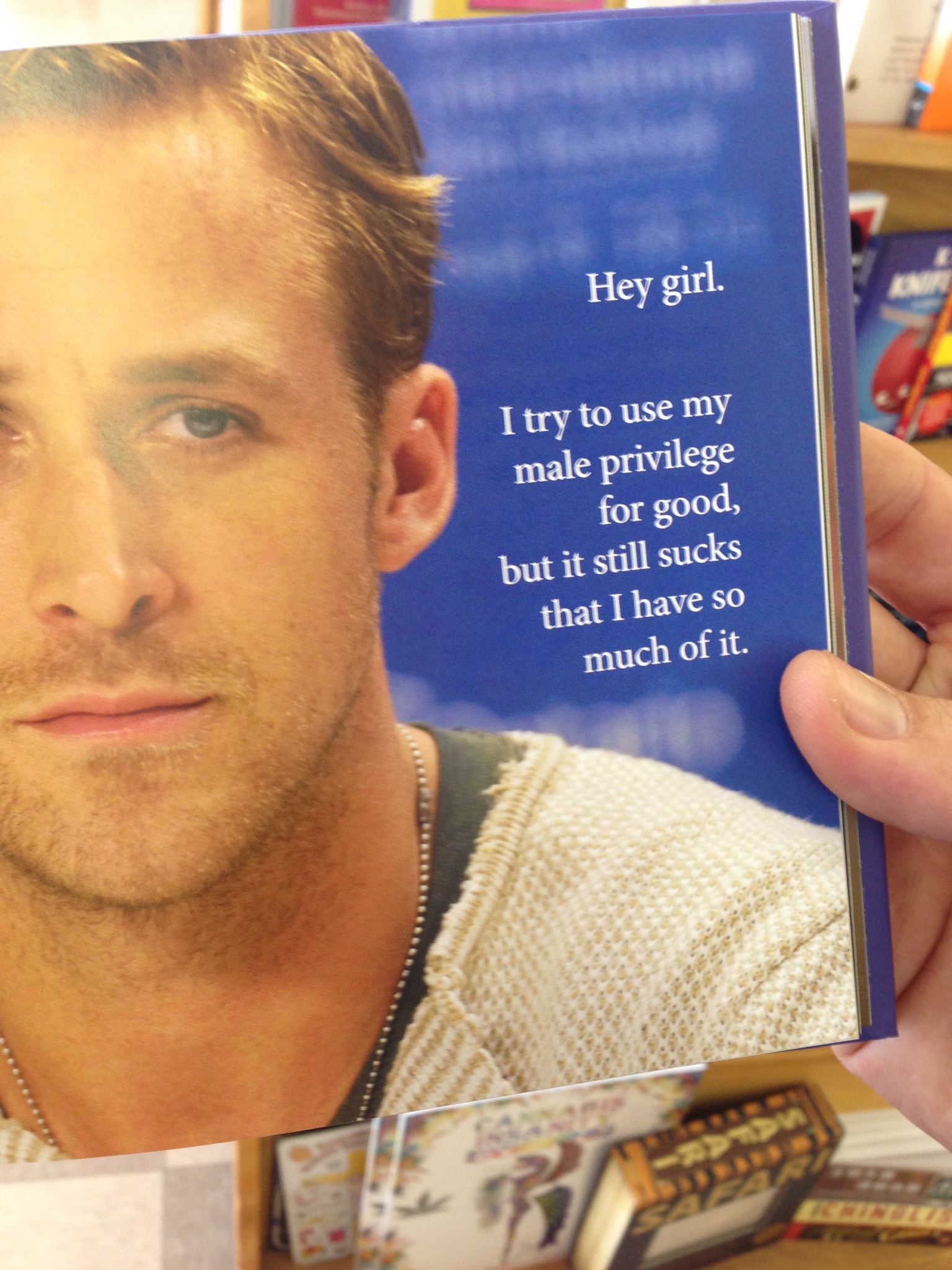
Good to know that plundering male privilege is just one more thing that Ryan and I have in common…
For more shots of the pro-women Ryan Gosling, go to the tumblr page here. Or, the above picture comes from the book version here.
You want the Dodger score, you get…cleavage.
 Our family is a sports family.
For one thing, we play sports. Mom and Dad are runners. Our son and oldest daughter race cross country and play soccer. That same daughter is right now in a basketball program. Our two younger daughters are also on soccer teams. That’s right, on any given weeknight, you’re liable to find us shuttling from a cross country course to a practice soccer pitch to a sweaty gym with bathroom and water breaks in between.
But wait, there’s more…
In our family, we also coach sports. This year Mom started a 100 Mile Club at our elementary school. As such, she’s spending the year inspiring, rallying and cajoling dozens of kids through their quest to run 100 miles by year-end. On top of that, both Mom and Dad are coaching soccer teams. So, to bookend our weekdays, you can find us starting our day at school before the bell helping kids run laps and the finishing our day trying to wrangle a bunch of little girls into soccer players.
Hold on. There’s still more…
Because our family is also a sports watching family. In person and on TV. In fact, when it comes to TV, Dad is pretty well addicted. If someone’s competing and we get the channel, I’m predisposed to watch it. Especially if it’s English soccer. And particularly if Manchester United is playing.
So you can imagine my joy this year when our son caught the sports watching bug. In fact, he’s become a rabid sports fan. Honestly, it’s made us closer, and I cherish that. When asked the other day at school what his favorite TV show was, he answered, of course, “SportsCenter.”
So last night, when we went online to check the score of the Dodger game, imagine my chagrin and frustration when I saw this:

Now I’m no fool. I realize how the system works. ESPN signs on advertisers in order to generate revenue. On top of that, I also know that certain ads appeal to certain target groups. And, yes, it makes sense that sports fans are also Grand Theft Auto V game fans, and that the way to their wallets is through massive, cartoonish cleavage.
It makes sense, but that doesn’t make it right. After all, I want to talk to my boy about baseball, not boobs. I want us to check out the scores, not a woman’s chest. And when I go to ESPN, I want to help my son learn about the games I love, not our culture’s obsession with objectifying women.
Honestly, its exhausting to continue to have this conversation. Yet have it we shall. Because, in the end, our family is more than a sports family.
We’re also a family who stands for what’s right.
Patriarchy, Matriarchy, Schmpatriarchy…
 Not all of my readers are American, of course. In fact, my blog stats tell the story of periodic visitors from 57 countries in total. So, shout outs to those of you reading in Myanmar, Peru and Morocco!
Still, most of you are from the States, and, as a result, you know only a world marked by male privilege. Put another way, you and I have been breathing the air of patriarchy for a long time.
So much so that we have a hard time seeing it.
But here’s the thing…not every culture operates this way.
Meet the Mosuo, a group of people in southern China who operate in a matriarchal system. That’s right, in Mosuo culture the women are in charge. Thanks for my friend Caroline for sending along this article, that tells the story of Argentine writer Ricardo Coler’s visit to the Mosuo. What he found is striking. It’s also more than a bit disturbing.
For instance, according to Coler, the Mosuo’s matriarchal system has a whole different take on authority. He writes:
“I had expected to find an inverse patriarchy. But the life of the Mosuo has absolutely nothing to do with that. Women have a different way of dominating. When women rule, it’s part of their work. They like it when everything functions and the family is doing well. Amassing wealth or earning lots of money doesn’t cross their minds. Capital accumulation seems to be a male thing.”
I’m not sure if I agree that getting rich is only a “male thing,” but there’s something compelling about this picture of leadership. It feels communal and empowering. In fact, elsewhere in the article, Coler notes that the matriarchs absolutely abhor violence and will do almost anything to avoid it. Imagine if American culture operated like that.
On the other hand, there appears to be a fair degree of, well, gender funk in Mosuo culture.
Most distrublingly, the matriarchs endorse a free sex, low commitment culture. Coler notes that sometimes a woman will get pregnant and have no idea who the father is, such is the prevalence of promiscuity in the culture.
But perhaps more significantly, Mosuo’s matriarchs appear to have little respect for their men. Men get treated like little boys, they are only sporadically involved in the decision making, and there is little clarity about the role of a father. In fact, Mosuo’s matriarchal culture reminds me in some ways of American patriarchal culture:
The out-of-power gender gets the short end of the stick.
Sometimes people ask me what the end goal is. They want to know what I think should replace male privilege as our cultural norm. After reading about the Mosuo, I feel comfortable saying that it’s probably not matriarchy.
In the end, I want to live a world where neither patriarchy or matriarchy wins the day. I want a third option, a world marked by collaborative partnership, power-sharing, and mutual, joyful submission.
An Unwanted Conversation
 Recently, our daughter had a question for my wife:
“Mom, when will I be allowed to dress sexy?”
It’s a devastating question. Because little girls shouldn’t want to dress “sexy.” Heck, because little girls shouldn’t even know the word “sexy.” And, most of all, because our daughter is so young.
In fact, she just turned 9.
As it turned out, our little girl has no idea of what dressing sexy actually means. For her “sexy” is more of a synonym for “grown up.” You see, in her mind, she’s ready for the earrings, the heels, the straps and the skirts. She wants to look like the girls she sees on TV.
And, for the most part, the girls on TV dress to impress the boys on TV.
In her article “A Grown-Up, Not Sexed-Up, View of Womanhood,” writer Tish Harrison Warren explores the question of whether the church can provide an alternative paradigm to the one that suggests that female adulthood is equated with romantic or sexual availability.
Clarifying the dominant cultural model of womanhood she writes, “In order to be seen as an empowered adult in our contemporary society, we can’t just be mature sexual beings; we must be sexually available. As females, we often demonstrate adulthood by using our sexuality in ways that invite, in fact that practically beg for, the male gaze. It is a sort of post-sexual revolution version of the debutante coming out.”
As I said in a recent post on “Mileygate,” “for the most part, in Tertullian’s reductionistic world, when it comes to sexuality men are there to be serviced. It’s our privilege.” It’s tragic, and, too often, so is the church’s response.
Warren’s diagnosis reads as follows: “The church…must offer another way to attest to our adult womanhood. If we do not, when we encourage young women to remain chaste and value modesty, it will inadvertently be a message of juvenilization–to remain good “little girls.” In order for celibate adults to be acknowledged as adults in evangelical churches, our understanding of adulthood needs to be clarified and decoupled from sexual activity or marital status.”
Simply put, the church right now has no category for unmarried women who are too old for youth groups. After all, not every women will one day be married; as my friend Steph helpfully noted this week, it’s more of an “if” than a “when.” So what’s the alternative?!?
Warren sees a confirmation rite as one way to celebrate a girl’s transition to womanhood. She writes, “Unlike baptism, confirmation is not a sacrament and does not have the theological import thereof. But if we want our young women to feel valued, welcomed into adulthood, and affirmed as strong, independent women without having to reject modesty and chastity or twerk with Robin Thicke, then we need meaningful, communal rites of passage. Maybe celebrating confirmation like we mean it is a step in that direction.”
In the end, I’m not sure if some sort of initiation rite will suffice. We need wholesale culture change.
We need the kind of change that tells women and girls that their identity is in Jesus, not in men and boys. We need the kind of change that affirms women of all ages for who they are, not who they could someday become. We need the kind of change that empowers women and girls with a vision for who they can become in Jesus’ church.
Closer to home, most of all, we need God’s grace to parent our kids the best that we can.
Low Hanging Fruit
 Every once in awhile, some knucklehead does or says something that unambiguously illustrates the reality of male privilege. It’s sort of low hanging blogging fruit for me.
The other day I noticed this story, about some yahoos out of Texas who created a truck decal that depicts a bound and tied woman. Evidently this thing is so real that people have seen it and called the police. Here’s a screenshot:
 Sadly, the reaction has been mixed. On one hand, there has been an onslaught of negative response. I’m glad to know that. On the other hand, business is up, proving the adage that any publicity is good publicity…
Asked about it, the company owner said this:
“I wasn’t expecting the reactions that we got, nor was it really anything we certainly condone or anything else,” Hornet Signs owner Brad Kolb told KWTX. “But it was just something…we had to put out there to see who notices it.”
Gag me.
The truth is that you knew exactly what you were doing and you are getting the publicity you want. Who wouldn’t notice a life-sized, realistic image of a woman held captive in the back of a pick-up?
And, further, by printing and publicizing it, you are, in my estimation, condoning it. And that’s wrong. Violence against women is a real issue that should not be glorified on a truck decal.
Can we agree that it’s time for this crap to end? Honestly, we have enough trouble dealing with the hard-to-find fruit that’s hidden high up in the male privilege tree.
Let’s be done with the overt, low-hanging fruit as well.
 Challenging Tertullian