Thoughts on Dealing with Friction in the Church
 I love the word “kerfluffle.”
It’s an underused but interesting word, meaning “row or disturbance.” For me kerfluffle is sort of a hard word to say. Go ahead, try it out loud. See? In a way, it audibly represents the difficulties we often experience during conflict.
Two days ago, a bit of a kerfluffle erupted in the twitterverse, involving author/blogger Rachel Held Evans and Todd Rhoades, organizer of “The Nines,” a popular online church leadership conference backed by Leadership Network.
It began with Evans pointing out, on twitter, that of the 110 speakers featured at “The Nines,” only 4 were women.
Stop right there. 4 out of 110 is flat out ridiculous. It’s shameful. If you ever doubt that today’s version of Christendom bears Tertullian’s fingerprints, let this serve as a stark reminder. We’ve got to do better! Surely a conference with this kind of stature could field a speaking roster that is greater than 3.6% women?!?
But then the kerfluffle got worse as the tweeting continued. Take a look at Rachel Held Evans’ storify rendering here. For me the worst of the lot came from Rhoades, when he tweeted this:
“A female leader adds new perspective on important female specific topics such as pregnancy, abortion, and marriage.”
Huh? What’s going on here? Is this a joke? I mean, it’s difficult to read tone online, and when you’re dealing with twitter’s 140 character limit, it’s even tougher. But what does Rhoades mean? And does he really think this? In her storify retelling, Evans calls Rhoades’ tone “patronizing.” I’m tempted to call it ignorant at best, sexist at worst.
But maybe we should give him the benefit of the doubt. Yesterday, in this piece on CT, Rhoades defended the conference, blaming topic choice and an above average decline rate from female invitees for the lack of women on the roster. He wrote:
“We don’t pick speakers based on quotas, but we realize the importance. We’ve tried to do better, we need to do better, but we also don’t want to be misrepresented [as being against women leaders].”
If that’s the goal, there’s clearly work to be done.
Yesterday, I read this post, from Jonathan Merritt at Religion News Service. Following the online kerfluffle, Merritt did an informal online survey of the major Christian leadership conferences, looking at plenary speaker gender proportions. The result? Only 159 out of 805 plenary speakers at the top 34 major Christian leadership conferences were women. Merritt writes:
“By my count, that’s around 19% female speaker representation at these major Christian conferences–presumably better than it was even a few years ago, but still lower than it should be. While I don’t think we can conclude that the Christian conference industry is downright sexist, we can say that most conferences have some serious work to do if they want their stage to look anything like the 21st century church.”
Amen.
And this brings us to yesterday’s blog post from Evans. It’s perhaps my favorite piece she’s ever written. In the post, she laments how she’s experienced being slapped with the label “divisive” when she attempts to call the church to greater inclusiveness for women. In the post, she calls the church to become a place where we can have a frank, honest and, yes, public debate about these things:
“Maybe friction isn’t a sign of decay, but of growth. The world is certainly watching. But this doesn’t mean we hide our dirty laundry, slap on mechanical smiles, and gloss over all the injustices and abuses, conflicts and disagreements, diversity and denominationalism present within the Church; it means we expose them. It means we talk about them boldly and with integrity, with passion and with love. I suspect that talking about our differences is better for our witness than supressing them, and I’m sure that exposing corruption and abuse is better for our witness than hiding them.”
In our marriage, Amy and I don’t fight much. Praise the Lord for that! But when we do, in most cases we are not opposed to arguing in front of our kids. Why? Because at the end of the day, we’d rather teach them to fight fair and well, as opposed to not fighting at all. We want to give them good models for dealing with conflict instead of teaching them that it doesn’t exist.
That’s what we need in the church. How great would it be if the world saw us wrestle honestly and fairly with issues like these, as opposed to sweeping them under the rug? What if the world saw us debate with grace and truth?
In fact, what if we showed the world how to thoughtfully and peacefully handle a kerfluffle?
2 Reasons Why I’m Coaching Girls Soccer
 When I started, it was mostly about need.
As in, my daughters’ team of under 8 girls needed a coach, and I needed some venue to express my love of all things soccer. Somewhere along the way, need morphed into, well, a calling of sorts. Like, I feel called to coach soccer. Even more to the point…
I feel called to coach girls soccer.
There are more than this, but here are two key reasons why:
First, I see coaching these girls as a way to make a tiny dent in the largely anti-female culture of American (and global) sports. I’ve blogged about sports culture before (here, here and here), but in case you need a reminder, we live in a world where boneheaded talk radio jocks say things like this:
“I enjoy many of the women’s contributions to sports — well that’s a lie. I can’t even pretend that’s true. There are very few — a small handful — of women who are any good at this at all. That’s the truth. The amount of women talking in sports to the amount of women who have something to say is one of the most disproportionate ratios I’ve ever seen in my freakin’ life. But here’s a message for all of them … All of this, all of this world of sports, especially the sport of football, has a setting. It’s set to men… It’s a man’s world.”
I wish this sentiment was an aberration, but I’m afraid it’s not. And while we rarely experience sports as this overtly and verbally sexist, Tertullian is still there, lurking in the shadows. Recently I read this article, about a group of elite women cyclists and their supporters, who are seeking to create a Tour de France for women. The litany of legal, financial and attitudinal barriers they are facing is staggering and depressing.
So, by choosing to coach girls, perhaps I can punch a small hole in a long-established male-favored sports culture.
Second, coaching the girls gives me an opportunity to try to be a healthy male role model. To be sure, I don’t know the full stories of each of the girls on my team, but I know enough to know that many of them could use a positive and encouraging male role model in their lives. And, sure, I’m only with them 3 hours a week, but I am acutely aware that I when I am, I have an opportunity to bless and encourage them, in a way that they might not get consistently at home.
That’s right, what I’m saying is that soccer coaching can be ministry.
Both of these reasons–culture shaping and role modeling–are ways that I’m trying to leverage my male privilege to bless others. In the overall scheme of things, there are small, almost token acts.
And yet, at the end of the day, I don’t live in the overall scheme.
I live in my neighborhood, with these girls and their families, coaching and playing soccer.
Women at War
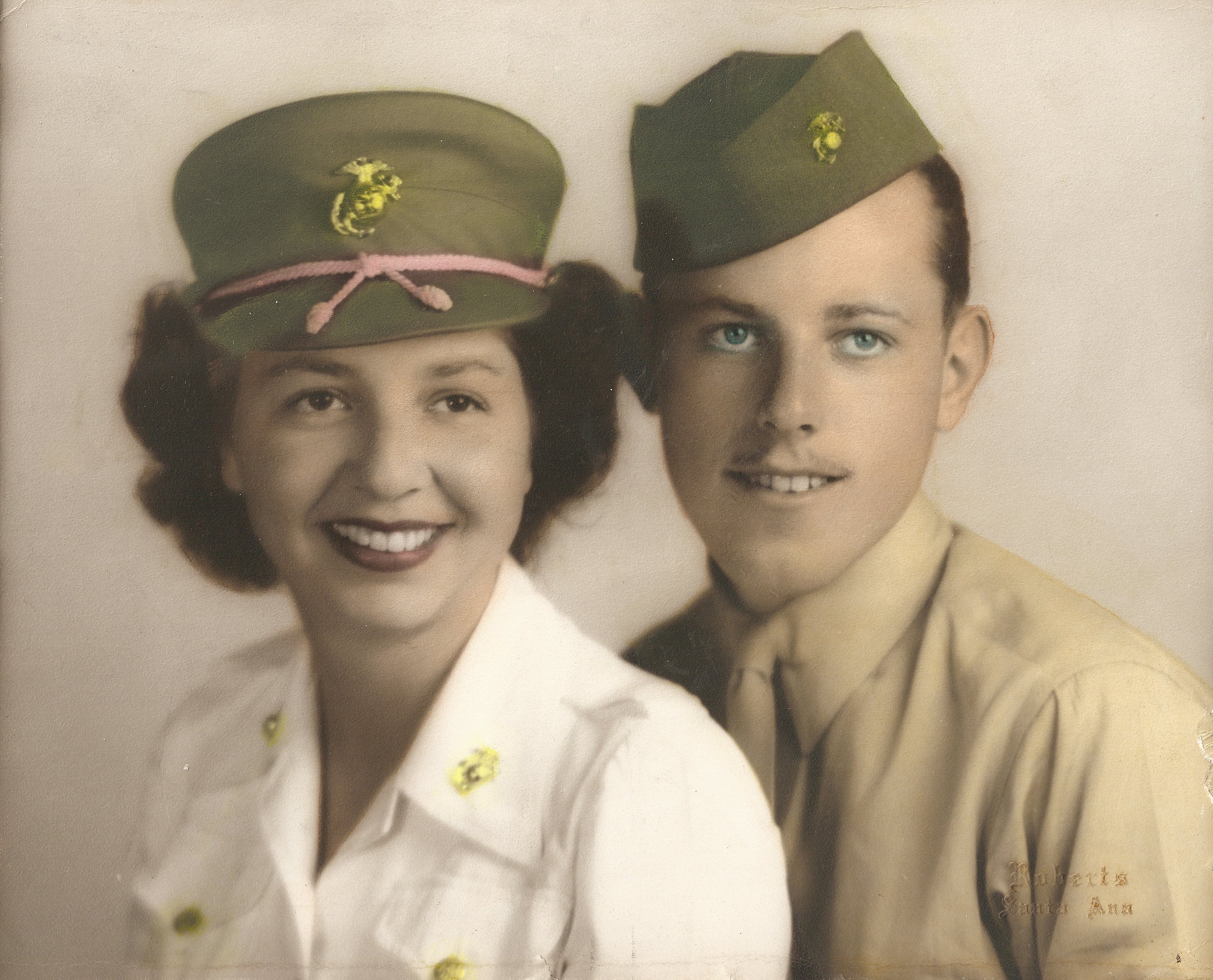
My Grammy was a proud Marine.
I mean, of all the amazing things she did in her life, serving her country as a U.S. Marine was right at the top of the list. Grammy enlisted on August 2, 1943, and family lore says that she was the first enlisted female Marine from the state of New York. She went through Basic Training at Parris Island, SC and, later, she graduated from the Corps’ Motor Transport School.
Assigned to serve at the Marine Corps Air Station El Toro in Orange County, CA, she worked as a truck driver and dispatcher. One day, she met my grandfather, an aircraft mechanic who saw action on Guadalcanal and the Solomons, at a street corner on post. In the end, she was discharged in 1945, after she became pregnant with my mom.
A good buddy of mine is in Washington D.C. this week, and today he sent me the following picture. It’s taken at the World War II memorial on the national mall, and it commemorates and honors the military service of women. In fact, it reminds us that it wasn’t just men that sacrificed and served.

It’s fitting to get this just days before Veteran’s Day, a day where honor the men and women who have served our country.
Last year, I saw the memorial in person, and I know my Grammy would have been proud.
As I am of her.
A Phrase I’m Ready to Be Done With
 Admittedly, when it comes to gender exclusive language, I’m a bit, ah, sensitive.
As I’ve said before, I’m ready for our culture (and our church) to progress when it comes to the words we use with regard to gender. You know what I’m talking about, the gender exclusive terms that unfortunately litter our rhetorical arsenals. Perhaps the most common example would be using words like “man” or “mankind” instead of “people” or “humans.” Words matter, and, in the case of gender exclusive language, they can too often cause damage.
Of all the gender exclusive words, terms and phrases that we use, there’s one that’s really starting to bug me:
“You’re the man.”
Maybe it’s just me, but I feel like I’ve been hearing this little gem a lot lately. Like when I’m watching a tournament and a golfer tees off to the sound of someone in the crowd yelling, “you’re the man!” Or when someone posts a picture on facebook of their son doing something good and some commenter chimes in with a, “he’s the man.” Or when the pastor preaches a whale of a sermon and the overheard comment on the patio afterward goes something like “wow, pastor was the man this morning.”
It sucks. And here’s why:
It equates success, victory, achievement and accomplishment with being male.
And that’s a problem for women. Because what it says is that if you have the wrong chromosomes, then you’re out of luck. In the “you’re the man” framework, women are sequestered to the realm of the inferior. They are the contrast, the other. And it’s a one way street. After all, no one’s saying “You’re the woman!” when an LPGA golfer stripes it down the middle.
But it’s also a problem for men. Because there’s a dark side to male privilege. Continually having to embody the gold standard of human accomplishment can be exhausting. It can be stressful. Because it’s unrealistic, and it’s painful when you don’t measure up.
So…what to do? Allow me to propose a couple of alternatives:
First, if you insist on using the term “You’re the man!” to affirm the good works of the men in your life, balance the ledger by using “You’re the woman!” as well. Will it be awkward? No doubt. Maybe it would help to make it a campaign? We could hashtag it at #yourethewomanisjustaslegitasyouretheman
Or, better, what if we all just staring using a hearty “well done” or “good job” when someone does something good?
Regardless of gender.
Halloween Gone Amok
 Make no mistake about it, we Dixons aren’t really Halloween people.
What I mean is that our Halloween enthusiasm level could be called tepid at best. If you’d like to read my wife Amy’s musings on Halloween, you can do so here, but every year we sort of relucantly mark the occasion. Tonight you’ll find us at a friend’s house doing some limited trick or treating on their block, then early to bed.
Of course, in this regard, we Dixons are counter-cultural. Because Halloween is big business, nationally a 6.9 billion dollar business in fact. Locally, I know this because of the overnight proliferation of Halloween shops in the normally vacant storefronts near my house. I also know this because, come October, the elementary school “what costume are you wearing?” chatter increases exponentially every day we get closer to the 31st.
And, for the record, this year in the Dixon house, we’ll have kids dressed up as Leo Messi, a cookie monster, Belle before she became Princess Belle, and then Princess Belle herself.
Collective cost of all the Dixon family Halloween costume paraphernalia? Like $25. Again, we’re not Halloween people.
And after reading this article, you won’t be either.
Evidently, two years ago, some knucklehead produced a Halloween costume called “Anna Rexia.” Yep, you read that right. “Anna Rexia.” The tagline? “You can never be too rich or too thin.”
Because making fun of the estimated 12 million women and girls who suffer from anorexia is a sure-fired Halloween hoot.
Two years ago, a change.org petition helped remove the offensive costume from its online retailer, but this year it came back, peddled by a company called HalloweenParty13.com. Here’s a screen shot:

That’s right folks, plunk down your $39.99 and let the mocking of millions of struggling women and girls begin!
According to one report, “3 in every 100 American women suffers from an eating disorder which is the leading cause of death for girls ages 15-24.”
Shame on a company that glamorizes an illness such as this. Let’s hope that “out of stock” becomes a forever condition for this Halloween travesty.
The Right Way to Think About Privilege
From the folks at “Men and Feminism” here.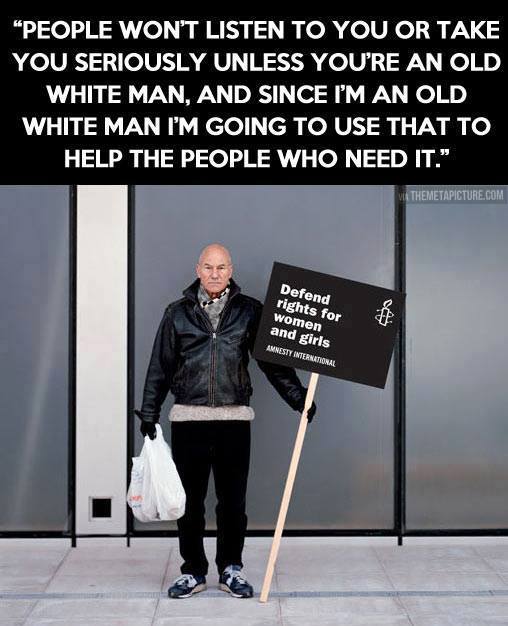
Truth in Advertising?
So you can find Tertullian on google autocorrect, and as we’ve said before, you can find him in the land of advertising.
For instance, the other day on facebook, I noticed this ad:

Because nothing shouts “mortgage rates” like an attractive woman with striking green eyes…
Of course we know what’s going on here. Lendgo wants to promote their services, and, like everyone else, they’d love to woo the right demographic. And, evidently, for Lendgo the “right demographic” are, oh, 25-45 year old available (or not) men.
Ads like this one illustrate that premise that what a company chooses to put forward in their advertisements is designed to capture the attention of the specific constituency they are hoping to attract. I mean, don’t get me started on how World Series games double as 3+ hour opportunities to talk with my kids about erectile dysfunction…
And so I paid attention last week when the latest edition of Christianity Today arrived, complete with a “Special Advertising Section” devoted to seminaries, bible colleges and graduate schools. Just who, I wondered, are America’s Christian graduate institutions hoping to attract?
Could it be…women?
Whether it’s the same line of reasoning as Lendgo’s ad above, or, far better, if it’s because these schools are legitimately trying to attract women, for me there were a surprising number of women featured in the section’s various ads. Here’s the tale of the tape:
By my count, there are 21 schools with ads featured in the section in total (there are other ads in the magazine; I’m just counting the ones in the special advertising section).
3 have no pictures whatsoever in the ad. Seriously? You’re spending all that money on a copy-only ad? Aren’t we catering to a generation who uses instagram?!? #adfail
4 have pictures without people in them, including Baylor University’s, which features a massive dog snout. I was going to make a snarky comment about Baylor’s vision for canine theological equipping, but then I read that they are using the scent receptors in a dog’s nose to help identify cancer in humans. Um, good one Baylor.
8 have pictures of just men, most of them solo and, not surprisingly, the majority of them are white. I think my favorite is Western Seminary’s ad featuring a motorcycle rider–wait for it–with a red colander on his head. Huh? Also, honorable mention goes to Liberty University’s ad featuring none other than Kirk Cameron holding court with three cinematic arts students.
And that leaves 6 ads featuring women. And 5 of those ads have solo women. So props to Moody, Palm Beach Atlantic University, Regent University, Union Presbyterian Seminary, Bethel Seminary and Cairn University for featuring women in their ads. I have no idea what the theological bent is for any of these 6 institutions, but putting women in their ads seems to me like a step in the right direction. If these schools are hoping to attract women, they are putting their ad money where their hopes are.
So, for those of you scoring at home, 29% of the total ads feature women, but that number jumps to 43% when you remove the ads without people.
And when you consider that according to the Association of Theological School’s website, women make up just 34% of the 74K students currently enrolled in the 270 ATS member campuses…
43% starts to look pretty good.
Searching for Tertullian
 Remember when we all had encyclopedias?!?
You know, the 20-whatever volumes of World Book or Britannica fun? Growing up, we had a set and we used them. If we had to search for something for our homework, it was off to the bookshelf to dig it out of the trusty encyclopedia.
Nowadays, encyclopedia sets are archeological relics. In fact, when she was cleaning out her classroom last year, our daughter’s teacher sent kids home with volumes that matched their initials. Hence the lonely “L” volume of the World Book sitting on a shelf somewhere around the house…
Today of course we google. Oh how we google!
In theory, google makes our lives easier. We can look up maps. We can find deals. We can read books. And of course we can search. Google is the postmodern equivalent of the 15 year old me digging through a dusty encyclopedia.
And, with google autocomplete, they’ve made it even easier. You know what I mean. Type in a search term and before you’ve gone very far, you get some options. According to the google autocomplete site,
“The search queries that you see as part of autocomplete are a reflection of the search activity of all web users and the content of web pages indexed by Google.”
In other words, call autocomplete the aggregate of our collective social conscience.
Because of this, what gets autocompleted is pretty revealing. And, in the case of male privilege and sexism in general, it’s downright alarming.
This article exposits what happens when you type in terms about women. I’ll give you an example:

See the problem? And it’s similar for search terms like “women cannot,” “women need to” and “women shouldn’t.”
Curious, I did a similar search for men. For the term “men should,” google came back with:

OK, it’s not exactly a great collection of options for men either, but it’s better than the ones for women.
Most of the time, male privilege lurks in the shadows. In our post-encyclopedia world, leave it to google to bring it out into the light.
Happy Ada Lovelace Day!
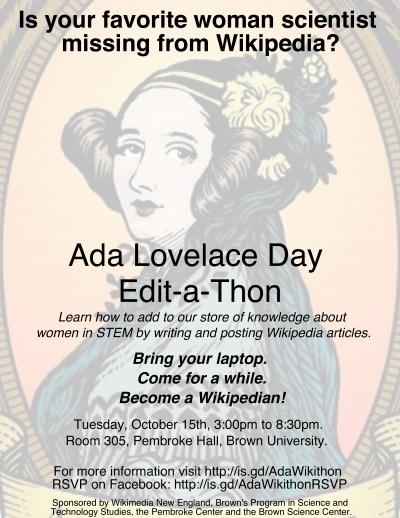 You probably missed it. No, I’m certain you missed it. We all did.
Tuesday was Ada Lovelace Day.
Who’s Ada Lovelace, you ask? Born in 1815, the daughter of English poet Lord Byron and a mathematics-loving mother named Annabella Milbanke, Ada Lovelace was a math prodigy. According to this biography,
“Fearing that Ada would inherit her father’s volatile ‘poetic’ temperament, her mother raised her under a strict regimen of science, logic, and mathematics. Ada herself from childhood had a fascination with machines– designing fanciful boats and steam flying machines, and poring over the diagrams of the new inventions of the Industrial Revolution that filled the scientific magazines of the time.”
Over time, Ada Lovelace found her way into some pretty lofty mathematics and science circles. Ultimately, in 1842, Lovelace wrote what some consider to be the first computer program, when she published an article entitled, “Sketch of the Analytical Engine, with Notes from the Translator.” Because of this, in her time, Lovelace developed quite a reputation. Check out what one of her contemporaries had to say about her:
“Babbage described her as “that Enchantress who has thrown her magical spell around the most abstract of Sciences and has grasped it with a force which few masculine intellects could have exerted over it,” or an another occasion, as “The Enchantress of Numbers”.
“The Enchantress of Numbers.” If you ask me, that’s a pretty sweet nickname.
Every year, Ada Lovelace day celebrates women in the science, technology, math and engineering fields. It won’t surprise you to know that these sectors of culture are owned by Tertullian. After all, according to this article,
“Women software developers earn 80 percent of what men with the same jobs earn. Just 18 percent of computer science degrees are awarded to women, down from 37 percent in 1985. Fewer than 5 percent of venture-backed tech start-ups are founded by women.”
Simply put, we need more Ada Lovelace Days.
For this year’s celebration, Brown University hosted a wiki editing session, where “volunteers could gather to create and expand upon entries about women in science and technology.” Talk about setting the record straight! The story is here.
Recently, my daughter Lucy and I were talking about what she wants to be when she grows up. She blew my mind when she described a job where she could design buildings that were beautiful and safe for people to live and work in. Yep, my 9 year old is trying to decide between being an architect or an engineer.
Either way, I think Ada would approve.
Good Advice
 As I said, I want to be better about offering solutions, ways both large and small, to overcome the problem of male privilege.
So, today let me offer a set of helpful tips from the blog “Tenure, She Wrote.” The post is entitled “Don’t be that Dude: Handy Tips for the Male Academic.” As the title suggests, the advice is written from an academic perspective, so depending on your situation you’d need to do some translating. In addition, it lacks an overtly spiritual perspective. Still, these 20 suggestions are full of intentionality, thoughtfulness and practicality. Here they are in full:
1. Use the appropriate salutations when writing to a woman academic. Don’t call your female professor “Miss” or “Mrs.” Don’t write to a colleague as “Ms.” when you would otherwise say “Dr.” or “Prof.” There is a long history of baggage around names, and I guarantee that most women are sensitive to this. Show that you’re not One of Those Dudes by respecting a woman academic’s titles, at least in the initial greeting.
2. Don’t comment on a woman’s appearance in a professional context. It doesn’t matter what your intentions are; it’s irrelevant. Similarly, don’t tell someone they don’t look like a scientist/professor/academic, that they look too young, or they should smile.
3. Don’t talk over your female colleagues. There is a lot of social conditioning that goes into how men and women communicate differently. You may not realize that you’re doing it, but if you find yourself interrupting women, or speaking over them, stop.
4. Avoid making sexual remarks (or wearing clothing, etc., that is sexually explicit or suggestive), regardless of whether they are about your colleagues.
5. Make sure your department seminars, conference symposia, search committees, and panel discussions have a good gender balance. If you find that someone turns you down, ask them for recommendations for an alternative; don’t give up. Recognize that if there is a minority of women in your program or discipline, they may be disproportionately burdened with invitations to serve on committees or give talks. Be sensitive to this!
6. Pay attention to who organizes the celebrations, gift-giving, or holiday gatherings. Make sure that it’s not disproportionately women in your lab, department, or organization who are the party planners or social organizers. Volunteer to do it yourself, or suggest a man next time.
7. Volunteer when someone asks for a note-taker, coffee-run gopher, or lunch order-taker at your next meeting. Don’t let this task fall to women, even if they tend to volunteer (we’re socially conditioned to do so). Make sure that women aren’t being asked to do this more than men.
8. Don’t refuse to go through doors opened by women, insist on carrying their field equipment, or otherwise reinforce stereotypes that women need special treatment because of our gender. Offer help, and drop it if help is declined.
9. Take an equal share in housework and childcare duties at home. Women (including academics) are often disproportionately burdened with domestic duties relative to their male academic spouses. Figure out if your household is an equal one.
10. During a talk Q&A session, call on women. Be a good moderator, and make sure men aren’t talking over women. In large lectures, use floating mics, rather than mic stands, to encourage women to comment (this works!).
11. Learn about benevolent sexism.
12. Learn what mansplaining is (I’m not going to get into whether this is a good term or not). Guard against it, and be quick to derail it when you see it in others.
13. Learn what the tone argument is. Don’t use it. Don’t dismiss your female colleagues as angry, emotional, or otherwise not deserving of respect because they aren’t adopting what you think is the appropriate tone.
14. Learn how to apologize when someone has called you out for inappropriate behavior.
15. Don’t leave it to women to do the work of increasing diversity. Be proactive, rather than reactive, in your departments and institutions. Speak out about incidents that promote a hostile environment at your school, to your students and your colleagues. If you observe someone doing or saying something sexist, tell them that it’s not okay. Actively support your female colleagues when they experience sexism.
16. Adopt teaching tools and practices that promote gender equity. Pay attention to the example you set for your students.
17. Pay attention to who you invite to informal work-related gatherings. If you’re often going out with members of your lab or department for drinks, make an effort to include women. You may be shutting your colleagues out from research opportunities or the sharing of ideas that happen in informal settings.
18. Make sure you’re aware of the gender biases in scientific journal editorial practices. If you’re an editor, find out what the gender ratio is among your reviewers. Take steps to make it more equal.
19. Know when to listen. Don’t assume you understand what it’s like for women. Don’t interject with “but this happens to men, too!” Don’t try to dismiss or belittle women’s concerns. Remember that women are oftenreacting to a long history of incidents, big and small.
20. Finally, if you do all of the above, don’t expect a cookie. Your efforts may go unacknowledged or even unrecognized much of the time. Keep at it anyway, because you’re not out to get special recognition. You’re doing it because it’s the decent thing to do.
 Challenging Tertullian