Tertullian in the Church
 I’m continuing to enjoy (and be challenged by) Sarah Bessey’s Jesus Feminist. Yesterday, I came across the following description of male privilege, from Bessey’s journey with the evangelical church:
“A woman managed the children’s ministry. Her role was almost identical to my husband’s role as youth pastor: she preached, prepared sermons, organized programs, counseled, loved kids, trained leaders, attended strategy meetings, and managed a budget, among other staff duties such as prayer meetings and hospital visits. And yet the church called my husband Pastor Brian, and she was just Lisa. I couldn’t figure out why her official title was director instead of pastor. I was told the omission of ‘Pastor’ from her title was ‘for appearances’–to avoid a direct challenge to certain passages of Scripture about women being silent in the church, or ‘You know–how women can’t be pastors.’ One person told me that it was also because if she had the title of pastor, she would automatically be part of the executive team, and the team needed to be only composed of men because a woman would change its dynamic. It was believed that her presence in their meetings would mean that the guys couldn’t be as honest or open; she would upset the delicate accountability structure and honest dialogue of the inner sanctums of church leadership. Lisa did not let her lack of a title hold her back from building a complex and strong ministry centered on discipling kids in the ways of Jesus. Semantics and titles weren’t her worry; she pastored those kids and their parents, whether anyone wanted to call her pastor or not.
Upon my introduction to the larger Church culture, I discovered that the way I grew up, particularly in terms of ‘women in ministry,’ was not common. Everywhere I turned, evangelical sermons on marriage were filled with ‘Oh, you know women’ jokes. Generally speaking, women were perceived as soft, emotional, and naturally nurturing, while men were positioned as natural leaders, hating to talk about relationships, and requiring more sex. Male and female relationships were framed as fairy tales where women are encouraged to be passive receivers and men are the heroic rescuers or as a contest and exercise in combat and negotiation. There was a lot of talk in those days of the ‘feminization of the church’ and how guys needed to step up and be men, which apparently resembled the ideal of benevolent dictators, rather than the Son of Man.”
The Idealism of Youth
 In his book Start, Jon Acuff recounts a story of his kids discussing the famous writer Roald Dahl:
“I heard L.E., my 9-year-old, say to her little sister, McRae, ‘Did you know that the guy who wrote The Twits also wrote James and the Giant Peach?’
I heard McRae respond, ‘I know! I love that guy. He’s got a great imagination, like me.’
Like me.
What a powerful declaration.
Roald Dahl has been called the greatest storyteller of our generation…He’s sold millions and millions of books. And in McRae’s little 6-year-old mind, his imagination is on par with hers. He’s her peer.
You used to believe like that too. You used to turn sticks into swords or dirty flip-flops into glass slippers. You climbed trees and made forts and thought being a doctor wasn’t out of reach. Nothing was out of reach.
Then, somewhere along the way, you lost it.”
I think there’s a lot of truth to this dynamic, or at least there is in our house.
Last week, our eldest daughter submitted a story to an online writing contest. Basically she’s the youngest entrant by decades, and she’s certainly the least experienced. But neither of those things stopped her from immediately beginning to speculate about which prize she’ll choose when she wins. (the story is here, if you’re interested)
Or our son, just a month into his first foray into organized basketball, debates which team he’ll be playing for when he makes it into the NBA. The NBA. My kid has no idea how to box someone out, but that’s not stopping him from deliberating about which number he’ll wear when he plays for the Lakers.
As a parent, I just shake my head.
I mean, I cannot shoot them down. On the other hand, I should let them down gently. Right?
Right?!?
Sometimes I’m prone to despair about this gender stuff. Like, we’ll never get to the point where men and women are freely and joyfully sharing power. We’ll never balance the ledger such that God’s church will be a welcoming place for women to use their gifts as well as men. Or this blog. Is it making an impact? Should I just pack it in and find something else to do twice a week?
And when I get like that, I remember a conversation my son and I had one Friday afternoon. He was traveling with me to speak to a room full of college students on the topic of gender reconciliation. And while we drove to campus, I was practicing my talk while he played his Nintendo in the back seat.
Finished practicing, I took and breath and, on a whim, asked him what he thought. I figured he’d be so zoned out that I’d get a “good, Dad.”
Instead, he said this:
“Dad, I heard you talking about feminists in your talk, but it just seems like the goal should be for men and women to work together as equals. So shouldn’t we all just be genderists?”
Genderists.
Sounds good to me. Who’s in?!?
More Tertullianized Advertising
 Sometimes, you write a post that riles people up.
Monday’s post on Carl’s Jr. and their sexist advertising was one of those posts. Many replied on Facebook affirming that they too are (or have been) avoiding Carl’s Jr. Others sent me similar advertising tales of woe. So as a follow-up, I want to share two reader-generated ad fiascos.
First, there’s this company, Bottom’s Up Espresso, your Starbucks alternative…with a side helping of hypersexualized flesh and a liberal sprinkling of in-your-face sexual innuendo. This one hits close to home, as there are stores just two hours away from me.
Next, I came across this set of vintage ads. In case you’re tempted to think that male privilege themed advertising is a recent phenomenon, check these out and let your stomach turn. Here are a couple of examples:

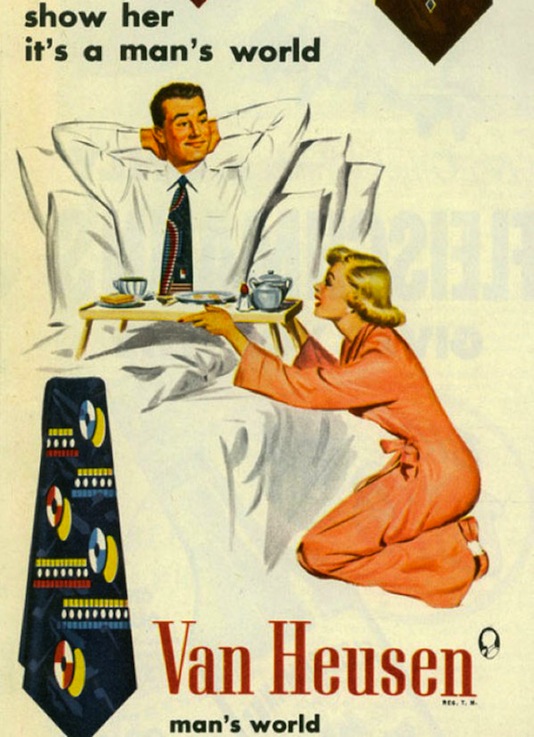
And, just for continuity’s sake, note the star on this one:
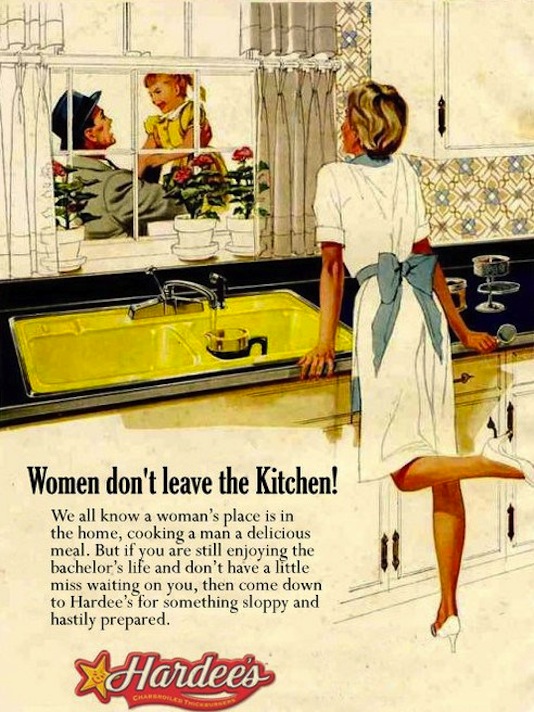
Friends, we have a problem, and we’ve had a problem for awhile. Lord have mercy.
And the Bummer is that I Really Like Those Western Bacon Cheeseburgers…
 Our son Josh and I have been watching a lot of sports lately, which of course means that we’re also watching a lot of commercials. The other day, we were watching yet another round of commercials during a Lakers game, and I had a moment of parental clarity:
This is my moment to pull back the curtain on American materialism.
Now I forget what the commercial was, but it doesn’t really matter, because they’re all the same. Simply put, the message is “buy this, and your life will be better in some way.” Buy this new Lexus and you’ll end up with a mansion, a fleet of new cars and, yes, a cute black puppy. Buy a Subway sandwich and become successful, since of course Subway “is where winners eat.” And–you guessed it–buy some little blue pills and your marriage will never be better.
The reality is that commercials preach the gospel of materialism and comfort. They make the promise that if you plunk down some cash, you’ll get what you want…and more.
And in the case of Carl’s Jrs., that evidently means sex.
I mean, have you seen a Carl’s Jr. commercial lately?!? If I was to sum up their corporate advertising philosophy, I think it would be scantily clad women eating burgers with dripping sauce. Heck, on the Carls Jr. website right now, you can watch a video of a woman eating a burger, you can buy “Eat Like You Mean It” boxers (huh?), and on the main page, you are greeted with this visual:

Subtle, eh?
In our family, we don’t eat a lot of fast food, but in light of their evident determination to equate their product with sex and with the objectification of women, we’ve definitely crossed them off the list. Feel free to join us!
This week, I came across this video. Entitled “How the Media Failed Women in 2013,” it illustrates the persistently sexist advertising and media coverage from the past year. May we do better in 2014.
On Being Part of a What I Hope is a Movement
 Sometimes it seems like things are never going to change.
What I mean is that when it comes to gender equality in the culture and the church, I’m tempted to feel like we’re either not moving at all, moving backward, or if we’re moving forward, it’s at a glacial pace.
As I’ve said before, when people ask me if I think this situation is getting any better, my answer is always a qualified yes. As in, “we’ve come a long way, and we have a long way to go.”
On the other hand, perhaps that’s just my cynicism talking.
This morning I started reading Jesus Feminist by blogger and writer Sarah Bessey. I’m only one chapter in, but so far, so fantastic. And to read Bessey and her forward writer Rachel Held Evans…
We’re in the middle of a nothing less than a movement toward gender equality.
Here’s Evans:
“These stories are followed by groans, by laughter, by tears, by commiseration, by celebration, and often by sacred silence. They are being told in living rooms, sanctuaries, Sunday school classrooms, coffee shops, campsites, rural villages, city streets, and chat rooms all around the world. In the company of one another, women are finding their voices, telling untold stories, and singing freedom songs. A movement is underfoot, a holy rumbling. And things will never be the same.”
Wow. Now here’s Bessey:
“The Table may be loud and dominant , but love and freedom and spreading like yeast. I see hope creeping in, destabilizing old power structures. I feel it in the ground under my feet. I hear it in the stories of the people of God living right now. We’re whispering to each other, eyes alight, ‘Aslan is on the move.’ Can’t you feel that? The kingdom is breathing among us already.”
All things considered, I like the thought of being part of a movement.
In fact, forget the glacier. Maybe we’re in an earthquake.
Just over a year ago, in this post, I reported that the church of England had tragically voted against ordaining women as bishops. Using that as an example of the gender bias entrenched in the church, I wrote, “In other words, we’re not just talking about a problem in the larger culture. It’s in our house as well. Indeed, in the clerical (church leadership) world in particular, male privilege continues to thrive.”
Now let me use the Anglicans for a different kind of example. As reported in Christianity Today several weeks back,
“The Church of England has voted to draft new legislation that would allow women to be ordained as bishops.
The church will draft its new measure to approve female bishops by November, but any language likely will not receive final approval until November 2015, Reuters reports. Still, Anglicans have been awaiting this vote to re-start the process since the Church narrowly rejected the appointment of women bishops by just six votes in the House of Laity, one of the Synod’s three chambers, last November.
Archbishop Justin Welby says the mood within the church has shifted since then, and the Belfast Telegraph reports that he is ‘extremely optimistic’ about the promise of moving forward.”
It’s important to note that this isn’t the end of the road for the Church of England. There is more process to come. But, one year removed from the no vote, it’s a significant step in the right direction.
Come to think of it, maybe it’s more than a step.
Maybe it’s a movement.
Stop What You’re Doing and Read These Pieces!
 Over the last several weeks, I’ve been inundated by some amazing articles and blogposts on the topics of gender issues and gender equality. So, instead of cooking up my own stuff today, I thought I would curate a selection of material from others. Enjoy these terrific and thought-provoking links!
“The Incomplete Gospel of Biblical Womanhood”
By the Kate Wallace of the Junia Project. The perspective on “Biblical womanhood” that’s outlined in this post makes my blood boil. Here’s a quote from the piece: “That is why I do not buy into the “biblical womanhood” gospel, and why I cannot be a part of that movement – because it preaches a “to do list” instead of freedom; because it is gendered when scripture is not; because it demands uniformity instead of celebrating diversity; because it elevates married life over single life; because it doesn’t apply to everyone.”
“The Objectification of Women–It Goes Much Further Than Sexy Pictures”
From the Crates and Ribbons blog. When we talk about women being tragically objectified, we mostly do so with sexual material in mind. But according to “Crates and Ribbons” it’s so much more foundational than that. “The cumulative effect of all this is that we are socialising generation after generation to view the world, and the women in it, from the point of view of men. As a result, only men are seen as full and complete human beings, not women. Women are objectified — this means we are denied agency, and are seen from the outside, our own consciousness, our thoughts and feelings, utterly overlooked.”
Three Ways Patriarchy is Bad for Men”
How does male privilege damage men? Tim Peck has three reasons. The one that most grabbed me has to do with the tragic impact on our collective mission: “If one’s role in the church is based on gender alone, some men may find themselves in church leadership roles that they lack the competency to fulfill. By effectively disqualifying more than half of the potential leaders in a church by virtue of their gender, the need for leadership will necessarily be larger than the pool of available male leaders.”
A few weeks back, I blogged about the lack of female speakers at Christian leadership conferences (here). Here’s a bit more perspective from Jim Wallis and Lisa Sharon Harper from Sojourners: “So, it is not only a sociological problem, but a theological one — an ecclesial one — when more than half the church is excluded from upfront leadership, prophetic ministry, and public teaching. This denial repudiates the power of the gospel of reconciliation.”
“Woman Pastors–I Just Couldn’t Picture It”
In her post this week, Erna Stubblefield eloquently captures what it feels like to be on the outside looking in in a ecclesiastical world dominated by male privilege: “I realized that though I believed in the Biblical basis for women in leadership I was uncomfortable with it in praxis. I was guilty of the same kind of subconscious male bias that I had experienced through others towards my leadership. I couldn’t picture myself as a pastor because I was woman.”
“A Lament for Women in Leadership”
Sit with this reflection on Psalm 40 and let your heart engage this issue. “My sisters and I have cried when we’ve been told “no”, “be quiet”, “this is not your place”. We need your rescue, God. We desperately need you to bring good news in places where we are pushed down, snuffed out, and negotiated around. Your Kingdom suffers when we are relegated to roles and ministries and places where we are not gifted or passionate. How long?”
“How I Became a Jesus Feminist”
Micah Murray went from being “least likely person to ever become a feminist” to someone who could write this: “I realized that the “Gospel-centered manhood” promoted by so many leaders didn’t always have much to do with the Gospel. I realized that the violent masculinity that I’d admired wasn’t consistent with the Jesus who showed us that God can bleed.”
Last but not least I present you with…Goldiblox. And the Beastie Boys. What’s not to like?!? Here.
Good Words
 This Thanksgiving, I’m thankful for…words.
As a blogger, perpetual grad student and as a campus minister who communicates best in writing, I love the process of wrangling a jumble of words into something meaningful. So I’m grateful today for words and the beauty that comes when they are well-shaped.
In that spirit, I present this particular collection of words, from former President Jimmy Carter. President Carter has featured on this blog before (here), but today I want to share these words with the hopes that next Thanksgiving we’ll be able to say that gender-based injustices have been lessened, and this vision of gender equality is nearer.
“One of the most powerful truths in my Christian faith is that I and all other people are equal in the eyes of God. Many believers of all religions – Christians, Jews, Muslims, Buddhists – violate this basic premise by claiming that men are exalted at the expense of women.
Several years ago my wife Rosalynn and I decided to sever our ties to the Baptist denomination to which I had given allegiance for seventy years because its leaders decided to depart from this principle and to deprive women of equal rights to serve as ministers, deacons, chaplains, or in other positions of leadership. We continue to worship in our local Baptist church that is served by both a male and female minister, where I teach Bible lessons and Rosalynn is a deacon.
Devout Christians can select specific verses from the Holy Scriptures to justify this claim of masculine superiority, but their premise contradicts the incontrovertible fact that Jesus Christ never condoned the subservience – or inferiority – of women. It is well known that there were many examples of women leaders in the early Christian churches.
This prejudice, unfortunately, is extremely common. Men who wish to abuse women physically, deprive them of equal pay or exclude them from the same opportunities in political or economic affairs tend to justify their actions because of this misinterpretation by men who are in ascendant religious positions.
The abuse of women and girls is the most pervasive and unaddressed human rights violation on earth.”
Pastoral Privilege
 I’m not a church pastor by vocation. But Erik Parker is. And he’s written an insightful post entitled “12 Reasons Why Being a Male Pastor is Better.” I’m going to excerpt his whole list here:
Like all the advantages of being white and male in North America, there are advantages when it comes to being an ordained pastor. Here are some of the obvious ones:
- No one ever defines my ministry by my gender. No one says, “wow a male pastor or a man in ministry, good for you.” I always get to be just a pastor. I don’t have to constantly live with a qualifier in front of “pastor”, and I am not forced to bear someone’s inappropriate shock that I am my gender and I am a pastor.
- People expect me to be direct and tell them what I think. They want me to lead them somewhere. I am rarely challenged or expected to defend or make a case for my ideas. I don’t have to apologize for having strong opinions or constantly defend my ideas.
- People think twice about fighting with me. I always have a leg up in conflict, bullies find it harder to push my buttons because I have fewer to push. I am never automatically second class because of my gender, so conflict is on equal terms or tipped in my favour. I don’t have to suffer being called “boy” or “son” as way of dismissing my point of view, and I am not accused of being divisive if I disagree with something or anything.
- People are used to pastors of my gender. There are no congregations that are unsure of male candidates for ministry, no parishioners who think it is alright to say something like, “I will never be buried by a man.” I don’t have to endure questions about whether I will take paternity leave, or what will happen when I have kids.
- People almost never assume that I have a particular gift for ministry before they know me. They don’t automatically think that my gender is suited to particular areas of ministry like preaching or administration. No one assumes that I am not good at pastoral care or being nurturing. People don’t say that I have the gift of speaking with a voice that men can relate to.
- I don’t have to worry about my safety. I don’t think twice about being alone in the church or if I am safe on my own. If a man asks to meet with me one on one, I don’t have to question my physical safety or his motives. Men don’t try to share the peace with me by hugging me (or grabbing my ass).
- No one assumes that I am the church secretary or the pastor’s spouse. I am never told, “You don’t look like a pastor or you are took young to be a pastor” even thought I am built like a football player and at times have had long hair and a beard like a hell’s angel. And I have a tattoo. And I am 30 (two decades younger than the average age of pastors in our denomination).
- Churches are built for men. Pulpits, altars, pastor chairs, vestments are all designed my size and body type in mind. I don’t look ridiculous because the standard garb of my profession is made for my gender, and I don’t look like a cross dresser in a clergy shirt.
- All the pronouns are for my gender. God is a he. Jesus is a he. Pastors are almost always referred to as he or him or his. I don’t have to correct people because they never use the wrong pronoun to refer to me.
- Being male is the norm in the church. I didn’t have to take classes in seminary about men’s issues, there is no post-modern male theology, male pastors where never brought in to speak about being male pastors as if it was special or odd or a novelty.
- I could join the Old Boys Club if I wanted to. Leadership in the church is still overwhelmingly male, and there are no glass ceilings for male pastors in the church. No one pretends it is, “all in good fun” to make sexist jokes about my gender, and none of my colleagues treats me like I am second class because of my gender.
- I don’t have to walk on egg shells in ecumenical situations. I don’t have to justify my position and call to my conservative colleagues, because they all have male pastors in their denominations. I am not an oddity or the token male at ministerial events.
I’m not a church pastor by vocation. But if I was, I think I would write up a list a lot like this. Thanks Millenial Pastor.
What about you? What on this list resonates for you?
What’s Beneath the Vatican?
 Growing up, I was really into Biblical archaeology.
Allow me to explain.
My grandmother, a woman of great faith, subscribed to a magazine called Biblical Archaeological Review. I loved that magazine. To be sure, it was far more appealing than its neighbors on the coffee table, Good Housekeeping and National Geographic.
I think two things about B.A.R. caught my attention. First, the Indiana Jones factor. Surely the discovery of cracked potsherds in the ruins of Biblical Gilgal must imply poisoned arrows flying from the walls, treasure maps on ancient amulets and, most likely, the arc of the covenant hidden in a snake filled chamber. But more importantly, I think B.A.R. wooed me because it promised, well, truth. Or certainty. Or the affirmation of faith, both mine and my grandmother’s. In other words, find a stele inscribed with “King David” and you can bank on the resurrection.
Since those days, I’ve sort of settled in with my faith. Sure, archaeology is important, but it’s not everything. These days, my faith is built on much more than the pages of B.A.R. Still, every now and then, an archaeological discovery catches my eye. Maybe there’s something new to understand about the faith?!?
Yesterday, it was reported that some frescoes in some ancient Roman catacombs depicted women serving in the early church…as priests. Priests! Here’s what could be in those paintings:
“One in the ochre-hued Greek Chapel features a group of women celebrating a banquet, said to be the banquet of the Eucharist. Another fresco in a richly decorated burial chamber features a woman, dressed in a dalmatic — a cassock-like robe — with her hands up in the position used by priests for public worship.”
Predictably, the Vatican sees something different on the walls. Fabrizio Bisconti, the superintendent of the Vatican’s sacred archaeology commission, said such a reading of the frescoes was pure “fable, a legend…These are readings of the past that are a bit sensationalistic but aren’t trustworthy.”
Perhaps. Or perhaps not. Feel free to see them yourselves here.
Several months ago, I blogged about the church mothers (here and here). And in one piece, I quoted from a book called When Women Were Priests by Karen Jo Torjeson:
“The last thirty years of American scholarship have produced an amazing range of evidence for women’s roles as deacons, priests, presbyters, and even bishops in Christian churches from the first through the thirteenth century.”
Could it be that there is archeological evidence of this, right under the church’s feet?!?
More Critique of American Sports Culture
 Yesterday, I woke up thinking about sports.
It could well have been because of the amazing soccer match my girls played on Saturday, the one where we broke the will of our rival elementary school en route to a 2-0 win. Oh, and did I mention that both teams were undefeated coming into the match?!? Next up for us is a rematch versus that same school next Saturday in the championship game.
Yes, I’m a proud coach. Last week I offered two reasons why I love coaching girls soccer. Add a third one:
It’s fun to win.
And/or, it could have been because of this article from writer Marta Oti Sears. Similar in theme to my recent post on the topic, Sears offers an insightful critique of a sports culture that equates masculinity with success and femininity with weakness. Here’s a couple of excerpts, and I recommend the entire piece:
“As a coach and parent, I’ve become increasingly concerned about another form of injustice taking place in locker rooms, living rooms, and around water coolers across the country.
A frustrated middle school boys’ coach calls a time out and yells at his players, “You look like a bunch of girls out there! Come on ladies, get your heads in the game!” A dad says to his five-year-old son, “You’re throwing like a girl. Let me show you the right way to throw a baseball.” A high school football kicker misses a field goal that costs his team the game. The next day, he opens his locker and finds it full of tampons.
There’s a common message in all of these scenarios. Femaleness is equated with being weak, passive, and a loser. The accompanying message associates maleness with strength, aggression, and victory.
Sadly, kids and adults are as likely to hear this message at home and at the church picnic, as they are to hear it on the school playground or the local youth sports league. It’s the same kind of language we’ve heard for decades, kids calling each other “sissies” and men calling each other “pussies.” But in 2013, we can do better.”
And, later:
“If we want to raise boys and girls to become healthy, whole men and women who live and love like Jesus, we must release our gender stereotypes and embrace the complexity and paradox of being human. As image-bearers of God we are all strong and vulnerable; brave and fearful; aggressive and peacemaking.”
Amen.
 Challenging Tertullian