Honored
First of all, for those of you new to Challenging Tertullian, a hearty welcome! Thanks for stopping by. My aim is to post every Monday and Thursday morning. To get more of a sense of what you can expect, check out the “About this Blog” page here. Enjoy!
So, there I was, casually reading the latest Junia Project post last Friday. At first glance, it looked interesting:

Scrolling down, I was pretty sure I could guess which blogs would make the list. For sure Rachel Held Evans. And probably Sarah Bessey. And, most likely, the good folks over at CBE.
But imagine my surprise when the list also included:
Me.
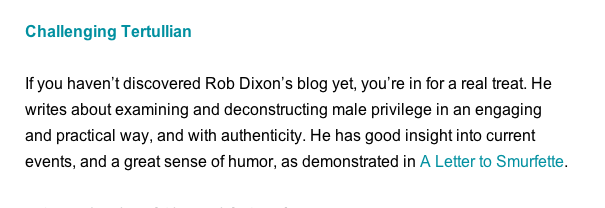
Wow. What an honor.
Reflecting a bit over the weekend, a couple of thoughts:
First, I’m reminded that I am a small part of something a lot bigger. Specifically, I’m a part of a community of Jesus followers who are trying to figure out how to do church in a gender-equal kind of way. Thanks for coming along with me as I wrestle with what that could/should look like.
Second, I certainly experienced a wide range of emotions. From elation (my phone ran out of power midday due to all the email, Facebook and blog checking), to curiosity (really? me?), to angst (holy cow, the posts better be good now!) to a whole lot of gratitude.
Third, I’m reminded of the power of advocacy. This blog got a lot of traffic on Friday, and it received a lot of new followers. In fact, the Smurfette post, one that I had forgotten, had more eyes on it than ever before! All of this because of the advocacy of Gail Wallace and the folks at The Junia Project. Again, I offer my sincere thanks.
Lastly, let me try to return the favor. If you’re a regular Challenging Tertullian reader who has not yet visited The Junia Project, please remedy that soon. And if you’re not sure where to start, and if you’re unclear on the origin of the name, go here.
Because Junia, someone who for too long has been “tertullianed” in the very printing of the Holy Scriptures, deserves your attention.
Thanks again.
Central Research Issue
 Everyday, I’m edging closer to clarity.
I’m talking about my doctoral program, and for the last 4 weeks I’ve been on a quest to focus in on what exactly I’ll be researching and working on over these next four years.
To be specific, I’ve been working to articulate something called a Central Research Issue. Looking for a nice summer beach read? Consider Introduction to Missiological Research Design by Edgar Elliston. It’s a hoot.
According to Elliston, a CRI is “the primary guiding and constraining perspective throughout the whole study…The goal of selecting a research topic is to have a topic that is narrow enough to be done well by the researcher but broad enough to be significant to the researcher, the constituencies with whom the researcher is affiliated, and to the related academic disciplines…[The CRI] is the most difficult sentence, by far, of the whole thesis or dissertation.”
So, drumroll please, right now my latest version of my CRI is this:
“To examine and evaluate the qualities and characteristics of flourishing inter-gender partnerships in mission throughout selected segments of the InterVarsity staff community.”
…and now you now how to pray for me!
From here on out, I will be all about understanding everything I can find about this CRI. In particular, for the first year, I’ll be all-in on a literature review. In fact, the goal between now and mid-October is to absorb and review somewhere around 90 different academic-level sources. I’m talking books or journals. I’ve parsed the lit review into three categories:
1. InterVarsity and the historical development of the value for inter-gender partnership in mission.
2. Qualities and characteristics of flourishing partnerships, in three contexts: in the Scriptures, in the evangelical church and in the secular world.
3. Contemporary theories of gender difference, because it will be important for me to understand the prevailing wisdom of the scientific community.
Now, I’m off to become a terrific researcher. It’s like a treasure hunt for sources.
Anyone have any leads for me?!?
“Women Can Be Doctors Too, Rob”
 In case you are tempted to think that I get this male-privilege stuff right all the time, believe me, I don’t.
Allow me a short story to illustrate:
This weekend I was talking with two friends of mine about their doctor, and how they had been sternly warned to wear sunscreen in order to avoid skin cancer.
My friend said, “Yeah, and Dr. So and So was all over us about it.”
I replied, “Wow, he was serious then.”
Pause.
Same friend says, “Wait a second, our doctor is a woman.”
At which point my other friend says, “Um, women can be doctors too, Rob.”
Doh.
I’ve blogged before about being a work in progress, and this short story illustrates that point again. The fact that this interaction came on the heels of two hard weeks of working on my doctoral program in inter-gender partnership in mission? All the more embarrassing.
Simply put, we’re all indoctrinated by a culture marked by male privilege. So much so that we only notice it when we choose to, or when someone points it out.
Which is exactly what Nicolas Kristoff did in his column from yesterday. In the piece, Kristof starts with the same study on hurricanes that I blogged about last week (great minds…), and from there he engages the sexism that lurks below the surface in our culture. Here’s a particularly rich quote:
We often assume that racism or sexism is primarily about in-your-face bigots or misogynists, but research in the last couple of decades — capped by this hurricane study — shows that the larger problem is unconscious bias even among well-meaning, enlightened people who embrace principles of equality.
This affects the candidates we vote for, the employees we hire, the people we do business with. I suspect unconscious bias has been far more of a factor for President Obama than overt racism and will also be a challenge for Hillary Rodham Clinton if she runs for president again.
“It’s a mistake to assume that gender bias is only or mainly about misogynists,” said Susan Fiske, a psychology professor at Princeton University and the editor of the hurricane study. “Much gender bias is more automatic, ambiguous and ambivalent than people typically assume.
Something tells me that I will never be over Tertullian’s influence. After all, when you’ve been breathing bad air for 42 years, it has cumulative effect.
So recovery is a step by step process.
One that happens one conversation at a time.
Interested Stares and Plenty of Questions
 “I knew it was going to be a lot of work, but…holy cow.”
And that just about sums up my experience with the first week of my DMiss program. As an example, for the next month or so I’ll be working on my research design proposal, a 20ish page document that articulates my idea of how I’ll use these next four years.
And then the fun begins. Between now and October, I’ll need to critically engage around 90 different sources (books, journals and articles) related to my central research issue.
So, if you need me, I’ll be buried in a book.
But the other thing about this first week is that I got to meet my cohort mates. I’ll be accompanied on this four year odyssey by 8 other souls, each of us engaging different topics within the field of missiology. Honestly, this feels like one of the best features of the program, because I’ll benefit not only from others’ perspectives on my topic, but I’ll get to understand 8 other ways that God is at work in the world. So this week I’ve been thinking about, among other things, internet evangelism with Chinese youth, business as mission models in Liberia and Christian community development in racially fractured Benton Harbor, MI.
This is gonna be fun.
As a part of getting to know my cohort, I got to share about my proposed research topic. Here’s what happened:
Me: “And so, with all of this as background, I am planning a research project entitled ‘”Women and Men Flourishing in Mission: Models of Healthy Gender Equal Ministry Partnerships.'”
Them: (interested stares, and several “Hmms”)
Me: “In closing, do you have any questions for me?”
And then it erupted. Lots of really great questions. Like about how I came to be concerned about a topic like this. And about how my context of InterVarsity will fit in with my study. And about what I anticipate as roadblocks to my research. And more.
My experience with my team fits the general experience I have when I share about what I’m doing in this program:
Interested stares and plenty of questions.
Come to think of it, it’s not unlike the reaction I get when I tell people about this blog. Interested stares and plenty of questions.
And here’s the thing:
I love this reaction.
Because, if it’s authentic (and it usually is), it indicates a curiosity that I think God can and will use. For most people I connect with, this is a completely new topic. Few people in the church are really talking about this stuff. As a result, I am finding that people really want to know how to think about gender issues within the framework of their faith.
So I say keep it coming. I’ll keep reading and writing.
And you keep staring and then asking your questions.
Which One is It?
On Tuesday morning I started the first intensive associated with my DMiss program. So far it’s been amazing. As we meet these two weeks, I’m aiming to get to know my cohort, to refine/narrow my topic and to plot out my research process.
In the run-up to these two weeks, I’ve been doing some reading. OK, a lot of reading. Like a 7-8 books in the last month level of reading. And I discovered late last week that I also need to read a bunch of missiological journal articles. (Note to self…read the syllabus more closely!).
So last weekend I did a bit o’ online research, looking for recent missiological articles related to my topic. The result?
For the most part, “crickets.”
For instance, I went to the site for Evangelical Missions Quarterly, searched for “gender partnership” and found nada. Here’s a shot:

Same thing for “gender.” In fact, if you search the site for “gender” all you get is an article that contains the word “engendered.”
So then I tried Mission Frontiers, the magazine/site of the U.S. Center for World Mission.
Again, a search for “gender partnership” came up empty:

And then I tried the International Bulletin of Missionary Research, and, same story. Here’s a shot of the search page:

In this case, at least it only took 16.45 seconds to find out the news!
Similar stories with Missio Apostolica, Missiology and Mission Studies. In fact, the one place I found articles was on the Lausanne site.
So what’s going on here?
I think it’s either one of two things.
Maybe there’s really little out there on the topic of intra-gender partnerships in mission. I mean, I might be plowing new ground here.
Or, I’m just a really bad researcher who needs of some better search keywords!
Either way, it’s going to be fun to learn and grow through the process.
It’s Dry, but it’s Inclusive!
This morning it hit me:
“I’m a doctoral student now.”
Perhaps it was the three short papers due on Friday. Or the fact one of those papers is a book report and I had yet to read even a page. Or, maybe, it was the type of book I was starting:

Jealous?!?
Thought so.
Reading a different but similar book the other day, I was glad to come across the following section, on gender inclusive language in research writing. As you know, I’m a bit of a nut about inclusive language. Here’s the excerpt:
“Typically in the past, one wrote in sexist noninclusive archaic English. Singular masculine pronouns commonly referred to an indefinite person. However, that practice effectively excluded women. Old style manuals used terms like ‘mankind’ for all people. Language and writing style values have changed. In contemporary English such exclusive language is not acceptable. Many researchers have learned English composition using ‘he,’ ‘him,’ and ‘his’ as the correct way to refer to any person. To correct this practice and to conform to contemporary values, some simple editing procedures may be employed. In a few cases, one might use both pronouns (e.g., he or she, him or her, his or hers), however, in many cases the subject may be changed to a plural or to the specific name of the person or role. Using plurals allows for the use of inclusive plural pronouns. In other cases the author can simply edit the sentence structure to avoid exclusive language. One must however keep the pronouns agreeing in number with the nouns to which they refer.
Int the past many roles were defined in gender-specific terms (e.g., chairman). A more acceptable and contemporary practice is simply to refer to the person in nongender specific terms, (e.g. chair of the board). Many contemporary English style manuals provide many more suggestions about this change in writing style.”
Here’s to a generation of gender inclusive research writers!
Reflections
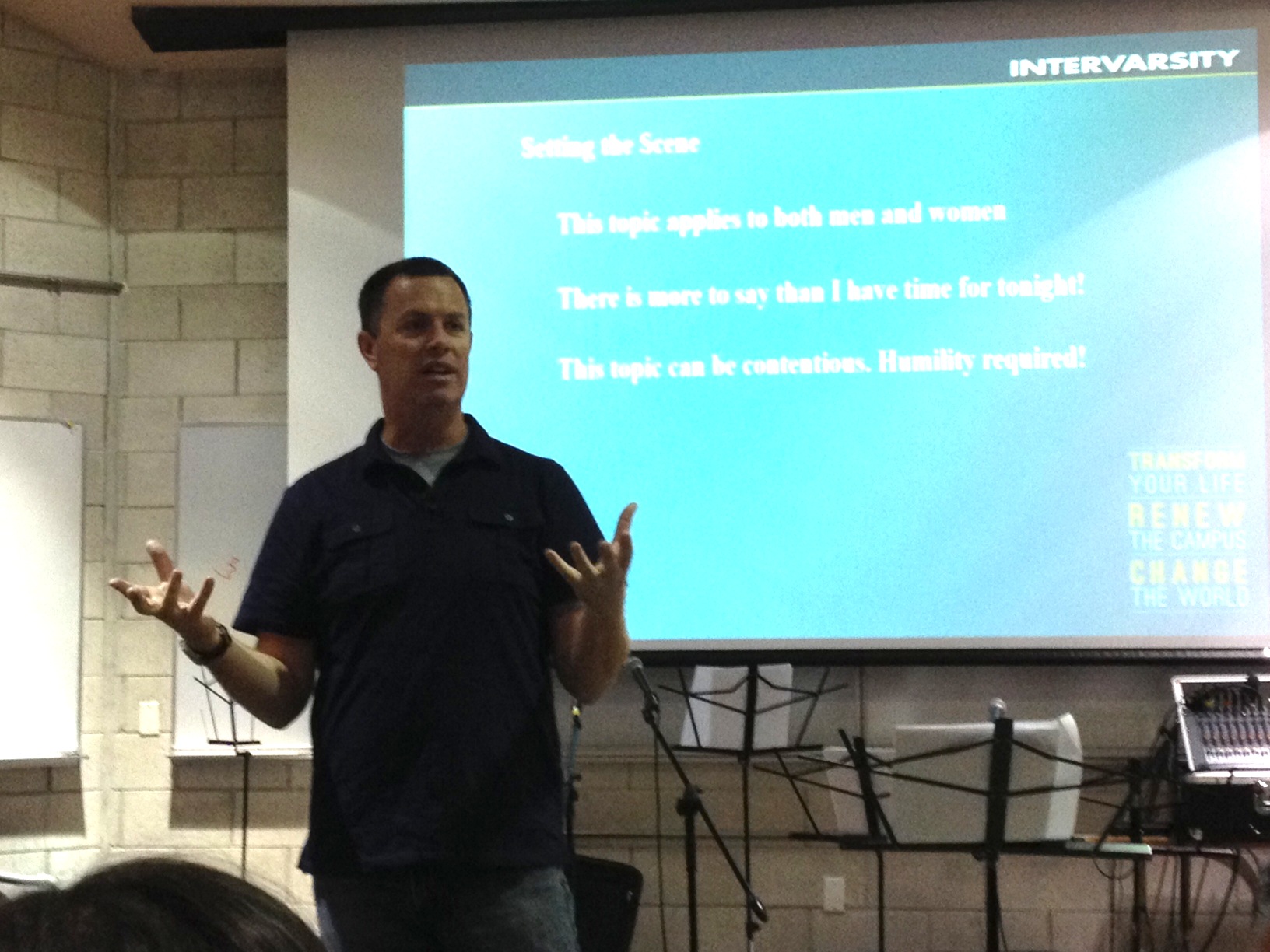 Last night I walked 50 or so UNLV students through what the Bible teaches about women (and men!) in leadership.
It was amazing.
A couple of reflections on the experience:
First, it’s indeed a vast topic. Right off the bat, I warned the students that this was the stuff of seminary courses and that I’d be moving fast during the talk. I hit everything from Genesis to Psalms to the Gospels to about 8 texts from Paul. I was flying. Even so, the 40ish minutes that I was given morphed into–wait for it–65 minutes. I think it was the longest talk I’ve ever given!
Next, they were with me the entire time. Good eye contact, nodding heads, laughing at the right times, etc. What this tells me is that there is a thirst for teaching on this topic. Is it possible that our churches are shirking responsibility by not teaching on these things? I think so.
Third, my burden for teaching and training on these topics continues to grow. After the talk, I told one of my staff that I’d teach it again tomorrow night. To be clear, I’ll be glad for a night off tonight; still, I’m growing into a new phase of call to teach, train and lead on these things. Of course the graduate program is a part of that, as is this blog. It is a joy to sense God’s profound work in my soul.
Fourth, my convictions about the Bible’s message of gender equality continue to solidify, clarify and find a greater purchase in my understanding. I always try to preach and teach from a place of conviction, but sometimes conviction is more available than others. Last night conviction was a potent presence in my teaching. I am convinced that the Bible’s message is one of freedom for women, and that God’s desire is for men and women to together carry the good news into mission with a posture marked by equality, mutuality, interdependence and dynamic partnership.
Many have asked for my notes from last night. I think I’m going to clean them up a bit and then send them. And/or I might chop the talk up and feature it as a series of posts here on Challenging Tertullian.
For now, I’ll leave you with Paul’s words to the Galatian church in 3:26-29:
For you are all children of God through faith in Christ Jesus. And all who have been united with Christ in baptism have put on Christ, like putting on new clothes.
There is no longer Jew or Gentile, slave or free, male and female. For you are all one in Christ Jesus.
And now that you belong to Christ, you are the true children of Abraham. You are his heirs, and God’s promise to Abraham belongs to you.
Praise God for the cross, which burns through the divisions of race, class and gender.
Happy Easter everyone!
I’m In, It’s On, Here We Go!
Awhile back, I mentioned that I had applied for a doctorate program.
Well, I got in.
Here’s what they told me:

I know what you’re asking…”what the heck is a Doctor of Missiology program anyway?”
I’ll try to explain.
To me, missiology is the study of how the good news about Jesus goes out to the world through the church. That’s my laypeople’s definition. Want a more, er, robust definition? Try this one, from this post:
“Missiology is an interdisciplinary discipline which, through research, writing, and teaching, furthers the acquisition, development, and transmission of theologically-informed, contextually-grounded, and ministry-oriented knowledge and understanding, with the goal of helping and correcting Christians, and Christian institutions, involved in the doing of Christian mission.”
On second thought, go with mine.
Simply put, I’m going to spend the next four years journeying alongside a cohort of ministry leaders from around the world learning about how the church can do a better job fulfilling its God-given mandate. I’m anticipating a lot of fun, some serious hard work, and near constant reading and writing. At the end of the program, I’ll be writing a dissertation and defending it before a committee.
And on the front end, DMiss students are tasked with presenting their “problem,” the particular missiological issue that they will be exploring. I’m told that everyone’s problem gets tinkered with early in year one, but for now, see below for what I’m thinking I’ll be tackling. I’m looking forward to bringing y’all along with me!
It is safe to say that I would not be the person, disciple or minister that I am today were it not for the influence of godly women. Indeed, in 2 Timothy, when Paul exhorts Timothy to recall the faith of his grandmother and mother, I can identify with Paul’s young protege. Likewise, in my life, God has used female family members, peers, partners, mentors and followers to form me spiritually more fully into the likeness of Jesus.
And for more than 16 years of ministry with InterVarsity Christian Fellowship/USA, it has been my privilege to share in the formation of women as well as men. Many of my enduring ministry partnerships cross gender lines, and today I lead a ministry where women are empowered to use their gifts to their fullest in pursuit of our campus mission.
Still, along the way I have experienced challenges, both internal and external. I’ve had to face my own gender brokenness. I’ve come up against the systemic patriarchy both in American culture and in my organization. And, from time to time, I have had to engage with theological opponents in conversations that have been both taxing and painful. After all, it is never easy to be called a “false teacher” because you are allowing women to preach in your ministry.
Because of this, I am interested in expositing models for healthy gender equal ministry partnerships where both men and women can flourish. I want to construct a set of cross-gender competencies by which we could measure whether such a ministry partnership is successful. And I am eager to discern ways to help both men and women become more competent and ready to establish mutually empowering partnerships. In the end, I want to push against what I believe to be the church’s frequent conclusion that men and women cannot simultaneously flourish in ministry with one another.
Accordingly, I propose a DMiss study entitled “Women and Men Flourishing in Mission: Models of Healthy Gender Equal Ministry Partnerships.” This study will take place within the context of my organization, InterVarsity Christian Fellowship/USA, where I serve as a Divisional Director in central California. My intention is to do my field research both locally, in the portion of InterVarsity that I am responsible for, and nationally. For this latter portion, I intend to rely on the access provided by my supervisors as well as by InterVarsity’s National Women’s Council.
No leader can choose their legacy. But if I could, it would be to articulate and then field test a paradigm of cross-gender ministry partnership where both men and women are fully flourishing. My hope is to leave such a thing as a gift, to InterVarsity, to the church, and to the advancement of God’s mission in the world.
I’m Not Finished Yet
 Evidently, last week Tertullian was traveling in Canada.
How do I know?
This note, left on an airplane, spelling out an anonymous passenger’s conviction that the cockpit of an airplane is no place for a woman. Here’s the transcript of the note:
“To Capt./WestJet,” the note says. “The cockpit of airliner [sic] is no place for a woman. A woman being a mother is the most honor not as “captain” Proverbs 31 (Sorry not P.C.) P.S. I wish WestJet could tell me a fair lady is at the helm so I can book another flight! Were [sir] short mothers not pilots Westjet.”
Outrageous. Indefensible. Atrocious. Don’t get me started about the Bible reference.
And I wish the attitude behind were less common.
After all, there are so few women pilots. Think about it. When was the last time you were on a flight piloted by a woman? Heck, when was the last time you saw a woman pilot on the airport concourse?
The statistics demonstrate this reality. In 2010, nationwide, fewer than 7% of commercial pilots were women. It was even worse for “airline transport” pilots, with women constituting just 3.92% of the population.
On it’s website, American Airlines celebrates the facts that it was the first major airline to hire a female pilot (in 1973), to have a female captain (in 1986) and to have an all-female crew (in 1987). Still, in 2011, American’s pilot corps was over 96% men.
Amelia Earhart once said, “Men do not believe us capable, because we are women, seldom are we trusted to do an efficient job.”
It seems like decades later, Earhart’s observation remains accurate.
At least I’m inclined to see it as true.
What?!?
Obviously, I’m someone who cares a lot about gender equality. Every time I blog, I try to identify and call out the male privilege embedded in our culture. And, daily, I am working hard to bring to Jesus the male privilege embedded in my own soul.
But on the rare instances when I’m on an airplane and it’s a female voice telling me that “we’re first in line for take-off,” to be honest I pause. In fact, I do more than pause. What happens is that my sense of personal safety drops a bit. Not a lot, just a bit.
That’s right. When a woman is piloting my plane, my gut reaction is to feel slightly less safe.
All evidence to the contrary of course. Women pilots are just as competent, just as trained, as their male counterparts. That I know of, there is no data to suggest that I am in any way in more peril when there is a woman behind the controls. In fact, once my initial, millisecond reaction passes, I’m perfectly comfortable with whoever is in charge of my plane.
So what’s happening here?
Simply put, since my youth I’ve been breathing the foul air of culture that tells me that women are less competent, less trustworthy, and less safe when it comes to important things like flying airplanes. I’m at 41 years of having that message reinforced day by day, and old habits die hard.
You see, I’m on a journey. And I’ll always be on a journey. It’s a journey that is taking me from a blissfully unaware and privileged man to someone who recognizes privilege and seeks Jesus’ guidance for how to use it to bless others. It’s a journey toward shedding my biases and honestly it feels terrific.
What’s that old quote? “I might not be where I want to be, but thank God I’m not where I used to be.”
Indeed.
So here’s my pledge. Next time I’m on a plane being flown by one of the 4%, I’m going to find my nearest napkin and write a different note. One of affirmation. One of encouragement.
One of personal repentance.
Jesus, Gender and Faith
 Two nights ago I got to speak on the topic of gender reconciliation.
And, wow, it was terrific. First of all, it never ceases to amaze me how novel topics around gender and faith are for people. Truly, it exposes the lack of intentional conversations about these things, both in the culture and, particularly, in the church.
Next, in large part because of that novelty, it strikes me that people are hungry for teaching and training on these topics. We could have gone for hours the other night, because once I had raised the issues, people wanted to both process them and share their stories.
Finally, it was a great experience for me personally. When I got home I said to Amy, “that’s what I want to do when I grow up.” It feels great to share the thinking I’ve been doing and to see it benefit, bless and challenge people. I was a very satisfied teacher the other night!
I’ll share some of the content with you over time, but here’s a quote that I’ve really been chewing on, about Jesus, gender and faith. It’s from a book entitled After Eden by a team of writers. Read this and chew along with me!
“The life and teachings of Jesus as revealed in the Gospels and the account of his continuing work through the Holy Spirit in the New Testament church display God’s will for gender relations. It is God’s desire to oppose societal patterns that elevate some persons over others and that harm, demean, subordinate, and oppress various women and men. It is God’s will to restore gender relations to the mutuality and equality that characterized the covenant partnership of woman and man in creation. Christ was sent by God the Father and anointed with the Spirit to initiate, among other things, this redemption of gender relations.”
 Challenging Tertullian