The Case for Women
 I think there are plenty of reasons to overturn the system of male privilege. Recently, the New York Times focused on one in particular:
Economics.
In his article “The Case for Women,” economist and M.I.T. professor Simon Johnson examines a recent speech by Heidi Crebo-Rediker, the chief economist at the U.S. State Department, in which Crebo-Rediker called for the International Monetary Fund to recognize and validate the economic importance of women as it works with member nations.
There’s a lot to like about Johnson’s article. Here are three highlights:
1. This is truly a global issue. Johnson cites examples of how getting women more involved in fiscal matters will positively transform countries and regions ranging from United States to Japan to North Africa to southern Europe. Indeed, empowering women economically is a global solution to a global problem. Johnson writes, “the fund and other organizations should be encouraged to emphasize the importance of female opportunities, representation and participation for economic development around the world.”
2. In our country, empowering women should be on everyone’s political agenda. Interestingly, Johnson notes that before the 1960s, the Republican party was known was the party of women’s rights. Then, with the arrival of the feminist movement and its embrace by the Democrats, the parties essentially switched sides. If the United States is going to benefit in greater measure from the economic impact of women, we would do well to close what Johnson calls the “gender gap between Democrats and Republicans.” Women’s rights ought to transcend party lines.
3. There are hopeful signs of change at the top. Johnson concludes his piece on an upward note, for women are gaining power in some key seats of economic leadership. Currently, Janet Yellen serves as the vice chairwoman of the Federal Reserve, and there is a good chance that President Obama will appoint her to the top post. Then there’s Sheila Bair, former head of the FDIC, who according to Johnson would be an effective Secretary of the Treasury. Finally, Crebo-Rediker’s appeal will be heard by a woman, as Christine Legarde is the current leader of the IMF. As we move toward a greater empowerment of women at the ground level, it’s important that that move is accompanied by a similar trend at the leadership level.
So, why dismantle the system of privilege? The answer, at least in part, is so that the global economy can flourish as women find greater economic opportunities.
Want more? I’ve blogged previously about money and privilege here and here.
Double Fault
 Every summer, tennis players and fans gather together in London to play a little tennis tournament. You may have heard of it. It’s called Wimbledon.
I’d imagine that for a tennis player there are few things cooler than playing on the lawns of Wimbledon. Stefan Edberg, 6-time major winner and 2-time Wimbledon champ, captured the aura of the tournament when he said:
“For me, and most of the other players, too, if you had to pick one of the four Grand Slams, you would pick Wimbledon. It’s got tradition, it’s got atmosphere, and it’s got mystique.”
To play Wimbledon is one thing, to win it of course is another.
And winning Wimbledon is exactly what Frenchwoman Marion Bartoli did two weeks ago. The 28 year old, playing in her 11th Wimbledon, defeated German Sabine Lisicki to win the title. It was the biggest win of her career and her first major trophy. When you consider the years of effort, training and sacrifice, for Bartoli, it was a glorious day.
But that didn’t stop Tertullian from rearing his ugly head.
John Inverdale is a tennis commentator for the BBC. In the wake of Bartoli’s triumph, here’s what he had to say about the new champion:
“Do you think Bartoli’s dad told her when she was little ‘You’re never going to be a looker? You’ll never be a Sharapova, so you have to be scrappy and fight.'”
To Inverdale, I say this:
Shut it. Now.
The sad reality of a world marked by male privilege is that female athletes are judged on more than their athletic merits. In other words, too often, it’s about the clothes, the look, the fitness and the lifestyle. Marion Bartoli just won Wimbledon. Who cares what she looks like?!?
In this 2011 article, writer Mary Jo Kane summarizes the problem:
Study after study has revealed that newspaper and TV coverage around the globe routinely and systematically focuses on the athletic exploits of male athletes while offering hypersexualized images of their female counterparts. These findings are no trivial matter. Scholars have long argued that a major consequence of the media’s tendency to sexualize women’s athletic accomplishments is the reinforcement of their status as second-class citizens in one of the most powerful economic, social and political institutions on the planet. In doing so, media images that emphasize femininity/sexuality actually suppress interest in, not to mention respect for, women’s sports.
In the end, BBC and Inverdale apologized. That’s great.
Someday, we hope, apologies won’t be necessary.
Dixon in 2016!
 My family’s lot in life is to have a history major for a father.
So, among other things, this means that I’m at least tempted to stop at every roadside historical marker, park, museum and monument. And while much of the time–with a bit of, ahem, assistance–I manage to resist the temptation, sometimes you just can’t.
Which is why we found ourselves touring the Gerald Ford Museum in Grand Rapids, MI over lunch today.
Jealous?
Turns out Jerry Ford has a pretty nice museum that honors his 70’s era, partial term administration. In particular, we appreciated the oval office and cabinet room mock-ups. The section on Watergate was interesting too, of course. I found myself seriously questioning Ford’s decision to pardon Nixon. I mean, you can understand his impulse of wanting to spare the country the pain, but, you know, sometimes the best way to recover from pain is to go right through it.
In any event, another section that caught my eye was a piece on Betty Ford, Jerry’s activist wife. Cancer crusader, addiction confronter and, turns out, women’s rights champion. Here’s a shot of Betty proudly sporting her ERA pin:
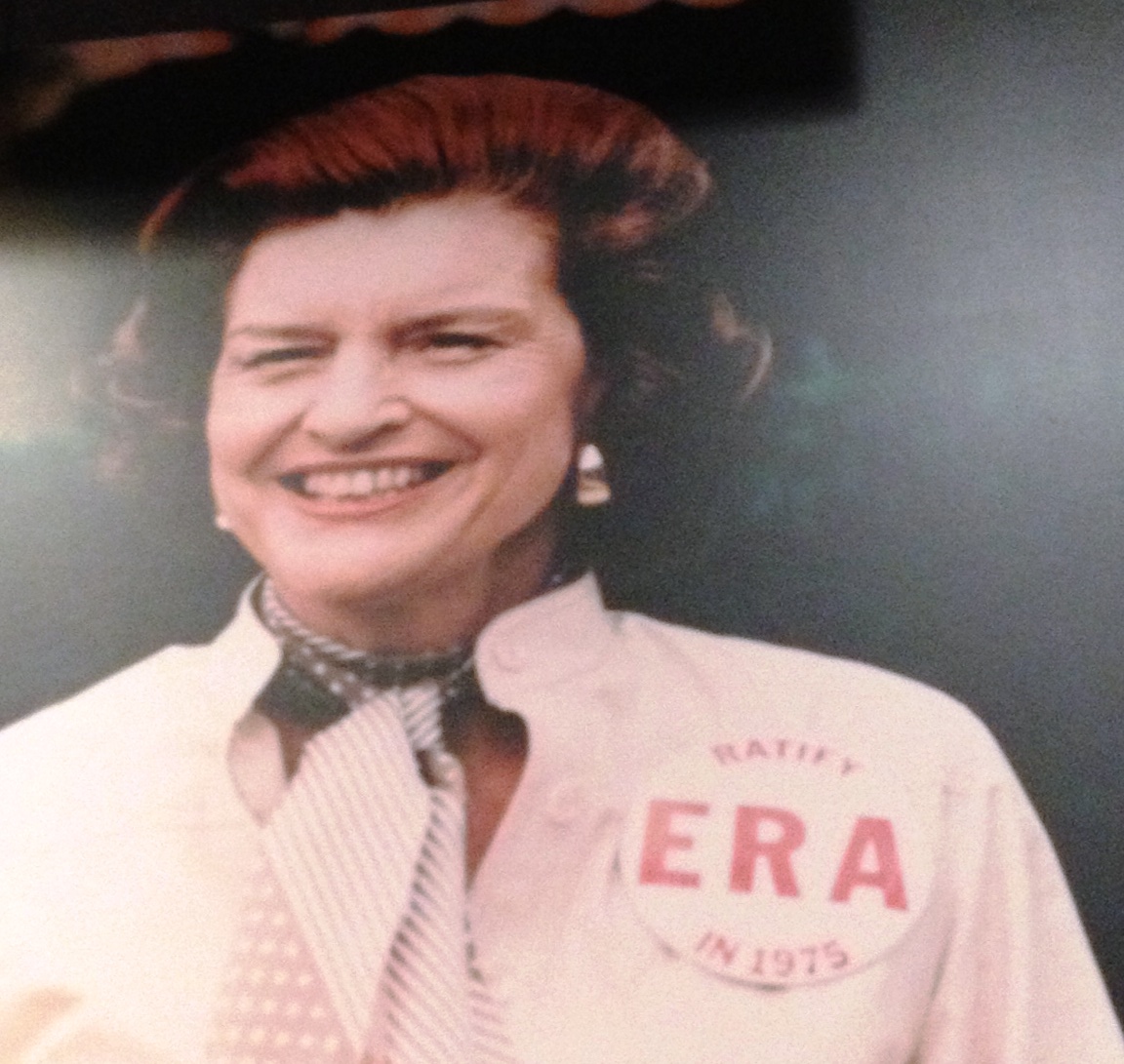
I absolutely love how Betty Ford levied her influence with regard to women in government:
“I used everything,” she admitted later, “including pillow talk at the end of the day, when I figured he was most tired and vulnerable.”
The First Lady’s pillow talk and otherwise resulted in a Ford presidency that had women in upper leadership and, most notably, a January 1975 executive order establishing the National Commission on the Observance of the International Women’s Year. That’s a mouthful, but an important one.
In a day and age where the United States ranks a pathetic 91st in women’s participation in the national legislature (a full 37 percentage points behind leader Rwanda and just behind the Slovak Republic, Indonesia and some country called Sao Tome and Principe), it’s time for more of a dose of that kind of influence.
At Jerry’s place, you couldn’t laze around in the oval office display, but you could sit in the cabinet chairs, which is how I found myself taking this picture:
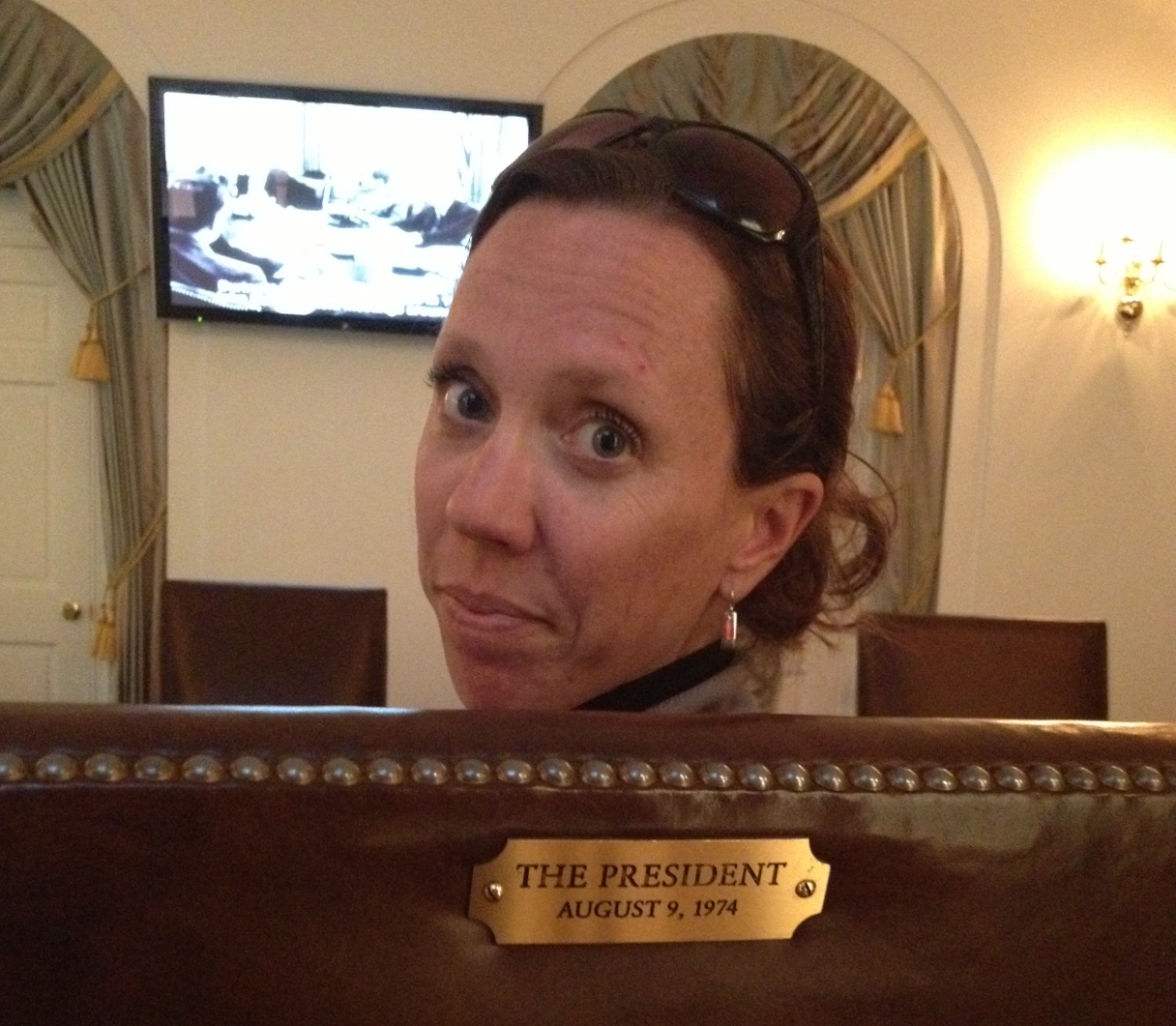
Trust me, if you could have any Dixon in the oval office, you’d want this one. So, join me. Make the country a better place.
Dixon in 2016!
When One Website Gets it Right
 Violence against women has no place in our culture, and that extends into the virtual world as well.
Kudos to the online project fundraising site Kickstarter for recognizing that fact and issuing this apology after it allowed a female “seduction guide” to get funded through its site. The whole apology is good, but here’s an excerpt:
Dear everybody,
On Wednesday morning Kickstarter was sent a blog post quoting disturbing material found on Reddit. The offensive material was part of a draft for a “seduction guide” that someone was using Kickstarter to publish. The posts offended a lot of people — us included — and many asked us to cancel the creator’s project. We didn’t.
We were wrong…
Let us be 100% clear: Content promoting or glorifying violence against women or anyone else has always been prohibited from Kickstarter. If a project page contains hateful or abusive material we don’t approve it in the first place. If we had seen this material when the project was submitted to Kickstarter (we didn’t), it never would have been approved. Kickstarter is committed to a culture of respect.
In a web that is tragically overfull with sites that degrade and demean women, it’s nice to have at least one site choose to not perpetuate the problem. Bravo Kickstarter for getting it right.
Extraterrestrial Parity
 When I was younger, I wanted to go to space.
I mean, it was tough not too. Whether it was watching The Right Stuff, reading astronaut books or catching shuttle launches and landings, it was all space, all the time. Where I grow up, if you played your cards right, you could hear (and feel) the sonic boom when the shuttle began its final decent across the country to Florida.
And as a young boy, it was easy to dream of becoming an astronaut. After all, all of my heroes looked like me. In fact, it wasn’t until Sally Ride’s 1983 voyage on Challenger that a woman flew in space with an American flag on her spacesuit. By the way, the Russians are the real extraterrestrial feminists; Valentina Tereshkova flew in space aboard Sputnik almost exactly 50 years ago today (interesting and brief article on Tereshkova here).
So I read this article with interest the other day. In NASA’s latest astronaut class, there is gender parity. 4 men, 4 women. According the article:
“NASA has selected another generation of astronauts to travel to new destinations in the solar system, including an asteroid and Mars, and for the first time in its history half of the new candidates are women.
Four out of the eight candidates are women, ‘making this the highest percentage of female astronaut candidates ever selected for a class,’ the US space agency said.
The new space explorers, drawn from among 6,000 applicants, are all in their 30s, according to NASA. New astronauts will begin with a two-year general orientation training and a flight mission to low-Earth orbit afterwards.
‘We have great female candidates in the pool this year. The selection is about qualifications. It has nothing to do with their genders,’ said Jay Bolden, public affairs officer at NASA.”
Bravo, NASA. If that’s true, it’s as it should be. Astronauts should in fact be chosen by their qualities. It would be great if one day that was the common practice across the culture.
It will be interesting to see what happens with this astronaut class and the ones to follow. Decades after Neil Armstrong landed on the moon, it’s entirely possible that the first words heard from Mars will be:
“That’s one small step for a woman…”
Tertullian Goes to School
 On Tuesday morning, Amy’s writing career took us to another elementary school in our district. For two assemblies, she sang the virtues of literature and bestowed medals on kids who’ve read their eyes out this academic year. On a side note, I couldn’t believe it, but this school had a fourth grader who had read 4 million words since August.
Four. Million. Words. A fourth grader.
Anyhow, during the course of the morning, we encountered that school’s principal. Wow was she impressive. On the ball. Good with the kids. A schmoozer with the parents. All things you’d want for someone in that difficult job.
But amongst all those qualities, one thing in particular caught my attention: the woman was in control. I mean, if one kid was squirmy during the presentation, they got called out. Clapping out of turn called for silence. On the mic, she would wait, (im)patiently, until every one of the 300 children were “criss-cross-applesauce” before she’d utter another word.
Basically, you didn’t mess with that principal.
Later in the day, when I got back to our campus, I mentioned our visit to our principal, and I specifically talked about how tight a ship she was ran during the morning’s assembly.
His reply went something like this: “Of course she has to be strict. In fact, women principals have to be twice as strict. It’s the only way for them to gain respect.”
Well, hello there Tertullian.
By and large, the world of education is a “woman’s world.” For instance, we’ve now had 16 different teachers instruct our kids and only 3 of them have been men. Nationwide, according to this site, 76% of teachers in 2011 were women. In other words, in today’s educational landscape, you’re three times more likely to have a woman stand up in front of your kids every morning.
The situation is a bit different down the hall in the administration building. In 2009, the percentages were roughly equal. For the most part, you are just as likely to have a woman principal as you are to have a man.
And yet even though the numbers are roughly equal, when it comes to authoritative school leadership, men still enjoy the privilege of assumed and easier authority. What I mean is that men have to do less to earn respect. Authority is, for the most part, freely given. Friends, that’s privilege.
Being a principal is a tough job. Every day the “bad kids” end up across the desk from you. Regularly, you have to deal with school politics. When parents have a beef, it’s coming your way. For anyone, male or female, leadership in the principal’s position is a high and difficult calling.
But, here’s hoping that someday it will not be twice as tough for women.
When Privilege Goes too Far
 In a 2005 speech at a concert in South Africa, Nelson Mandela said this:
For every woman and girl violently attacked, we reduce our humanity.
Tragically, by this metric, we are in cultural free-fall. According to a 2011 Center for Disease Control survey, “nearly one in five women has been raped or has experienced an attempted rape. The results also found that one in six women has been stalked, and one in four have been reported being beaten by their intimate partner.”
Heaven help us.
Thankfully, most of the time our cultural bias toward male privilege does not result in explicit violence. And yet, it’s also true that because our culture permits privilege, the door is opened to violence against women. After all, if women are second-class citizens–if they are objectified and commodified for men’s entertainment–how long before they become the object of violence?
So whether it is the 71% of Ethiopian women who reported physical and/or sexual violence by an intimate partner in their lifetime…
Whether it is women murdered in my beloved Guatemala, where according to this post, 2 women are killed, on average, every day…
Whether it is sexual assault in the U.S. military, where it seems like a new story comes out every day that implicates U.S. commanders with allowing and perpetuating a culture of violence against women…
Or whether it is the gruesome kidnapping and 10-year imprisonment and assault of 3 women in Cleveland..
…it has to stop.
Jesus stands against violence against women. John 8:1-11 tells us the story of a women who is caught in the act of adultery and then dragged before Jesus to be a pawn in the Pharisee’s attempt to entrap him. For this poor woman, violence was likely behind her, and then violence is surely ahead of her if Jesus commands the men to stone her. On the other hand, if he refuses to issue the command, he comes off looking like he is against the Mosaic law. It’s a charged and difficult situation. What does Jesus do?
But Jesus bent down and started to write on the ground with his finger. 7 When they kept on questioning him, he straightened up and said to them, “Let any one of you who is without sin be the first to throw a stone at her.” 8 Again he stooped down and wrote on the ground.
9 At this, those who heard began to go away one at a time, the older ones first, until only Jesus was left, with the woman still standing there. 10 Jesus straightened up and asked her, “Woman, where are they? Has no one condemned you?”
11 “No one, sir,” she said.
“Then neither do I condemn you,” Jesus declared. “Go now and leave your life of sin.”
Advocate. Defender. Challenger of the status quo. Jesus puts violence against women, and male privilege more broadly, to rights.
In that same spirit, I want to offer this list of 10 things that men can do to stop violence against women. While it lacks an overtly spiritual lens, it’s nonetheless a valuable resource. In particular, I appreciate the exhortation to self-awareness and understanding.
Because condemning violence and redeeming privilege starts with admitting that as men we have both within us.
Garbage In, Then What?
 What you choose to allow into your brain matters.
The Apostle Paul had it right in Philippians 4:8-9 when he wrote: “Finally, brothers and sisters, whatever is true, whatever is noble, whatever is right, whatever is pure, whatever is lovely, whatever is admirable—if anything is excellent or praiseworthy—think about such things. Whatever you have learned or received or heard from me, or seen in me—put it into practice. And the God of peace will be with you.”
In light of Paul’s words, let me pose a question:
When it comes to issues related to gender roles, power and mixed gender relationships, who are you listening to?
Are you listening to Pat Robertson? You remember Pat?!? Well, as you might have noticed, Pat was back at it last week, once again essentially condoning adultery. The full clip is here, but the most damning quote is this:
“Males have a tendency to wander a little bit. And what you want to do is make a home so wonderful he doesn’t want to wander.”
Because, evidently, it’s the woman’s fault when men cheat.
Or are you listening to Mark Driscoll? I haven’t done a whole lot of work with Mr. Driscoll, but I know that he is a polarizing figure. At the recent Catalyst conference, he was quoted as saying this:
“If you drive a mini-van, you’re a mini-man.”
Um, yeah, I drive a minivan…
In fact, you might appreciate this article that connects both of these two gentlemen.
Let me be clear, I’m not saying that these brothers are totally unworthy of your attention. In fact, my rule applies and without a doubt there is more that I agree with them on than not. But here’s what I am saying:
We need to be careful what media we choose to consume. Is it true? Or noble? Or right? Or pure? Is it lovely? Admirable? Excellent? Praiseworthy?
Next, we need to think critically. In Philippians 4, Paul uses the Greek word logizomai, which usually gets translated “think.” Perhaps a better translation would be “reckon” or “contemplate.” Indeed, the exhortation here is to give careful attention so as to understand what is factually accurate. I don’t know about you, but most of the time, I hear something and then just move on.
Lastly, when it comes to gender issues in particular, we must make sure that we are listening to a diverse selection of voices. Want some options to get you started? Try this TED talk. Or read this blog. Or join me in not being able to wait for this book. Heck, if you have other voices that you listen to, please share in the comments.
And, finally, since you’re reading this, let me say thank you for joining me in “thinking about these things” on this blog. I appreciate it.
Koofi for President!
 In the last several American election cycles, we’ve seen women featured prominently on major party tickets. The results, however, have obviously been less than stellar.
This of course speaks to a larger problem. As I’ve said before, women are woefully under-represented on the American political landscape. For example, according to this document, less than 25% of elected positions nationwide are held by women.
In this country, politics is a cultural institution firmly gripped by male privilege.
A litany of factors hold women back. A lack of access. A lack of power. A lack of funding. The stubborn persistence of a “good, ol’ boys network.” Unhelpful, incorrect yet persistent stereotypes that hold that women cannot lead.
All of the above.
And then there’s a woman’s appearance. That’s right, what a female candidate wears matters. A lot. According to this study, when women are physically described in a new’s report, their approval rating plummets. Here’s a quote:
“Another study presented participants with profiles of ‘candidates’ Jane Smith and Dan Jones. If participants only read the profiles, the woman emerged with an edge. But that edge was eclipsed immediately, as soon as physical descriptors — like ‘Smith dressed in a brown blouse, black skirt, and modest pumps with a short heel…” — were added to a “news story.'”
Friends, this is America. In 2013.
Perhaps we can learn from…Afghanistan.
Afghanistan? Again? Yep. Consider the courageous story of Fawzia Koofi:
“Surviving an assassination attempt by the Taliban, Koofi continues to campaign for the 2014 Presidential seat. Because traditional Islamic culture views women as property, Koofi’s courageous campaign and leadership stirs tension among some Afghans – particularly the Taliban. Resigning herself to the idea that she might, one day, be killed by the Taliban, Koofi continues fighting for women’s rights and is undeterred on her journey to becoming the first female President of Afghanistan.”
How’s that for guts?
At the start of the new congress earlier this year, Foreign Relations expert David Rothkopf tweeted this:
“So glad we now have 20 women serving in the Senate. Only 31 to go until we have proportional representation. At this rate, that’ll be 2380.”
Not another 367 years of male privilege in the political world! Let’s hope for and work for a day when women can run for office on their merit as candidates, both here at home and across the world in Afghanistan.
Follow along with Koofi as she campaigns for the Afghani presidency here. Or follow her on twitter @FawziaKoofi77
Male Privilege and the Movies
 Right now the top movie at the U.S. box office is the film Oblivion. A drone repairman assigned to work on Earth makes a reality-altering discovery. It looks great.
Oblivion stars Tom Cruise, all of 50 years old. He’s of course the male lead. The female lead? 32 year old Ukrainian actress Olga Kurylenko. Who, you ask? Right. It’s as if Universal, the producer, said to the casting folks: “We need a gorgeous, up-and-coming, cheap actress to play opposite Tom. Oh, and make sure she’s young.”
18 years younger to be precise.
The other day I came across this article, from vulture.com. It’s an interesting study on gender, age and Hollywood. And the results of the study are clear:
As leading men age, their love interests stay the same, and even the oldest men on our list have had few romantic pairings with a woman their own age (or even one out of her mid-thirties). If our actor was sharing the screen with an A-lister of commensurate star power like Julia Roberts or Angelina Jolie, the age difference would drop somewhat, but in movies that relied solely on our guy’s big name, the lesser-known love interests would nearly always be decades younger.
Evidently, for Hollywood, men age well and women, well, they just age.
At the risk of over-doing it, one more sample. This is the article’s verdict on Johnny Depp, now a spry 49:
Johnny Depp likes ’em young: Nearly all of his notable love interests have been 25 or under, and a few of them — including Winona Ryder, Juliette Lewis, Christina Ricci, and Keira Knightley (who shared a kiss with Depp in the second Pirates film) — would have been carded at the time they swapped spit with the star. In fact, the cradle-robbing Depp has only had two notable love interests in their mid-thirties, and all Juliette Binoche and Angelina Jolie had to do to make that cut is win an Oscar beforehand. Easy!
On one hand, it’s almost comical.
But on the other hand, there’s nothing funny about it. Because millions will watch Oblivion. And in and among all of the other messages that they’ll receive is this one:
It’s the male’s privilege to age well and to have his pick of beautiful, younger women.
And, it’s the women’s problem to age out into obsolescence and/or invest piles of cash in the attempt to look younger and fitter, all in a quest to remain the coveted object of an older man’s desire.
About the media in general and Hollywood in particular, it’s been said that “whoever tells the stories defines the culture.”
It’s time for this particular story to be finished.
 Challenging Tertullian