Where the Streets Have (Different) Names
 Our family lives on a street named “Shirley.”
In the 10+ years we’ve lived here, I’ve never once wondered about the significance of that name. Are we talking about Shirley Temple? Or Shirley MacLaine? Or, with a nod to my wife’s literary brain, Anne Shirley from Anne of Green Gables?
Or could Shirley the name of our track developer’s daughter? Or wife? Or mother-in-law? Or, given the fact that the next street over is “Dennis,” perhaps we’re talking about some 1970s era Clovis, CA power couple?
Who knows?!?
I’ve never wondered about our street name’s significance until I read this article.
It tells the story of a group of subversive Parisian feminists who spent a recent night renaming 60 streets in Paris after notable French women. Yep, evidently they printed up some signs, downed some espresso, called up Google maps and did some city (re)planning.
From the article:
In visual protest of the fact that only 2.6 percent of the streets in Paris, the capital of France, are named after notable women, French feminist group Osez le Féminisme pulled off a covert stunt that left almost all of the street signs on the Île de la Cité with new names yesterday morning. Overnight, they managed to cover around 60 real street signs on the historic island in the Seine with new ones boasting the names of women who made “incredible contributions” to France’s history.
I love it!
Wondering about this group’s motivation? Here you go:
Aurelia, a spokeswoman for the organization, explained the motivation behind their guerrilla marketing campaign, which coincides with the 45th anniversary of the women’s liberation movement, to The Local. “Little kids walking around Paris will subconsciously be taking in the history of France through things like street signs. They’ll think that France was built by great men – but it’s important they know about the important women too.”
Interesting. I wonder if one of the streets they renamed was the “Rue de Tertullian?”
I’ve said it many times before, but male privilege can be extraordinarily subtle. As subtle as a major international city with a mere 2.6% of its streets named after women.
Closer to home, we’ve got a bit of Paris here in our town. Our city’s name, Clovis, honors our founder, Clovis Cole. So there’s a Clovis Ave., and, for good measure, not only is there a Cole Ave., there’s also a Cole Elementary.
But it doesn’t stop there. According to the Clovis wikipedia page, “the original townsite featured streets named for the officers and principal investors of the railroad: (Benjamin) Woodworth, (Marcus) Pollasky, Fulton (Berry), (Thomas) Hughes, (Gerald) Osmun, and (O. D.) Baron.”
You got it. All guys.
Perhaps I need to gather a band of Clovis feminists and start making some signs…
What’s in a Name?
 Does your soon-to-be 11 year old have a journal full of songs?
Because ours does. This summer, as we’ve driven some 6,000 miles around the western states, Lucy has been Taylor Swifting her way through her journal jotting down lyrics and song ideas. It’s fun to watch her express herself through writing.
But, then again, she’s a Dixon. She has writing in her blood.
According to the kids, Dad writes the boring stuff, pieces that require lots of dusty books and hours in front of the computer. Worse, Dad writes the stuff that gets…graded.
By contrast, Mom writes the good stuff, picture books full of wonderful characters that actually get printed into book form (here and here).
Put it this way…I’ve never had a child ask me to read them what I wrote before bed, but that feels like it’s a daily occurrence for Amy.
And as Amy has traveled the children’s publishing world, we’ve learned a lot. We’ve learned that the writing process can be anything from brutally difficult to wonderfully cathartic. Or we’ve experienced the reality that getting a manuscript onto the desk of an editor is perilous quest worthy of Indiana Jones. And then we’ve learned that once it makes the desk, you’d better have a thick skin. Because rejection can be a writer’s constant companion.
But one thing we have yet to learn about is any sort of gender bias in the industry.
Until now.
This piece tells the story of a woman’s journey of submitting a manuscript for consideration from a variety of editors. It’s a social experiment, whereby she submitted her work as herself, Catherine, and then as a man, George. Here’s what happened:
Almost all publishers only accept submissions through agents, so they are essential gatekeepers for anyone trying to sell a book in the traditional market rather than self-publishing. There are various ways of attracting an agent’s attention, but sending query letters is the most accessible. The letter describes the novel, the author, and usually includes the first pages of the manuscript itself—the equivalent of what a reader might see picking up a book in a store. Agents can let silence speak for itself, write back with a rejection, or ask to see the novel.
I sent the six queries I had planned to send that day. Within 24 hours George had five responses—three manuscript requests and two warm rejections praising his exciting project. For contrast, under my own name, the same letter and pages sent 50 times had netted me a total of two manuscript requests. The responses gave me a little frisson of delight at being called “Mr.” and then I got mad. Three manuscript requests on a Saturday, not even during business hours! The judgments about my work that had seemed as solid as the walls of my house had turned out to be meaningless. My novel wasn’t the problem, it was me—Catherine.
I wanted to know more of how the Georges of the world live, so I sent more. Total data: George sent out 50 queries, and had his manuscript requested 17 times. He is eight and a half times better than me at writing the same book. Fully a third of the agents who saw his query wanted to see more, where my numbers never did shift from one in 25.
Crazy, right? Who knew Tertullian was a book editor?
Now, as the writer speculates in her piece, it’s possible that other things are going on here. For instance, an editor could well be wooed by the prospect of representing a novel featuring a female character written by a man.
But it’s also possible that we’re talking about good, old-fashioned male privilege as well. She writes, “maybe the agents were subconsciously friendlier to George. Unconscious bias is difficult to overcome.”
Indeed it is.
Which leaves me to hope that one day, sometime down the road, a book of songs, or poems, or short stories, or–what the heck–academic research, will be published not by Luke…
But by Lucy.
Laying Down Male Privilege for Joy
It’s an honor again to feature on The Junia Project today, with a piece entitled “Laying Down Male Privilege for Joy.” Find the full post here, and find a teaser below:
Like most kids, our children love their candy.
A relatively rare treat in our house, every piece of candy is something to be cherished, savored, and, above all else, hidden from your siblings. I mean, God forbid your older brother finds your hidden stash of Jolly Ranchers!
I think a lot of us view power in a similar way.
I’m talking about social power, like who has authority, who exercises leadership and who commands attention in a given situation. As with my kids and their candy, in our guts, we see power as something to be guarded and kept safe, under lock and key. Over the last several years I’ve been wrestling with what to do with the social power that culture gives me as a man, and my conclusion is this:
Out of reverence for Jesus, I am to release my socially-granted male privilege and power so that others, particularly women, may thrive.
…and don’t stop now! The rest of the post is here.
On Biases
 No one likes to admit they have a bias.
I mean, it seems to me we’ll do almost anything to avoid the appearance of bias. It’s like we have a built-in allergy to anything that implies that we are anything but, ah, fair and balanced.
Which is a problem, because we surely do have biases. Lots of them, and some that we aren’t even aware of. And recent evidence from a Harvard study suggests we have a clear gender bias. The full article is here, but here’s an excerpt:
The research found that 23 percent of girls and 40 percent of boys preferred male political leaders instead of female, while only 8 percent of girls and 4 percent of boys preferred female political leaders. Similarly, 36 percent of boys preferred male business leaders to female. (There was no significant difference between girls’ preference for male versus female business leaders.)
So what are we teaching our kids? The same things that may be holding women back today. The data suggest that awareness of gender discrimination may be related to unconscious bias against female leaders, and that this may also be true for racial bias.
Bias “can be a powerful — and invisible — barrier to teen girls’ leadership,” Weissbourd said. “Yet parents and teachers can do a great deal to stem these biases and help children manage them.” [Read the full report here.] Which would mean, yes, more future leaders who are women.
So what do we do? The article suggests five helpful ways parents can seek to counteract gender-based bias, and I recommend parents in particular take a good look. In particular the last two seemed helpful for me.
Want another option? I noticed the other day that the folks at Facebook have produced a series of videos exploring unconscious bias in the workplace. I have yet to listen to them all, but, right off the bat, Vice President of People Lori Goler comes right out and says it:
One important thing that we’ve talked about here at Facebook is that we all have bias, every single one of us. It’s just part of the human condition. And the reason it is important to acknowledge that, is if we don’t acknowledge it, we can’t do anything about it.”
Amen.
Friends, the first step to overcoming our unconscious biases are admitting they are there in the first place. That’s why when it comes to overcoming the bias of male privilege, I think it starts with admitting that privilege actually exists.
So, let’s all take a good, long look in the mirror. We’re all biased, and those biases run deep. Most of the time, we haven’t consciously bought into the bias, but they are there nonetheless. And while they don’t automatically make us bad people, they do demand our attention.
May we have the courage to face our biases and, eventually, put them to rest.
Reflections on “Becoming New”
 This past weekend, I had the opportunity to attend the Christians for Biblical Equality international conference in Los Angeles. Picture a hotel ballroom full of passionate, committed egalitarians, gathering for a time of learning, community, and focusing on the Biblical theme of gender equality, and you’ve got yourself quite a meeting.
Hey Tertullian, watch your back!
I thought I would offer a selection of reflections from my experience at the conference, my first ever CBE event:
First, overall, I was proud to simply be present. Don’t get me wrong…I hope that, one day, a group dedicated to the earnest and thoughtful promotion of Biblical gender equality will be flat out unnecessary, because that would reflect a church that has embraced the full and equal participation of women and men in ministry. Until that day, however, I’m proud to be a part of a community of believers who is committed to challenging the status quo in this area.
Second, I loved the culture of the group. For instance, right off the bat the emcee exhorted us to charity and grace with those with whom we might disagree. May it be so! Next, before every plenary speaker, a brother or sister from around the world would pray for us, both in English and in their native tongue. I found it to be a beautiful reflection of God’s Kingdom (and CBE’s international scope). And then there was the high value for Scripture. As one example, I spent an hour in a seminar on Paul’s letters led by Philip Payne, and while I left with my head spinning, I also left more convinced than ever that Paul preaches a message of gender equality. In fact, perhaps the only thing missing was a bit more space to chew on what was delivered in community. Every session was screaming for processing conversation that came only through my own initiative.
Third, I was helped to think about gender equality through the lens of justice. Because the truth of the matter is that gender inequality is indeed an issue of injustice. And so I straightened up in my chair when plenary speaker Eugene Cho, referencing the global scourge of human trafficking, called gender justice “a matter of life and death.” Strong words, but, in my heart, true ones.
Fourth, the age demographics of the room were fascinating to me, as it looked to me like the majority of the conference was 45+. On one hand, this is terrific; I love that an older generation of believers is all-in on behalf of gender equality. On the other hand, the cause also needs a younger generation to take it on. And so I was challenged to think about my role as a campus minister; how can I mobilize the young ministers that I am privileged to lead, as well as students, to advocate for gender equality in their contexts?
Finally–and this was perhaps my strongest impression from the weekend–it was great to network with like minded (and hearted) folks. Because, to be honest, sometimes all of this blogging, reading, writing, studying and speaking feels pretty isolating. Being at CBE, then, was a powerful experience in community, for which I was grateful.
So, who’s with me?!? To join up with CBE, go here.
PS…if you’re curious about others’ experiences at the conference, the Facebook processing is happening here (just scroll down), and my friend Ellysia’s write-up is here.
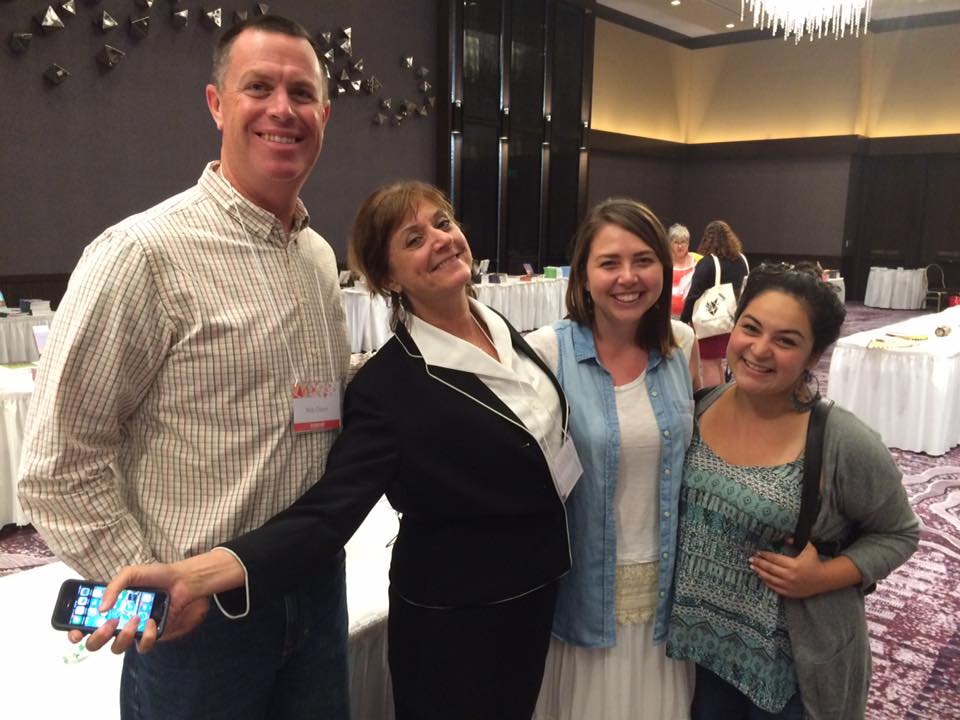
PPS…one final highlight. Here’s a shot of me and two of my staff friends with CBE President Dr. Mimi Haddad:

The (Almost) Overwhelming Power of Culture
 Culture is a powerful thing.
Perhaps it’s a bit like rushing river, where unless you’re a super strong paddler, ideally with a raft full of comrades, you just get carried along wherever the river takes you. On the world’s mighty rivers, when you’re in it’s grasp, it can be tough, even impossible, to get to the bank. Culture can be that way.
Let me illustrate.
The other day, a good friend and I were working on our house. Specifically, we were installing doors. That meant a decent amount of planing, chiseling and sanding.
It also meant Hurricane Lucy.
Our daughter Lucy, almost 11, was our junior carpenter. And to say she was fired up for the job understates it. Question after question, idea after idea, wanting to get a closer look…you get the picture.
You see, Lucy fancies herself a DIY queen. My wife Amy likes the tell the story of how Lucy wandered into a room in our house recently and proclaimed that the space would look better with a tray ceiling.
And then she went on to detail exactly what it would take in order to create such a ceiling.
What’s her source of home renovation confidence? She is a devoted Rehab Addict fan. When she’s around the job site, she’s the micro version of Nicole Curtis.
Just ask her.
So there we were, out in the garage, sanding the edge of the door, when our 13 year old son Joshua appears. Joshua surveys the situation, takes one look at Lucy, sand paper in hand, and says:
“Lucy, that’s a man’s job.”
Whoa. Back up. Slow your roll.
My first thought: “TERTULLIAN IS BEHIND ENEMY LINES!”
To be honest, it was a disturbing comment for me. Here’s why.
Let the reader understand that Joshua has spent each of the 13 years of his life around a marriage that strives hard to be fully egalitarian. From our decision-making to how we divide up the house chores to our co-parenting, Amy and I work hard to live out a marriage of equals.
Next, let’s understand that I work in a job where men and women share power, and so all of his life Joshua has been around powerful women. I’ve lost count of how many “honorary aunts” he has. Josh has seen women preaching, women directing conferences, and women leading meetings. In short, Josh has never lacked for examples of women in roles that have traditionally been in the hands of men.
Still further, Josh has lived in a house where gender equality has been not just been modeled, it’s been taught. For instance, Josh has sat in a room of 200 college students while his father, in partnership with a female colleague and friend, taught on the topic of gender reconciliation. On a smaller scale, as we watch sports together, Josh has had me interpret more Old Spice commercials than he cares to remember.
In sum, while I am sure that in our house I/we could be doing more to both model and proclaim a model of egalitarian partnership between the genders, of any kid I know Josh should be the last one to make a statement like that.
So what’s going on here? How does a 13 year old boy, the scion of committed egalitarians, come to the conclusion that if power tools are involved, it’s a man’s job?
The answer is culture.
Like the rest of us, our son lives in a culture tainted by male privilege. And the older he gets, the more engaged with culture he is, and thus the more influenced by it he becomes.
If I’m honest, it’s at this point in the story where I’m tempted to feel hopeless, to throw up my egalitarian hands and say, “how can we possibly compete with the patriarchal river of culture?”
Perhaps some hope comes from Andy Crouch’s book Culture Making. Crouch’s assertion is that it is indeed possible to change, to shape, culture. For Crouch, the river can indeed be re-routed. He writes:
“The only way to change culture is to create more of it…if culture is to change, it will be because some new tangible (or audible or visible or olfactory) thing is presented to a wide enough public that it begins to reshape their world…So if we seek to change culture, we will have to create something new, something that will persuade our neighbors to set aside some existing set of cultural goods for our new proposal.” (p. 67)
Want to move a river? Tell (and live) a better story.
So, more of the same in the Dixon house. Amy and I will keep making decisions in partnership. I’ll keep preaching and teaching on this stuff. And, for the love of Nicole Curtis, Lucy will keep sanding the doors.
And, gradually, over time, we’ll kick Tertullian out of our house. And then out of our community. And beyond.
May it be so.
It’s the Little Things…
 That Tertullian, he’s a wily one.
To be clear, that’s kind of a new phenomenon. He hasn’t always been this sneaky. After all, what Tertullian actually wrote about women is anything but subtle. In case you need a refresher:
“You are the Devil’s gateway; you are the unsealer of that tree; you are the first foresaker of the divine law; you are the one who persuaded him whom the Devil was not brave enough to approach; you so lightly crushed the image of God, the man Adam.”
Pretty in your face, I’d say.
These days, Tertullian’s influence is far more subversive. As I’ve said before, male privilege, the legacy of thinkers and writers such as Tertullian, basically “lurks in the culture.” It’s like air. You can’t always see it, you aren’t always aware of it, but you sure live in it.
Here’s an example, from, of all things, the world of graphic design and iconography.
This article tells the story of Facebook Design Manager Caitlin Winner’s redesign of the site’s ubiquitous friends icon. The original version (and, for some reason, the one that’s still currently on display on my Facebook page) has two figures, a man and a woman, with the man positioned slightly in front of and larger than the woman. Here’s Winner’s experience of the icon:
“Next, I was moved to do something about the size and order of the female silhouette in the ‘friends icon’. As a woman, educated at a women’s college, it was hard not to read into the symbolism of the current icon; the woman was quite literally in the shadow of the man, she was not in a position to lean in.”
The message? Even seemingly innocuous design elements can communicate our cultural bent toward male privilege. Is it subtle? Yes. Is it unintentional? I think so. But does it perpetuate the problem of male privilege?
I say yes.
Leave it to the Women…
 So far, year two has been even better than year one.
Don’t get me wrong, I loved the first year of my DMiss program. Reading, er, ransacking more than 100 books was good for my soul, and I feel like I learned a ton about flourishing inter-gender partnerships in mission.
On the other hand, you can only learn so much from a book, and, on top of that, reading and writing can be a lonely experience, and even introverts like me need good, old-fashioned human interaction from time to time!
So, that said, I’ve really enjoyed year two. My focus this year is on research. With people. With practitioners. With real-life, bona fide campus ministers who are trying to live out flourishing inter-gender partnerships in mission, day-in and day-out.
So far, I’ve conducted seven interviews, the first tithe of a group that might end up numbering at around ten times that number. And it’s been a blast. I’ve gleaned insight into how folks are holding the value for inter-gender partnerships, what they are doing to live them out well, and I’m slowly but surely gaining clarity about what just might make such partnerships really flourish in my context.
Another thing that’s emerged is that without exception people love working with people of the opposite gender. I mean, they really enjoy it, for a variety of reasons. Because it makes them sharper. Because the diversity of perspectives makes the end product better. Because it’s funner. And more.
This joy in partnership stands out in part because it is a relatively new phenomenon, because the sad fact is that in evangelical history for many years, inter-gender partnerships were something that just didn’t happen. As in, they were off the table as options. Like, don’t even think about it.
And who, you ask, were the folks that dreamed up this preposterous, out-of-the-box idea?
Women.
Recently, I read this piece, entitled “An Era of Women as Institution Builders,” in the third issue of Fuller Magazine, with interest. In the article, the writer, SPU Professor Priscilla Pope-Levison, analyzes the fruitful pioneering ministry of women in the late 19th century though the middle of the 20th century.
Here’s a quote from the article:
When the nation would not permit women to vote, when mainline denominations only begrudgingly allowed laywomen to vote in general church conferences, when a mere handful of women attended seminary, and when women’s ordination seemed a pipe dream, [these women] built their own institutions, undeterred by what culture or church had to say about their prescribed roles. In institutions of their own making, they exercised religious leadership as evangelists who led others to religious experiences, as ministers who shepherded congregations and celebrated the sacraments, as bishops who ordained ministers (female and male), and as theology and Bible teachers who instructed both men and women. By standing in the pulpit, presiding at the communion table, laying hands on ordinands, teaching classes, and evangelizing the masses, they pioneered women’s religious leadership in American Christianity.
Their significant legacy lies as well in their challenge to patriarchy in American Protestantism. These women broke ground as religious leaders by building institutions for women and men and enlisting male and female converts. Men and women joined their churches, sat alongside one another in religious training school classrooms, and filled church leadership positions at all levels. These women evangelists, therefore, rank among the first American women to build–and lead–mixed-gender religious institutions.
I don’t know. Maybe if I had historically been deprived of power, pushed to the margins of evangelical culture, I might be inclined to establish institutions that cared for and developed…people like me. And only people like me.
So how noteworthy is it that these pioneering women had a vision that was so open-handed, so generous, so inclusive, so…
Revolutionary.
Sending a Message
 Someday, when I grow up, I want to own a bookstore.
Like a cool used shop, with lots of old books, furniture for folks to sit on, and a bunch of bibliophiles that come in on a regular basis.
And while I can appreciate those stores where there are books crammed everywhere, two deep and literally flowing off the shelves, a Rob Dixon shop will be the most organized bookstore you’ve ever been in.
After all, it’s my nature. Everything in its place, with clearly marked shelves, fastidiously tidied up at the end of each day. And one thing is for sure:
I won’t let Tertullian influence the relative positioning of the topics.
This morning I walked into a Christian bookstore and saw this:

Put aside the nauseating “Manual to Manhood” title for a second (fourth shelf up on the far right side), with its stereotypical instructions on how to cook a steak, how to throw a football and find a wall stud. That’s stuff for another post.
Instead, look at the juxtaposition.
In an oh-so-subtle way, what could that particular bank of bookshelves be communicating?
You guessed it. That leadership and male-ness belong together. That they are yoked together. Literally, that they share a plastic sign. That of course a bookshop patron would be interested in one if they are interested in the other.
And, in case you’re wondering, the woman’s section was about 15 feet away on another shelf, next to the potpourri, greeting cards and wall hangings.
Can you see what something as innocent as product placement can communicate?!?
As with last week’s post on the U.S. Presidents, it’s important to say that I don’t think anyone is doing anything intentionally here. I’m sure the Presidential poster maker is simply putting faces on a board, and, likewise, this bookshop owner is just putting books where they make sense.
The problem is that when it comes to gender and Christian bookstores, too often what “makes sense” is less about what’s right and more about what Tertullian tells us is right.
 Challenging Tertullian