Sara, From Iran
In case you are tempted to buy Tertullian’s message that women can’t lead, preach, do evangelism, plant churches, suffer for Jesus and more, spend 6 minutes and 48 seconds and let Sara’s testimony from Urbana 15 challenge and encourage you:
Sara – Urbana 15 from InterVarsity twentyonehundred on Vimeo.
Us vs. Them
 Because I routinely spend my Urbanas squirreled away in the conference office, I almost never hear the plenary sessions, and certainly not in full. I mean, it’s been years since I sat through a full talk at Urbana.
So, for me, the week or two after Urbana generally involves watching the sessions to see what I missed.
The other day, I got a chance to watch Dr. Christena Cleveland‘s talk from one of Urbana’s morning sessions.
What a powerful word about us vs. them.
Dr. Cleveland talked about what she called the “power of us;” that is, the group we choose to become a part of goes a long way to forming our perceptions, and the ways in which we see the world.
And this has plenty of implications. On the plus side, as a part of an “us,” we experience deep belonging, and a strong sense of relational affirmation. Indeed, being in an “us” is a fundamental part of what it means to be made in the image of God, as our trinitarian God exists a perpetual, loving relationship between Father, Son and Spirit.
On the other hand, being in an “us” can spark division, because the second you opt into an “us,” you tend to create a “them.” And as soon as someone is a “them,” you can put them in a box and draw conclusions about them. These us vs. them. divisions can therefore dishonor the image of God.
The hopeful news?
According to Dr. Cleveland, bias can be overridden. We can change the way we perceive others. And, with effort and intentionality, a person can recategorize who fits into their internal definition of “us.”
In this we take our cues from Jesus, in Matthew 12:46-50, who radically redefines the definition of family, in the process abolishing the wall between “us” and “them:”
While Jesus was still talking to the crowd, his mother and brothers stood outside, wanting to speak to him. Someone told him, “Your mother and brothers are standing outside, wanting to speak to you.”
He replied to him, “Who is my mother, and who are my brothers?” Pointing to his disciples, he said, “Here are my mother and my brothers. 50 For whoever does the will of my Father in heaven is my brother and sister and mother.”
And though her primary context was race, Dr. Cleveland’s words likewise speak to the context of gender divisions. Because of course Tertullian and his ilk have led us to believe that there is an “us” and a “them” when it comes to gender and our faith communities.
The “us” are men, and, well, membership has its privileges. As a member of “us,” we can expect to receive respect, deference and our choice of leadership roles.
By contrast, for centuries women have been relegated to “them” status, pushed to the margins of church live with limits put on how they are permitted to express their God-given gifts and passions.
As with race, Jesus is our way forward. Jesus will break down the walls.
In closing this post, I was going to work on a paraphrase of Matthew 12, in light of gender divisions in the church. I was going to try to work the text to demonstrate Jesus’ commitment to ushering women from “them” to “us.”
But then I realized that Luke has already done the work for me, in telling Mary’s story from Luke 10:38-42:
As Jesus and his disciples were on their way, he came to a village where a woman named Martha opened her home to him. She had a sister called Mary, who sat at the Lord’s feet listening to what he said. But Martha was distracted by all the preparations that had to be made. She came to him and asked, “Lord, don’t you care that my sister has left me to do the work by myself? Tell her to help me!”
“Martha, Martha,” the Lord answered, “you are worried and upset about many things, but few things are needed—or indeed only one. Mary has chosen what is better, and it will not be taken away from her.”
Thanks be to God that we follow a Lord whose habit it was to welcome women from traditional roles into the position of disciples, from the kitchen into the community…
…in the process inviting women to move from “them” into “us.”
Want to join me in watching Dr. Cleveland’s full message? Here.
“Top of the Notch”
 Two weeks back, I mentioned that I was working on a seminar for Urbana 15 entitled “Women in World Mission: The Untold Story.”
Now I can report that the story has been told, at least my version of it.
If you have an hour and are curious, you can find the audio here. The first 40 minutes are me presenting my seminar and the last 20 capture our time of Q & A.
To be honest, it was sort of weird to listen to myself. And, sure, my inner critic found plenty to fret over. For example, why was I saying “right?” so often? Do I really do that?!? Or, I cringed over little misspeaks, such as when I said “summer missions” instead of “world missions,” or when I somehow morphed the idiom “top notch” to “top of the notch.” And why oh why did I choose to spell out P-A-T-R-I-A-R-C-H-Y?!?
That said, I’m mostly satisfied with my work. I mean if you’re looking for a 40 minute lecture that surveys 2,000 years of missions history with an eye to how the bane of patriarchy has conspired to suppress the stories of faithful women, I can help with that.
As for the Q & A, I’ll grade myself with a “B.” On one hand, I don’t think I said anything heretical as I tried to answer some tough and deep questions. On the other hand, I think I would say some things differently if I had it to do over again.
In the end, it was an honor to present at Urbana. I’m grateful for the opportunity.
And thanks to those of you who were praying for me as I prepared!
PS…I was honored to appear again this week on The Junia Project (here). Turns out my post about gender-based humor in the pulpit has been viewed 36,000 times!
Let’s Be Like Catherine (To a Point, Anyway)
 In my quest to find new missionary heroines for my Urbana seminar, I came across a short biography of Catherine of Siena.
Perhaps you’ve heard of Catherine, a 14th century Dominican mystic and theologian. Catherine crammed a lot of life and ministry into her short 33 years of life. Among other things, Catherine is known for receiving visions from an early age, mercy ministry among the poor, and her vocal political activism (in one case, she lobbied the pope, then in Avignon, to return to Rome).
In the end, I decided not to use Catherine in my seminar. Why?
Well, because the best Catherine of Siena story was simply too gross to tell.
Too gross for my seminar, but maybe not too gross for a blog post. So, buckle up and check out this story about Catherine from the book Daughters of the Church, by Ruth Tucker and Walter Liefeld:
“There are many stories about Catherine’s selfless sacrifice toward others…one of these stories depicts her with a dying woman–Catherine gently swabbing the pus-filled sores, but nearly overcome by the sickening stench.
But then in an instant, Catherine was guilt-stricken by her revulsion. In a demonstration of love and identity with this wretched creature, she picked up the bowl of pus she had drained from the foul sores and drank it, later claiming that it delighted her taste buds as nothing else ever had.”
Wow.
You read that right. Pus. The woman drank pus.
To demonstrate her devotion to serving others.
Out of reverence for Jesus.
Gross, right?
Now, truth be told, sometimes with saints like Catherine, it can be difficult to separate fact from fiction. It’s certainly possible that this story was, ah, crafted (or embellished) by some hagiographer along the way.
But let’s say it’s true, and, if possible, let’s put the pus aside for just a minute. Because we can learn a thing or two from Catherine. About serving the hard to serve. About devotion to Jesus. About soft-heartedness toward God with a willingness to repent.
And, most of all, about the importance of identifying with the poor and broken around us.
So here’s to Catherine of Siena, an example for us all…
…right up until the pus-drinking part.
** Picture of Catherine from here.
Women in World Missions: The Untold Story
 Reflecting on the influence of the Urbana Student Missions Conference, Billy Graham once remarked that fully half of all American vocational missionaries could trace their sovereign call to an Urbana conference.
In other words, when it comes to missions, Urbana is no joke.
This year’s Urbana, which starts this coming Saturday, will be my 8th Urbana and 7th on staff with InterVarsity. As with the last several Urbanas, I’ll do my part to make the conference go by directing the conference office. That means 18 hour (or more) days, serving anyone and everyone that comes through our doors (virtual and actual), and, oh yeah, driving the golf cart all over the Edward Jones Dome.
I can’t wait!
This year, in addition to all of that, I’ll also be leading a seminar. It’s called “Women in World Missions: The Untold Story,” and I have three goals for the seminar:
First, I want to tell stories of some amazing female missionaries from the last 2,000 years. And so I’ll be introducing the crowd to heroines such as Mary Magdalene, Lydia, Junia, Donata, Blandina, Lioba, Brigitta, Ann Judson, Mother Mary and more. The goal is to have students leaving with a new set of heroines they can admire.
Second, I’ll be calling out the villain. After all, I have to explain why these stories have been untold for so long, and that means I’ll need to exposit the tragic history of patriarchy in the church. So I’ll be talking about mis-translated Scriptures, misogynistic quotes from otherwise revered theologians, and the systematic usurpation of women in missions by male-dominated individuals and structures.
Third, I’m going to talk implications. Specifically, I’ll call students to check their hearts for bias, to level the gender playing fields in their contexts, and to recover and remember the stories of valiant women who have advanced the Gospel over the generations.
All of that in about 40 minutes, give or take. And then there’s time for Q&A.
If you’re the praying type, hook me up at 2pm (central) on Monday the 28th. And if you’d like to pray for Urbana as a whole, sign up for daily prayer requests here.
Getting the Message
 Well, I’m back from Researchville! On Friday, I took a deep breath and hit “submit” on my final paper for year 2 of my doctoral program. And then I celebrated with nachos. While the research process this year was a total joy for me, I’m pretty glad for a break.
Now let’s see if that break translates into more regular blogging or not…
On the Monday of Thanksgiving week, I had the opportunity to exposit Galatians 3:26-29 for a room full of Cal Poly Mustangs. I talked about how the text calls for both salvific and social implications. Indeed, according to the passage, God has no gender bias in salvation, and God’s dream is for there to be gender equality in the Kingdom community.
In other words, gender equality is designed to be good news, both eternally and currently.
In terms of application, I challenged the community to do three things: check their hearts for gender bias, search the Scriptures on the topic of gender equality as a community, and work to build healthy male/female ministry partnerships.
I hope the students engaged the message, and I hope their community is changed as a result of it. Since I’m not there in the aftermath, I don’t totally know what the results might be.
What I do know is the impact on my kids. Because it was Thanksgiving break, the Dixon family made the trip together, and the kids came to hear Dad speak.
And as much as I care about college students engaging the message of gender equality, I’m more eager to have my kids embrace it. If you’ve read my blog over the years, you know it’s been a work in progress, but it seemed like this trip was a helpful deposit.
How do I know?
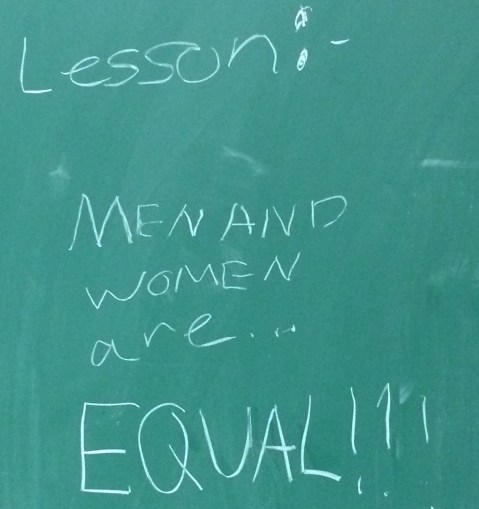
While I was speaking, the kids got some chalk and graffitied the back chalkboard. How’s this for some tagging, Galatians 3 style?!?
My Process
 Greetings from Researchville!
For those of you scoring at home, I’m in the thick of wrapping up the second year of my doctoral program, and it has been a year marked by all manner of academic research. At this point, the end is in sight. I have 40 pages of first draft due on November 20 and then my final paper is due on December 11.
In case you are curious, I thought I would detail my process. In other words, this is what I’ve been up to in lieu of blogging regularly.
First, the research part. The goal has been to cast the net wide and gather as much data as possible on my research problem, namely, the qualities and characteristics of flourishing inter-gender partnerships in my organization, InterVarsity Christian Fellowship.
Primarily, research has taken three forms:
- Participant observation studies. In this method, I’ve sat in the room while InterVarsity staff have conducted a run-of-the-mill staff meeting in order to observe the gender dynamics. You know, stuff like who is sitting where, who talks more (or less), who leads the meeting and how everyone interacts with each other. Think Gorillas in the Mist, only with campus ministers…
- Focus group interviews. I really like this method, as the whole idea is to get a group of staff interacting with one another around my topic. So we’ll have agreeing, disagreeing, and then a bunch of collaborative brainstorming. And when that all happens with some degree of vigor, good data tends to emerge.
- One-on-one interviews. The solo interview format has made up the majority of my research this year, and it has been a joy (and an honor) to hear people’s stories. Early on, I generated a ten question interview route, and I’ve been walking through it with staff from all around the country. Don’t get me wrong, I enjoyed all of the reading in year one, but the personal interaction in year two has been even better.
So…what do you think you get when you combine hundreds and hundreds of pages of notes and interview transcriptions?
Yep. Data. A lot of it. Like an overwhelming pile of information about inter-gender partnerships in mission and what makes them flourish (or not).
So, step two is to code the data.
Coding the data may sound fancy, but, really, it’s simply the process of culling the information in search of nuggets that while help inform my research problem. In my case, I’m seeking to wrangle the data into four different word documents, one that corresponds to each of my four stated research questions.
How do I do this? Simple. Sorta.
Each research question has a letter code. “H” is for “history,” as in, what is the history of inter-gender partnerships in IV? “C” is for “current state,” as in, what is the current state of those partnerships around the organization? “Q” represents “Qualities and Characteristics,” and that’s really the meat of my research. Finally, “F” stands for “flourishing,” as in, what could flourishing look like in my organization in this area?
And, armed with my H-C-Q-F rubric, I sort through my notes and transcripts, marking them up with one of my four designations. I’ve done this on airplanes, in coffee houses, at my kitchen table and even on a clip-board while I’m walking laps. Then, after I’m done with the paper coding, I go back through with my laptop open, transcribing observations or direct quotes in my word docs.
At this point, with most of my research data coded, I’m left with four really robust documents, each with information that (I hope) will help me answer my questions.
And now, step three lies ahead…to write. For this year two final paper, I have to write up two of my four research questions. Deciding which two to focus on is feeling like a challenge! Right now, it’s going to be F and Q, in case you’re curious.
And lest you think drawing the curtain on year two means an end to the research, think again! In some ways, I’m only beginning. In fact, later on this month, after the first draft deadline, I have more interviews scheduled, including one with our president. After that, in year three, more focus groups, more participant observation studies and, ultimately, perhaps a qualitative survey open to all InterVarsity staff.
All of that lies ahead. For now…time to get writing!
Don’t See that Everyday!
So there we were, walking down the hallway of a public High School, on our way to a volleyball game, when I looked up at a TV monitor and saw this:

I’m no expert on all things feminism, and I know there’s plenty to debate about the term, but I do know this:
If feminism is about the things on this screen, and particularly the fourth thing on the list:
I’M A FEMINIST.
(and, if I may, you should be too!)
Standing in Solidarity
 As I’ve been talking about male privilege over the last couple of years, I often get some version of this question:
“So are you saying that men should voluntarily give up power?”
In a word: YES.
I mean, if we’re going to eradicate the scourge of privilege and balance the gender scales, power is going to have to be redistributed. And that means women gaining more power and men giving up power. As I’ve said before (here on The Junia Project blog, most recently), releasing power is not necessarily a bad thing. Heck, if it was good enough for Jesus…
It’s good enough for me.
And, evidently, it’s also good enough for a tithe of Adventist pastors. According to this article, after their denomination voted to not ordain women, a group of male pastors decided to voluntarily downgrade their clerical status from “ordained” to “commissioned,” as a way to stand in solidarity with Adventist women, for whom commissioning is currently the only permitted ministerial option. Here’s an excerpt:
Mike Speegle, senior pastor of an Adventist church in Fulton, Md., said Wednesday (Oct. 14) that he requested and received a change in his credentials late this summer as his way of supporting his female colleagues.
“In our structure, I can’t make them equal with me by ordaining them, but I can make myself equal with them by taking the commissioned license, which is exactly what they have,” he said.
Pastor Kymone Hinds, the leader of a Memphis, Tenn., church, took similar action. He and another minister, Pastor Furman Fordham of Nashville, Tenn., received permission from their regional officials.
“Though I am not in agreement with the position that you brethren have taken on this issue, I admire your willingness to act on your convictions and fully support your right to do so,” wrote Elder D.C. Edmond, president of the denomination’s South Central Conference, in a September letter to them.
Cool, right? And costly as well. According to the article, the choice these men have made comes with clear costs:
Hinds said it was worth it to him to lose access to certain privileges of ordination: presiding over regional conferences; organizing churches; and ordaining elders, deacons or deaconesses.
Imagine that. Out of a place of conviction that gender equality is God’s creation intent, and out of a concern that their denomination was erring by not allowing the same access to power that they enjoyed, these men choose to willingly lay down their ordinations.
Friends, solidarity is a powerful thing.
I’ll give Pastor Hinds the last word:
“I wanted to stand in solidarity,” he said Wednesday. “We realize that our female ministers do the same work and have the same education but there is a glass ceiling over them.”
Amen.
Thoughts on Sowing…
 So I’ve been on a bit of a blogging hiatus recently.
In part, chalk it up to a lot of work on my doctoral program. Turns out interviewing folks is the easy part; it’s the synthesizing work that comes after that’s the challenge!
And, of course, it’s the fall. Which means the Dixon machine has cranked up again in earnest. Between work, school sports, soccer mania and training for this, it’s been tough for this blogger to find time for blogging!
But that doesn’t mean I’ve been silent. Far from it.
I won’t give you specifics, because each of these situations are ongoing and they involve people that I care about, but three times lately I’ve had the opportunity to offer a word of gentle (I hope!) correction in the area of gender.
What am I talking about? Subtle things, like someone using gender exclusive language when an inclusive term would be a better fit. Or calling out someone on social media for their clear bias toward men when the topic should be universal.
All of this comes in my attempt to be prophetic. In other words, I want to use my voice (verbal and otherwise) to correct our Tertullianized culture, particularly in the church.
But here’s the thing…I can only control my part of the equation. The response? Well, that’s about the person or people I am engaging with.
And on that account it’s been a mixed bag. Of my three recent situations, one went without any response at all. Like, crickets.
A second one involved a hearty back-and-forth, one that resulted in greater understanding but was ultimately less than satisfying for me.
And then the third one was, in a word, perfect. This person graciously received my input and asked for my help in generating a solution.
So, one out of three. Batting .333 I guess.
All of this reminds me of Jesus’ Parable of the Sower. You know the story. A farmer goes out to scatter the seed, and tosses it indiscriminately across the ground.
And some of it hits the path, where it’s picked clean by birds. Other seed falls into the rocks, where there’s shallow soil. And though something grows, it quickly dies. Then there’s the seed that falls into the thorns. Again, initial growth followed by the plants getting choked out.
And then there’s the fourth soil, the stuff the produces the harvest. According to Mark’s account, it’s the really good stuff, producing a crop that ends up “growing up and increasing and yielding thirty and sixty and a hundredfold.”
To me this parable captures the plight of the prophet. You can’t control the results. Some folks will respond well and others won’t.
All you can control is heart towards God, your willingness to speak, and the words you use to deliver the message.
The rest is up to the hearer.
 Challenging Tertullian
