Who are Your Faith Mentors?
 I have been and am currently blessed to be mentored by godly, gifted and faith-filled women.
And though their stories have been shadowed or obscured in the historic ecclesiastical fog of male privilege, the truth is that there have always been women worthy of emulating in the church. Today, these are women whose stories can and should mentor us as models of faithfulness.
Last week, I came across this article, entitled “5 Women of the Early Church You Should Know.” Read it and allow your faith to be inspired by the examples of these women. Here are the first few paragraphs:
Christianity bore a unique position in Roman society by seeing women as equal to men in worth. Today, we are seeing a backlash to what many perceive to be the Christian position of patriarchy. Some have decided that because Christianity won’t get with the times, than it’s time to throw the “baby out with the bathwater”. However, there are many others, like myself, who look at Christian history and see a long tradition of women put in positions of honor equal to men. Paul himself says in Galatians 3:28, “There is neither Jew nor Gentile, neither slave nor free, nor is there male and female, for you are all one in Christ Jesus.” Jesus demonstrated that while men and women may have different roles in their service to God, neither one is more valuable than the other.
A prime example of this is Mary, the Mother of God, also known as the Theotokos, or God-bearer in the Eastern tradition. Mary is a model example for all Christians and if you look at her role from a historical perspective, that is absolutely shocking. Think about how it would have seemed for a patriarchal society to encounter Christianity in the early centuries and to find out that they have icons, feasts and a highly honored place for a woman in this budding religion.
I’d like to highlight five other women in early church history who are honored as saints and considered models for our own lives.
Priscilla (1st century)
Priscilla is often mentioned with her husband, Aquila in several places within the New Testament. Her role as a leader along with her husband was instrumental in building the early church. Aquila and her both were missionaries who lived and worked with Paul on his journeys. She’s also noted with her husband for instructing Apollos, an important evangelist in the Church.
It’s important to note the radical nature of her marriage to Aquila. She was not considered his property or even mentioned secondarily by other men, but she had direct influence and access to Paul and other apostles, as friends. This already tells us a lot about the structure of Christian marriage and relationships in the 1st century.
Phoebe (1st century)
In Romans, Paul refers to Phoebe as a “presiding officer” over many. She’s also mentioned as a “deacon” (diakonos) and a “helper or protector of many” (prostatis). She’s the only woman in the New Testament that is called out specifically in this fashion. Little is known about her exact duties, but it’s clear that she was considered a leader and authority figure of some note. Some scholars even contend that she could be called the equivalent of a pastor or minister in part because of the terms Paul uses for her title.
What we do know is that Phoebe shepherded a lot of new Christians into the faith and was responsible for building the church in the region of Cenchreae and has been canonized as a saint in both the eastern and western traditions.
Want a bit more? Check out this category of posts here.
On Giving Up Power for the Sake of the Mission
 It’s so rare when someone willingly gives up power.
It’s even rarer when someone gives it up joyfully. And yet you get the sense that that is exactly what’s happening in Indiana.
In case you missed it, last week I blogged about the dramatic shift that leaders of one congregation are entering into around gender and power. Specifically, after prayer and discernment, they are choosing to open up their church leadership, at all levels, to women. This is a full-blown reversal from the church’s historic, restrictive posture.
There’s a lot to appreciate in this willful power exchange, but I think I’m most glad to see the emphasis on mission. For these church leaders, there is a deep conviction that accomplishing God’s mission requires both men and women using their gifts. Truly, it’s “all hands on deck.” I’ve blogged about mission before, here and here. And you’ll see the focus on mission in the quotes below.
In any event, the story continues to trickle out. Here’s an excerpt from this Christian Post article about the story, and thanks to Jeremiah Gibbs for the twitter share. Enjoy!
The brokenness of the world is reflected in the “equity and dignity between men and women,” according to Teaching Pastor Tim Ayers, who preached on Feb. 9 the second part of Grace Church’s new teaching series. In that message, Ayers spelled out the results of the leadership’s painstaking exegetical endeavor into the Bible’s position on female leadership.
“Our governing board and our pastors deeply studied the overall tenure of all of Scripture related to leadership within the people of God,” explained Ayers. “Then, they wrestled with God’s initial intentions, the world’s brokenness and God’s desire to repair that brokenness. Then, they affirmed that the task of the Church is to heal the broken places that resulted from the Fall and to live out in this world as best as we can God’s initial desires for His world. And they came to the conclusion that one of these broken places is the inequity that exists between men and women.”
Ayers insisted, “This decision is not a slippery slope. It is getting in line with God’s initial designs for His people, it is taking the whole of Scripture seriously, and it’s standing against the structures of a fallen world.”
The Grace Church teaching pastor stated that “the issue in 1 Timothy is competence and character” and that “according to Paul, race and class and gender are not the issues.”
“We need the best people that God has given our community at the table,” Ayers stated, “people who meet the character demands that Paul gives us, people who know the Word, people who walk in submission to the Spirit of God, and who live lives of prayer.”
The leadership’s decision to lift Grace Church’s gender restrictions and affirm female leadership did not come as a compromise to culture or to “make a point.” But rather, said Ayers, the decision was about a desire to allow all the people of Grace Church to join God in His mission in bringing salvation and hope to the world.
You Go for the Sports, You Get the…Skin
What’s the most appalling thing from this cnnsi.com screen shot from last night?
Hint: it’s not the Lakers score.
Come on folks. I want the Olympics, not the objectification!

The Tale of Two Blog Posts
 It was a dizzying week for posts about gender and faith.
First, there’s this post, from John Piper’s desiringGod.org. In the post, the author, John Ensor, uses pairs figure skating as a metaphor for the husband/wife relationship. Here’s an excerpt:
“He leads her onto the ice and initiates each part of their routine. She receives that leadership and trusts in his strength. His raw physical strength is more on display than hers; he does all the lifting, twirling and catching. She complements his strength with her own; a more diminutive and more attractive strength of beauty, grace, speed and balance. His focus as the head or leader is to magnifying her skills. Her focus is on following his lead and signaling her readiness to receive his next move. He takes responsibility for the two of them and she trusts his leadership and delights in it.”
Meh.
If you ask me, that’s a pretty apt description of the prevailing winds of male privilege that remain stubbornly entrenched in the church.
The narrative goes like this: men are stronger, better leaders, both in the home and in the church, while women are supporters and receivers. It’s simple. Live this way and you’ll see “male leadership and female support making one glorious whole.”
Simply put, this brand of theology limits women and pressurizes men. Further, it hampers our mission. And the embedded power differential means that equality is an unattainable reality.
Or is it?
Because this week I noticed this post. Read it and weep. With joy.
Here’s the story. 6,000 person megachurch in Indiana has a long history of male headship. Like the theology above, traditionally all of their lead pastors and preachers have been men.
So what happened? From the article:
“Grace Community Church, an evangelical church of 6,000 worshipers just north of Indianapolis, reversed their position and came out in favor of women’s leadership at all levels this weekend in their public worship services.
This is no liberal accommodationism. This is a conservative church that is focused on the teaching of the Bible. They have a staff of about 50…with men in all their traditional roles (pastors, elders, and adult ministries leaders) and women in all their roles (women’s ministry, children, and secretaries). But with a thorough study of Scripture and full of prayer, these men knew that Scripture demanded that women not be prohibited from leadership at all levels.”
Allow me to recap, for emphasis.
A group of male pastors, leaders of a sizable, conservative midwestern church, sense the Lord challenging their theologies around the role of women in the church. So they go to work. They pray, they read, they study, they talk. And then…
They change their perspective.
In the post, the author calls this a “changing of the evangelical tide.” He notes a 2011 Pew Research poll that says that 75% of evangelical pastors now think that women can and should serve in the pulpit.
I sure hope he’s right.
And if he is, we’ll need to rethink our Olympic metaphor.
Back to figure skating, because perhaps we can redeem John Ensor’s choice of metaphors.
According to this post, the Ensor piece really misrepresents the sport. For instance, according to the author, in pairs figure skating the real leader is first the choreographer and then the music.
In fact, really the couple’s role is to partner together in following the leader.
Come to think of it, sorta sounds like a different brand of theology.
One thankfully being embraced in Indiana.
Jesus, Gender and Faith
 Two nights ago I got to speak on the topic of gender reconciliation.
And, wow, it was terrific. First of all, it never ceases to amaze me how novel topics around gender and faith are for people. Truly, it exposes the lack of intentional conversations about these things, both in the culture and, particularly, in the church.
Next, in large part because of that novelty, it strikes me that people are hungry for teaching and training on these topics. We could have gone for hours the other night, because once I had raised the issues, people wanted to both process them and share their stories.
Finally, it was a great experience for me personally. When I got home I said to Amy, “that’s what I want to do when I grow up.” It feels great to share the thinking I’ve been doing and to see it benefit, bless and challenge people. I was a very satisfied teacher the other night!
I’ll share some of the content with you over time, but here’s a quote that I’ve really been chewing on, about Jesus, gender and faith. It’s from a book entitled After Eden by a team of writers. Read this and chew along with me!
“The life and teachings of Jesus as revealed in the Gospels and the account of his continuing work through the Holy Spirit in the New Testament church display God’s will for gender relations. It is God’s desire to oppose societal patterns that elevate some persons over others and that harm, demean, subordinate, and oppress various women and men. It is God’s will to restore gender relations to the mutuality and equality that characterized the covenant partnership of woman and man in creation. Christ was sent by God the Father and anointed with the Spirit to initiate, among other things, this redemption of gender relations.”
An Olympian Challenge
 What’s your favorite Olympic sport?
Personally, I like the luge, though I don’t think I could summon the courage to wear that suit. I also love the bobsleigh. Sign me up for that one. And who doesn’t love Olympic hockey? Blend normal, NHL-level hockey intensity with the jingoistic fervor of national pride, and you’ve got quite the spectacle. I can’t wait for the medal rounds.
But of all the great sports out there, how about ski jumping?
A skier, hurtling down a ramp at more than 60 mph, bursting into the air and into a drop of more than 14 stories. It’s mind-blowing.
It’s also been male only. At least until this year.
Yep, this is the first Olympics where women will be able to put on the skis and soar through the air. After 90 years of male domination, in Sochi women will attain gender parity in the sport of ski jumping.
Here’s the story, from this article:
“After decades of campaigning and a full 90 years since the first men’s competition, women will finally compete in Olympic ski jumping at the Sochi 2014 Games.
Despite the fact that men’s Olympic ski jumping has been around since the 1924 games, women have spent the last few decades campaigning for inclusion. This year, the first ever U.S. women’s ski jumping team will include Lindsay Van, 29, Jessica Jerome, 27, and reigning world champion Sarah Hendrickson, who is just 19 years old.
Although the reasons women were prevented from participating in the Olympic sport were mainly logistical, barring women from specific sports is rooted in gender bias — particularly the dusty old notion that rigorous physical activity is dangerous to women’s reproductive organs.”
To be clear, the news is not all good.
According to the official Sochi site, women will compete in the normal hill only, while men will compete in both the normal and large hills, and there is a team competition for the men. So that’s one competition for the women and three for the men.
Still, it’s a start.
Perhaps you’ve seen the VISA commercial celebrating this milestone and featuring Sarah Hendrickson. If not, here you go.
As the article notes, other Winter Olympic sports have led the way in gender parity. So, props to sports like cross country skiing, speed skating, curling, hockey and bobsleigh.
And now it’s your turn Nordic combined.
Note: cheer on the women ski jumpers as they compete on February 11th with the start of the normal hill competition.
Dear Charlotte
 Truth be known, I watched very little of the Super Bowl. As in, I maybe caught 20 minutes.
Granted, 20 minutes was more than enough to see the Fighting Pete Carrolls decimate Peyton and Co. #orangecrushed
It was also enough to catch a taste of the commercial onslaught and from the little I saw, it was a mixed bag. On one hand, you had actress Scarlett Johansson shilling for Soda Stream. In case you missed it, let’s just say that the ad involves wind machines, the seductive use of a straw and, oh yeah, a lab coat that somehow gets removed halfway through.
On the other hand, there was the GoldiBlox commercial (here). Wow. In the ad, a torrent of little girls gather all of the neighborhood’s pink toys and launch them into space!
What’s the message?
Girls can build things, people!
Don’t believe me? Just ask Charlotte.
Two Tertullian readers sent a link to this letter that a girl named Chartotte wrote to the folks at Lego. Here’s an excerpt:
“My name is Charlotte. I am 7 years old and I love legos but I don’t like that there are more Lego boy people and barely any Lego girls.
Today I went to a store and saw legos in two sections the girls pink and the boys blue. All the girls did was sit at home, go to the beach, and shop, and they had no jobs but the boys went on adventures, worked, saved people, and had jobs, even swam with sharks.
I want you to make more Lego girl people and let them go on adventures and have fun ok!?!”
I don’t know about you, but Charlotte opened my eyes. Because, of course, she’s totally right. I went and hunted through our family Lego box (consisting of vintage Legos from my childhood blended with a bevy of new fangled pieces that are way too specific if you ask me), and, sure enough, we have nary a female Lego person.
What’s the message there? Boys build things and girls do not. #notbuyingit
After Charolotte’s letter went out on the internet, Lego issued this response, which reads in part:
“LEGO play has often been more appealing to boys, but we have been very focused on including more female characters and themes that invite even more girls to build, and in the last few years, we are thrilled that we have dramatically increased the number of girls who are choosing to build. While there are still more male characters than female, we have added new characters to the LEGO world to better balance the appeal of our themes.
We are constantly developing our product collection, and new roles appear for both male and female minifigures. The great thing about LEGO play is that you are always able to create whatever adventure suits your interest, using the LEGO minifigures as your guide.”
So its getting better, and that’s good.
To speed it up, perhaps we should gather a bunch of male Lego people and launch them into space?!?
Tertullian in Latin America
 Another lifetime ago, my wife and I led several missions trips to Guatemala.
Oh what a joy those trips were! Sure, we helped others. We planted some corn, we vaccinated some chickens. We taught classes. And we ran the health clinic.
But, most of all, those trips changed us and our students.
Considering a short-term missions trip? GO. But, first and foremost, go because you want Jesus to change YOU.
One of the ways that God used those trips in my life is to help me care about the world. About injustice. About the poor. About marginalized people that I’ll never meet but am nonetheless called to love. And while it’s true that over the years God has enlarged my concern to include many other countries around the world, it started in Guatemala.
To put it simply, my heart beats for Guatemala.
Because of this, when it’s in the news, Guatemala catches my eye. And the other day, I read this piece about the tragic trend of not counting indigenous girls in Guatemala.
Imagine not having a birth certificate. Or a Social Security Card. Or a passport.
As the article says, “what if you didn’t know when your birthday was? What if your government didn’t know you existed? What if you weren’t counted at all? Counting means a lot of things but mostly ‘I count’ means ‘I matter.'”
The tragic thing is that this is ubiquitous around the world. It’s not unique to Guatemala. Whether it’s women living life without identification or sex-selective abortion and infanticide as exemplified by China’s one-child policy, in many places of the world…
…to be born a girl is to be born in jeopardy.
In their book Half the Sky, Nicholas Kristoff and Sheryl WuDunn write:
“The global statistics on the abuse of girls are numbing. It appears that more girls have been killed in the last fifty years, precisely because they were girls, than men were killed in all the battles of the twentieth century. More girls were killed in this routine ‘gendericide’ in any one decade than people were slaughtered in all the genocides of the twentieth century.”
This summer, my family and I will be back on the front lines, leading a team to Costa Rica. We’re looking forward to partnering with local ministries to serve the poor in and around San Jose. More than that, we’re looking forward to Jesus shaping us as we do that.
Costa Rica gets a lot of press for being Western friendly. I think what that means that is that you find your favorite restaurants, not have to speak Spanish and, heck, they’ve got a “blue zone” in Costa Rica.
Sadly, even a brief search shows that Costa Rica is not immune to the oppression of women. This article talks about how in many ways it’s better to be a woman in Costa Rica than it is in Guatemala, or even in the United States (lower wage gap, more representation in politics, etc.). And yet there’s also this:
“The National Institute for Women is particularly active on issues relating to violence against women, providing services to victims as well as advocating for better legal and practical protection. Sex work is legal, but pimping is against the law. Sexual violence remains a problem, with some evidence that rates have increased in recent years. Trafficking in women and even children is a growing concern.”
Time to ask the Lord to open my heart to a new country.
Sunday Prayers
 Last year, I reported on male privilege and the Super Bowl after the game.
This year, how about a preemptive strike?
Tragically, the Super Bowl is more than the biggest football game in the world. According to many, it’s also the biggest human trafficking event in the world. Last year, commenting on the objectification of women manifest in both trafficking and in those famous commercials, I called the Super Bowl “an annual crescendo in our culture’s habitual exploitation of women.”
This article, which includes one trafficked woman’s story, reports on the reality of Super Bowl trafficking:
Exact numbers are in dispute and hard to quantify, but according to the New Jersey Coalition Against Human Trafficking, “The Super Bowl attracts tens of thousands of fans to the host city … But it also attracts a sector of violence, organized criminal activity that operates in plain sight without notice including human trafficking in both the sex and labor industries.”
There are several reasons why sex trafficking may increase around a huge event such as this. As hundreds of thousands of people (mainly men) flock to the New York City metro area for the week’s festivities, the primary motivator for increased prostitution is increased demand for it. According to Dorchen Leidholdt, adjunct professor at Columbia University who teaches about violence against women, “The demand for prostitution will drive trafficking. … It’s supply and demand.” According to documentary filmmaker Jane Wells, who produced a film on the topic, “There is corporate entertaining, parties, alcohol, corporate-sponsored parties, people away from their families, anonymity. It’s kind of like a perfect storm.”
This year could be worse. CBS reported, “Many believe the state’s sprawling highway system, proximity to New York City and diverse population make it an attractive base of operations for traffickers.”
Horrific.
So, what to do about this perfect, tragic storm?
How about we pray?!?
The organization I work for, InterVarsity Christian Fellowship, is all about developing world changers. And alum Francis Socorro fits the bill. Francis went to our New York Urban Project in 2010, and she wants to put a stop to trafficking around the Super Bowl. She’s serious about it. Here’s what she and her friends are doing, from this post here:
“For about a year now, my five friends and I have weekly prayer meetings via conference call. The Super Bowl was one of the topics we would continuously pray about. The Super Bowl is commonly known as the single largest human trafficking incident in the United States. Now that the Super Bowl is a week away, and in our backyard, we have to do something about it. Numerous organizations are doing awesome things like approaching motels before this year’s Super Bowl and offering them free bars of soap with the National Human Trafficking Hotline phone number. Since we couldn’t help physically, God has laid on my heart to pray for the hotels that surround MetLife stadium.
So I mapped out hotels near MetLife stadium. I assigned each friend a hotel that they will pray for this week. Joanna will pray for Econo Lodge Meadowlands. Kat will pray for Hampton Inn Carlstadt-At the Meadowlands. Michelle will pray for Fairfield Inn East Rutherford. Sandy will pray for Holiday Inn Express Hotel & Suites Meadowlands Area. April will pray for Homewood Suites by Hilton East Rutherford. And I will pray for Renaissance Meadowlands Hotel. We will first research our hotel. Then we will gather information about previous super bowls and how human trafficking was linked to that. As we go about our week, we will keep that hotel in prayer and be open to whatever God wants to share with us. Then this Sundaywhen we gather for our Super Bowl party, we will talk about our week of prayer and intercede for the event. And of course, watch the Super Bowl!
We may not be like IJM rescuing victims on the front lines, but we can stand in the gap and intercede with Jesus for His people. Prayer moves the hand of God.”
Indeed!
Friends, this Super Bowl Sunday, may God’s hand move in concert with our prayers to make this forecasted storm disappear. Lord, change the world!
Asking the Pope for More
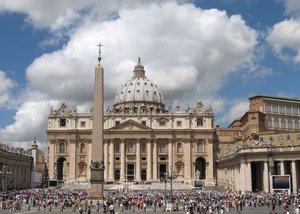 Like many protestants, I have loved the papacy of Pope Francis.
How could you not love a pope who lives not in the lavish papal apartments, but in the Vatican guesthouse? How could you not love a pope who randomly calls parishioners who have dropped him a note? Heck, how could you not love a pope who rides a Harley? And then sells it to bless the poor?!?
He’s amazing. And in large part he’s been amazing for women. Though he hasn’t seen fit to erase the Vatican’s historic bias toward men in the priesthood, he has made it a point to elevate women. In fact, when the pope affirmed the fundamental value of women, I blogged about him here.
So I read this article yesterday with a hearty helping of sadness.
Because on Saturday, Francis addressed a room full of Italian women. Here’s a bit of what he said:
Francis told his audience that he had stressed “the indispensable contribution of women in society, in particular with their sensitivity and intuition toward the other, the weak and the unprotected.” He said he has been heartened that “many women share some pastoral responsibilities with priests in looking after persons, families and groups” and he said he had hoped that “the spaces for a more diffuse and incisive presence in the church be expanded.”
In some parishes, women visit parishioners too frail to come to church, run prayer groups and outreach programs to the poor, as well as help distribute communion to the faithful at Masses, especially in churches with large congregations.
“These new spaces and responsibilities that have been opened, and I strongly hope that they can further be opened up to the presence and activity of women, both in the church environment as well that of the public and professional” spheres, Francis said, “cannot make us forget the irreplaceable role of the woman in a family.”
A couple of comments in response.
First, in that last sentence, I’m tempted to read a bit of “a woman’s place is in the home” into Francis’ words. Can you see it too?
I mean, of course a woman’s place is in the home.
But so is a man’s.
If I’ve learned anything on my parenting journey, it’s that it takes two to tango. In fact, it takes more than that, as help from family and friends is crucial. Honestly, I’m really not sure how single parents do it.
Let’s be clear. Both women and men have irreplaceable roles in the family. And, to go a step further, I would say that husband and wife are called to share the leadership role in the family, with specific roles being assigned by gifting/personality, not by gender. This week, blogger and writer Sarah Bessey beautifully described her egalitarian marriage (here), a marriage where she and her husband share leadership.
That’s the kind of marriage Amy and I are after too.
Second, I appreciate the fact that the pope is valuing and even calling out the particular gifts that women bring. And he is right. Women do bring sensitivity, intuition and pastoral skills to the work of the Kingdom. Elsewhere in the article, Francis is quoted as saying that women bring “gifts of delicateness, special sensitivity and tenderness.” I’m sure he’s right about women bringing those things too.
But that’s not all that women bring.
What about decision-making? Discernment? Peace-making? Administration? Faith? And a hundred more things. Heck, what about women bringing…
Leadership?
Furthermore, it’s not just women that bring the gifts that Francis is noting. Men do so as well.
The bottom line here is that I will continue to cheer on the pope, particularly as he relates with women.
And yet at the same time, I long for the day when there is gender parity both in marriage and in ministry, not just the Catholic Church, but in any church.
Come to think of it, maybe Pope Francis will call me sometime and we’ll have a chat. Clearly, I’ve got a few things I’d like to share with him.
 Challenging Tertullian