Take it from Jimmy
 I sure hope that when I’m almost 90, I’m as vibrant, sharp and feisty as Jimmy Carter.
Maybe you’ve seen the former president making the rounds lately promoting his new book A Call to Action? He’s gone toe to toe with Colbert, and then I really appreciated his turn on Letterman. I’ve watched a lot of Letterman in my day, but I’d never seen an interview like the one Dave did with Carter. I mean, how often do Dave and a guest talk about topics like honor killings and forced marriages?!? I found that interview to be a powerful exposition of Carter’s core message about empowering women.
Interested, I picked up a copy of A Call to Action, and I’ve been reading it over the last week. Carter’s challenge is really to religious leaders, and it’s a call to forgo the traditional interpretation of holy books where women are portrayed as second-class citizens. Because when women are second-class, and when that status is reinforced by religion, it is all too easy for them to become victims of violence.
Here’s a bit more of Carter’s thinking:
“There is a similar system of discrimination, extending far beyond a small geographical region to the entire globe; it touches every nation, perpetuating and expanding the trafficking in human slaves, body mutilation, and even legitimized murder on a massive scale. This system is based on the presumption that men and boys are superior to women and girls, and it is supported by some male religious leaders who distort the Holy Bible, the Koran, and other sacred texts to perpetuate their claim that females are, in some basic ways, inferior to them, unqualified to serve God on equal terms. Many men disagree but remain quiet in order to enjoy the benefits of their dominant status. This false premise provides a justification for sexual discrimination in almost every realm of secular and religious life. Some men even cite this premise to justify physical punishment of women and girls.
Another factor contributing to the abuse of women and girls is an acceptance of violence, from unwarranted armed combat to the excessive and biased punishment for those who violate the law. In too many cases, we use violence as a first rather than a last resort, so that even deadly violence has become commonplace.
My own religious experiences and the testimony of courageous women from all regions and all major religions have made it clear to me that as a result of these two factors there is a pervasive denial of equal rights to women, more than half of all human beings, and this discrimination results in tangible harm to all of us, male and female.”
Boom.
When you’re challenging Tertullian, it’s nice to have a former president on your side.
I’m In, It’s On, Here We Go!
Awhile back, I mentioned that I had applied for a doctorate program.
Well, I got in.
Here’s what they told me:

I know what you’re asking…”what the heck is a Doctor of Missiology program anyway?”
I’ll try to explain.
To me, missiology is the study of how the good news about Jesus goes out to the world through the church. That’s my laypeople’s definition. Want a more, er, robust definition? Try this one, from this post:
“Missiology is an interdisciplinary discipline which, through research, writing, and teaching, furthers the acquisition, development, and transmission of theologically-informed, contextually-grounded, and ministry-oriented knowledge and understanding, with the goal of helping and correcting Christians, and Christian institutions, involved in the doing of Christian mission.”
On second thought, go with mine.
Simply put, I’m going to spend the next four years journeying alongside a cohort of ministry leaders from around the world learning about how the church can do a better job fulfilling its God-given mandate. I’m anticipating a lot of fun, some serious hard work, and near constant reading and writing. At the end of the program, I’ll be writing a dissertation and defending it before a committee.
And on the front end, DMiss students are tasked with presenting their “problem,” the particular missiological issue that they will be exploring. I’m told that everyone’s problem gets tinkered with early in year one, but for now, see below for what I’m thinking I’ll be tackling. I’m looking forward to bringing y’all along with me!
It is safe to say that I would not be the person, disciple or minister that I am today were it not for the influence of godly women. Indeed, in 2 Timothy, when Paul exhorts Timothy to recall the faith of his grandmother and mother, I can identify with Paul’s young protege. Likewise, in my life, God has used female family members, peers, partners, mentors and followers to form me spiritually more fully into the likeness of Jesus.
And for more than 16 years of ministry with InterVarsity Christian Fellowship/USA, it has been my privilege to share in the formation of women as well as men. Many of my enduring ministry partnerships cross gender lines, and today I lead a ministry where women are empowered to use their gifts to their fullest in pursuit of our campus mission.
Still, along the way I have experienced challenges, both internal and external. I’ve had to face my own gender brokenness. I’ve come up against the systemic patriarchy both in American culture and in my organization. And, from time to time, I have had to engage with theological opponents in conversations that have been both taxing and painful. After all, it is never easy to be called a “false teacher” because you are allowing women to preach in your ministry.
Because of this, I am interested in expositing models for healthy gender equal ministry partnerships where both men and women can flourish. I want to construct a set of cross-gender competencies by which we could measure whether such a ministry partnership is successful. And I am eager to discern ways to help both men and women become more competent and ready to establish mutually empowering partnerships. In the end, I want to push against what I believe to be the church’s frequent conclusion that men and women cannot simultaneously flourish in ministry with one another.
Accordingly, I propose a DMiss study entitled “Women and Men Flourishing in Mission: Models of Healthy Gender Equal Ministry Partnerships.” This study will take place within the context of my organization, InterVarsity Christian Fellowship/USA, where I serve as a Divisional Director in central California. My intention is to do my field research both locally, in the portion of InterVarsity that I am responsible for, and nationally. For this latter portion, I intend to rely on the access provided by my supervisors as well as by InterVarsity’s National Women’s Council.
No leader can choose their legacy. But if I could, it would be to articulate and then field test a paradigm of cross-gender ministry partnership where both men and women are fully flourishing. My hope is to leave such a thing as a gift, to InterVarsity, to the church, and to the advancement of God’s mission in the world.
Want Some Hope Today? Here.
 It’s been a rough week in American Christendom.
And while the issues surrounding World Vision’s decision and subsequent reversal, and the amped-up responses to both, are outside the normal topical scope of this blog, I’ll just say that when American Christians publicly fight amongst themselves, particularly with such vitriol, we all lose. More than that, the mission loses. And that’s tragic.
Oh how I crave healthy venues that demonstrate that Christians can disagree, deliberate and debate…in love. On this week’s LGBTQ topic for sure, but also on every topic, gender equality and male privilege included.
Lord, have mercy.
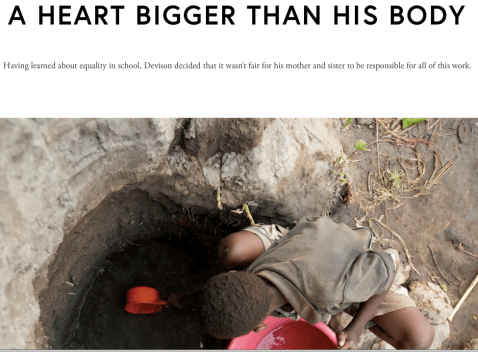
So in light of the week that has been, allow me to share a story of hope. It’s the story of “The Boy Who Walked For Water.” It’s a photo essay, and, trust me, you’ll be glad you experienced it.
What could an obscure Malawian boy teach us about courage and boldness? Heck, what could such a boy teach us about gender equality?
Plenty.
To whet your appetite, here’s a screen shot:
Just How Ought We Hold This Stuff?
 Last week I was talking with someone about their theology of “women in leadership,” and it was clear that she and I disagreed on the topic.
To be specific, whereas my understanding of the Scriptures compels me to the position that women and men are to share leadership, power and authority in God’s Kingdom in equal measure, this woman’s perspective was that women must not teach or have authority in the presence of men.
And as we talked more about it, it became clear that this woman’s posture was that she could hold her conviction and yet still fully participate in a gender-equal ministry context.
“How could that be?” I asked her.
Her answer?
“It’s like a tertiary issue.”
A tertiary issue?!?
Sadly, I didn’t have time to dig deeper into her taxonomy for how she ranks Biblical issues and theologies. Evidently, she has a developed grid, if she can rank something as “tertiary” instead of “primary,” “secondary,” or, what, “quadiary?!?”
In her Junia Project post from last week, Gail Wallace captures a bit of this sentiment:
“Some frame the debate about women sharing authority in the church and home as a “secondary” or “women’s” issue. Women advocating for shared leadership may be accused of wanting to be like men, of being selfish, or of fighting for their rights when there are more important things for the church to address. But it’s a mistake to assume that this is a minor issue or something that only impacts women.” (emphasis mine)
Indeed.
And in the rest of Gail’s piece, she shares three reasons why this is true, from the writings of Dallas Willard. I highly recommend the whole post.
Here’s what this has me musing about this morning:
I think it’s time for the “women in leadership” or “women in ministry” labels to go.
For two reasons.
One, as Willard rightly notes, the conversation has to do with men and women alike. If women cannot lead, or do ministry, in the presence of men, then the implication is that it’s all for men to do. And the converse is also true. So, both genders are impacted by the question of what the Bible has to say about gender roles in the church.
Secondly, we need a new vocabulary because the “women in leadership” label is inaccurate. After all, almost no one fully restricts women from “leadership” or “ministry.” Even in the most conservative complementation churches, women are exercising leadership in plenty of capacities and contexts, from coordinating the weddings to directing the children’s ministry to running the office. Instead, the precise issue is more like “authoritative leadership in the presence of men.” In other words, opponents of “women in leadership” are really talking about a narrow slice of the leadership function of the church.
So, perhaps it’s time we reframed this conversation?
In about a month, I’m going to be teaching on this topic. The leadership team who is bringing me has asked me to speak about “women in leadership.” So let me test drive a new way to describe or label the conversation. What if I started the talk like this:
“Tonight we’re not going to examine ‘women in leadership.’ That’s too narrow of a topic. Instead, we’re going to look at what the Bible has to say about how power works in the community of faith with regard to gender.”
I think that language is broader. And more accurate.
Let me close with a nod to Willard, again from Gail’s post:
“So the issue of women in leadership is not a minor or marginal one. It profoundly affects the sense of identity and worth on both sides of the gender line; and, if wrongly grasped, it restricts the resources for blessing, through the church, upon an appallingly needy world.”
Tertiary? No.
Secondary? No.
Central and primary? Yes.
“The Oldest Injustice in Human History is the Way We Treat Women”
 Some days, you go to write a post and then you realize that someone else has already written it.
For the past couple of months, I’ve been reflecting on how justice (or injustice) factors into this process of discerning how to handle my male privilege. Yesterday morning, I encountered a blog post that touches on exactly that topic.
It’s by pastor Eugene Cho, and while the post is largely about the development work that his organization, One Days Wages, is doing around the world, there is a devastating section on the plight of women in the world. Cho writes:
“The oldest injustice in human history is the way we treat women.”
(this is actually the title of an earlier post on Cho’s blog here)
Wow. What a strong statement. At once it captures the persistence of this malady and it also articulates the scope of the problem. And the noun “injustice” is perfect, because that’s exactly what this is.
In his post from Tuesday, Cho quotes an article from the Public Health Institute entitled “Girls: the World’s Greatest Return on Investment.” Here’s the quote:
Consider this – research demonstrates that girls who complete seven years of schooling will marry four years later and have 2.2 fewer children than girls who do not complete primary school. Yet even though the economic and social returns of investing in girls are undeniable, World Bank research demonstrates that only two pennies of every dollar in international aid funding goes to support programs for girls.
In Davos last month at the World Economic Forum, UN Secretary General Ban Ki-Moon told world leaders that girls are the key to ending global poverty. Investing in girls is now proven to be one of the most cost effective strategies to improve health, education, and economic outcomes for poor countries around the world.
Just like the girl on the train, there are 600 million girls living in poor countries who struggle to eat, attend school, and see a doctor when they need one. These girls could be our own daughters – bright, eager to learn, with dreams and hopes for the future. These girls could become doctors, entrepreneurs, and leaders of their countries. These girls could change the world.
Reality, however, is very different. Most of these girls are forced to work while their brothers attend school, suffer abuse in their families, and experience violence in their communities. They are too often married off as children to men three times their age, and give birth to daughters whose lives will follow the same cycles of exploitation…
The world’s 600 million girls are our greatest return on investment. The time has come for our dollars to follow our research and our rhetoric. As a global community, we can no longer afford to look away.
Friends, our Lord has things to say about injustices, such as this text, from Isaiah 61:8:
“For I, the Lord, love justice.
I hate robbery and wrongdoing.
I will faithfully reward my people for their suffering
and make an everlasting covenant with them.
Their descendants will be recognized
and honored among the nations.
Everyone will realize that they are a people
the Lord has blessed.”
May it be so with us.
Jesus the Storyteller
 You’ve gotta love Jesus the storyteller.
In particular, who doesn’t appreciate Jesus’ ability to develop a compelling character?!? In even a short Bible story, Jesus is able to give enough texture and detail to simultaneously help us identify with that person even as we’re being discipled by their story.
In his book Experiential Storytelling, Mark Miller writes:
“Jesus could have opened the Hebrew texts, read every passage flawlessly, exegetes every paragraph with precision, and explained every verse in minute detail. But he chose not to do any of that. Instead, he chose to tell stories. He told stories based on the experiences of the people. He told stories of things people had never thought of. He told stories that caused people to think. These provocative tales made his audience wrestle to understand what he meant. A Samaritan is a hero? A king extends invitations to commoners? And what is with a landlord who doesn’t seem to mind killing one of his servants? These are not trim, tidy, well-edited messages. They are raw stories aimed at the heart by way of the ear.”
And some of Jesus’ most vivid characters are women.
For instance, there’s the woman who searches for her lost coin from Luke 10:8-10. Jesus holds her up as a model for the intensity and the intentionality it takes to seek and save those who are lost, as well as the joy that comes in the finding.
Or there’s the one verse parable in Matthew 13:33 about the woman who uses a little bit of yeast to make bread. As the yeast permeates the flour, so too does the Kingdom of Heaven permeate everything it touches.
And then there’s the persistent widow from Luke 18:1-8. This week some friends and I spent some time with this woman and, wow, did she teach us! Such an example of persistence in prayer, of guts in the face of power, of relentlessness in advocating for what is right. Here’s what theologian Darrell Bock says about this woman:
“I am sure all of us know someone we would call a nag. Such persons are always complaining about something, and if there is an important issue or principle involved, they will not let it go until it is fixed. Such a woman is the example in this parable. We are to pray just as she nags, especially when we desire God’s vindication of our commitment to him. We are to pray and keep praying for this…the woman takes her problem to the judge again and again and again and again! Like a great defensive lineman rushing the passer or a famous goal-scorer sweeping down the goal, she just keeps coming.”
To be sure, using women as positive examples in teaching parables would have been revolutionary in Jesus’ day. After all, these were the men who daily prayed this:
“Blessed are you for not having made me a Gentile, Blessed are you for not having made me a slave, Blessed are you for not having made me a woman.”
Today, in Christendom, no one (or very few) are praying a prayer like that. And yet may say that men can’t learn from the teaching of a woman.
Clearly, Jesus felt differently.
Look @ Me, Look @ You
 Noemi Vega is a dear friend and ministry partner. Truly, my life is richer because of Noemi’s influence. Recently, I noticed Noemi deploying the “@” symbol in (to me) a novel way, using the term “Latin@” when referring to a mixed gender group of Latinos and Latinas. I haven’t done much with male privilege and ethnicity on the blog, so I’m glad to have Noemi’s thinking in this space today. Noemi’s a blogger too, and you can find her here.
One of my favorite stories about Jesus is his encounter with a woman who suffered from continuous bleeding (Mk 5:21-34). Mark’s careful attention to the fact that Jesus allowed this woman to tell her whole truth highlights for me two qualities of Jesus that I admire.
First, he stops and sees. Jesus stopped to see this woman. She could have gone unnoticed after receiving her physical healing, but Jesus wanted one more healing for her – relational healing, so he stopped in order to engage this woman.
Second, Jesus models for us what it truly looks like to see somebody. When we sincerely look into the eyes of the person we are speaking with, we are sincerely confirming her/his worth, beauty, and identity as a sacred image bearer of our sacred God. Jesus models the significance of listening to and looking @ one another.
Jesus sees the worth of a person and he challenges us to do likewise. You may imagine my great delight when I felt “seen” for the first time in the male-dominated language of my heart – Spanish. I remember the exact place and time I saw the @ symbol after the word Latin.
In 2011 I was on a service trip to one of Mexico’s garbage villages and our Mexican student leader was writing on an easel board some Latin@ demographics. For five minutes after first encountering the @ symbol my mind wandered to new questions and possibilities: Why am I barely seeing this for the first time?!? How wonderful to have a written symbol to include all of the people in the room! Can I bring this back to my community? Would they understand?
As I pursue my Masters in Theology I have witnessed how far we in the Christian community still have to go to see one another. My heart is breaking for gender reconciliation. Querido (dear) Spanish is my first language, my heart language. Yet, it is a male privileged language . We do not have a neutral word for speaking to a gathering of men and women, so we default to the male form of the word. The word Latino can be used to speak of a man as well as a group of people. Latina can only be used to speak of women.
So when I saw that @ symbol after Latin, I felt seen.
Since then, I have cautiously introduced the @ symbol in my own use of the word Latin@. It often sparks confusion and conversation, but it’s a conversation worth having – how can we better include and seeone another in language?
When I use the @ symbol, it is a declaration that I am trying to truly see the entire room – men and women who bear the image of our Creator.
I’m Not Finished Yet
 Evidently, last week Tertullian was traveling in Canada.
How do I know?
This note, left on an airplane, spelling out an anonymous passenger’s conviction that the cockpit of an airplane is no place for a woman. Here’s the transcript of the note:
“To Capt./WestJet,” the note says. “The cockpit of airliner [sic] is no place for a woman. A woman being a mother is the most honor not as “captain” Proverbs 31 (Sorry not P.C.) P.S. I wish WestJet could tell me a fair lady is at the helm so I can book another flight! Were [sir] short mothers not pilots Westjet.”
Outrageous. Indefensible. Atrocious. Don’t get me started about the Bible reference.
And I wish the attitude behind were less common.
After all, there are so few women pilots. Think about it. When was the last time you were on a flight piloted by a woman? Heck, when was the last time you saw a woman pilot on the airport concourse?
The statistics demonstrate this reality. In 2010, nationwide, fewer than 7% of commercial pilots were women. It was even worse for “airline transport” pilots, with women constituting just 3.92% of the population.
On it’s website, American Airlines celebrates the facts that it was the first major airline to hire a female pilot (in 1973), to have a female captain (in 1986) and to have an all-female crew (in 1987). Still, in 2011, American’s pilot corps was over 96% men.
Amelia Earhart once said, “Men do not believe us capable, because we are women, seldom are we trusted to do an efficient job.”
It seems like decades later, Earhart’s observation remains accurate.
At least I’m inclined to see it as true.
What?!?
Obviously, I’m someone who cares a lot about gender equality. Every time I blog, I try to identify and call out the male privilege embedded in our culture. And, daily, I am working hard to bring to Jesus the male privilege embedded in my own soul.
But on the rare instances when I’m on an airplane and it’s a female voice telling me that “we’re first in line for take-off,” to be honest I pause. In fact, I do more than pause. What happens is that my sense of personal safety drops a bit. Not a lot, just a bit.
That’s right. When a woman is piloting my plane, my gut reaction is to feel slightly less safe.
All evidence to the contrary of course. Women pilots are just as competent, just as trained, as their male counterparts. That I know of, there is no data to suggest that I am in any way in more peril when there is a woman behind the controls. In fact, once my initial, millisecond reaction passes, I’m perfectly comfortable with whoever is in charge of my plane.
So what’s happening here?
Simply put, since my youth I’ve been breathing the foul air of culture that tells me that women are less competent, less trustworthy, and less safe when it comes to important things like flying airplanes. I’m at 41 years of having that message reinforced day by day, and old habits die hard.
You see, I’m on a journey. And I’ll always be on a journey. It’s a journey that is taking me from a blissfully unaware and privileged man to someone who recognizes privilege and seeks Jesus’ guidance for how to use it to bless others. It’s a journey toward shedding my biases and honestly it feels terrific.
What’s that old quote? “I might not be where I want to be, but thank God I’m not where I used to be.”
Indeed.
So here’s my pledge. Next time I’m on a plane being flown by one of the 4%, I’m going to find my nearest napkin and write a different note. One of affirmation. One of encouragement.
One of personal repentance.
Fully Released
 This morning, I’m happy to be hosted over at the “Release the A.P.E.” blog.
What’s an A.P.E. you ask? It’s an acronym for apostles, prophets and evangelists, and the aim of “Release the A.P.E.” is to empower those offices in the church in greater measure.
I’m fully behind this empowerment, both for men and for women. In fact, my argument is that we need A.P.E.s of both genders in order to advance God’s mission in our world.
Here are the first few paragraphs of the post. Head on over to read the rest here.
I love the idea of releasing A.P.E.s into the world.
I also love the idea of releasing she-A.P.E.s into the world. In fact, I love most the thought of empowering apostles, prophets and evangelists of both genders to partner side-by-side in advancing God’s mission in the word.
And make no mistake about it, that’s the Biblical model for ministry. In spite of the overwhelming patriarchy embedded in the Biblical context, the Scriptures make clear that both men and women are suited for A.P.E. ministry tasks.
For instance, when it comes to apostles, there’s Paul (2 Timothy 1:1) partnering alongside Junia (Romans 16:7). When it comes to prophets, in the same passage in Luke 2, we have Simeon (v. 25-35) sharing the load with Anna (v. 36-38). And when it comes to evangelists, we can point to plenty of sinners of both genders who met Jesus only have their lives transformed; the demoniac from Mark 5 and the woman at the well from John 4 are just two examples.
And so the question bears asking: how can we do a better job of releasing male and female apostles, prophets and evangelists into mission in ways where both genders can flourish?
Read more here! And thanks to my friends over at Release the A.P.E.!
On Hinges and Mutual Submission
 Like some sort of debated piece of territory, Ephesians 5:21 has been fought-over theological ground for generations.
Here’s how the verse reads, in the NLT: “And further, submit to one another out of reverence for Christ.”
Some translators put Ephesians 5:21 at the end of the passage above it, where it serves as a final, summary statement to Paul’s thinking about how life should work in the overall faith community. For instance, the NKJV, NASB and ESV put verse 21 above the translator’s paragraph break.
On the other hand, some translators put the verse on the front end of the passage below it, where it serves as an introductory remark about how husbands and wives ought to live out their marriages. For example, the NLT, NIV and RSV put it below the break.
So which is it?
Or…what if it’s both?
Yesterday morning, our church marked a leadership transition. After two years of serving as co-lead pastors, our founding pastor willingly and joyfully laid down authority and passed off leadership to his apprentice. For me it was a holy moment. After all, you don’t see leadership transitions go well all that often. So, could it possible for leadership transitions to be healthy and even worshipful?
It is if Ephesians 5:21 is a guiding text.
In expositing the passage yesterday, our pastors described Ephesians 5:21 as a “hinge” text, meaning that it serves as both a summary of Paul’s thoughts in 5:1-20 and a governing principle for 5:22-33. It’s as if Paul is saying:
“In sum, as you live out your corporate mission in the world, be the kind of community that seeks to submit to one another. Hey, come to think of it, your marriages should be marked by the same thing. If you practice lives of mutual submission, if you basically try to outdo each other in serving, you will see fruit in your relationships and through you in ministry.”
Sounds pretty good, yes?
When it comes to living out our mission as an intra-gender community, Ephesians 5:21 directly challenges our attitudes. That is, if we’re going to create a world where male privilege is a thing of the past, where power-grabbing and resource-hording is no more, we will need attitudes marked by humble and mutual submission.
Here’s how theologian Walter Liefeld puts it, in his exposition of Ephesians 5:21:
“Certainly not every Christian is inferior to every other, but in humility one can esteem all others higher than oneself. Likewise it is possible on one occasion to defer to another, submitting to that person’s will, with the situation being reversed at another time. There is nothing illogical about mutual submission. Whether in the context of verses 18-20 or of verses 22-33, the idea of submitting is not on the surface as appealing as being joyful, but the result of this attitude can have a wonderful effect in the life of believers together. It has practical as well as spiritual benefits.”
May it be so, in greater measure, both in our churches and in our marriages.
 Challenging Tertullian