My Most Important Posts
 This is officially post #52. Let’s have a party!
Because I’ve been regularly posting twice a week, this post marks a full 6 months of challenging Tertullian. I’m realizing that 6 months is no slouch when it comes to blogging.
According to a 2008 New York Times article, 95% of blogs ultimately get abandoned. And, according to this article, 60-80% of them get abandoned in the first month. When you consider that there are now over 181 million blogs worldwide, that’s a lot of cyber-carnage!
Here at Tertullian, it’s so far, so good.
To mark this milestone, I thought I would offer a top 5 list. Not counting the initial post, these are the 5 posts that I consider to be my most important. What does “most important” mean? I’m not exactly sure. Maybe they’re the ones I’m proudest of. Or maybe they’re the ones I think you need to read. Or maybe I just think I did a good job with the writing.
However it is that they came to be–in my view–important, enjoy the list!
“About that Time I got Called a False Teacher…” (10/18/12): This post, my 4th ever, makes the list because I continue to see the sentiment behind it–the idea that you hold convictions with humility–as fundamental to how we engage around this conversation. When Jesus-loving and well-meaning Christians disagree, it’s critical that we figure out a way to stay at the table and be civil. Too much discourse just doesn’t go this way.
“In Our House as Well” (11/26/12): After spending two whole months examining male privilege in the broader culture, with this post I turned the microscope on the church. I remember that pushing the “publish” button felt scary with this one, like it was the proverbial point of no return. Here was my main point: “Male privilege is firmly and tragically entrenched in the offices and pulpits of the American church.” See what I mean?
“Christmas and Power” (12/24/12): This journey of reckoning with male privilege has me thinking a lot about power: who has power, what are they doing with it and how power can be better distributed. Looking at the Christmas story through the lens of power was a significant revelation for me last Christmas. If Jesus so freely gives away power, how can I not?
“On Really Respecting Someone” (2/4/13): There I was, just minding my own business and posting on how Jesus related with the women of his day, when the internet floodgates broke wide open. That day I got 464 views, for me a record, which goes to show that I really have no idea which posts are going to strike a chord and which ones won’t.
“Will You Join in My Crusade?” (3/11/13): This post was conceived in anger. Really. In my 6 months with Tertullian, I’ve been sort of “reluctantly OK” with posts gaining a wider audience; with this one, I wanted the post to go viral. It did pretty well, and I’m proud of it, but I’d be OK if more people read it. Please feel free to pass it on.
There you go, my 5 most important posts. Now here’s to another 6 months duking it out with Tertullian!
What about you? Which posts have been important to you?
2012 Year in Review
So I’ve been at this thing for about three months now, and while I have little idea what these stats mean, I’ll pass them on. Let me know what stands out to you!
I am grateful for your consideration, and in particular for the comments on this blog and on facebook. Thanks for thinking alongside me and sharpening my perspective.
And, most of all, HAPPY NEW YEAR!

Here’s an excerpt:
600 people reached the top of Mt. Everest in 2012. This blog got about 2,100 views in 2012. If every person who reached the top of Mt. Everest viewed this blog, it would have taken 4 years to get that many views.
Jesus is Lord…and Why That Matters When it Comes to Male Privilege, part 2
 I’m not really a fan of some of those common sermon gimmicks. You know, there’s the alliteration approach, where each sermon point starts with a “B.” Or a “V.” Or, if you’re really good, a “GH.” Or there’s what I call the “mad lib” sermon, where the preacher leaves a blank on your sermon outline and fills it in as they go. Is it a noun? A verb? An adverb? Amy and I always make it a game and try to guess the blanks before the sermon starts.
But when it came time for me to articulate what I think the right response to Jesus’ Lordship ought to be, I couldn’t help myself. I went the rhyming route.
So here’s what it means for men to surrender their male privilege to Jesus’ Lordship:
Admit, Submit and Commit.
That’ll preach, eh?!?
First, we must admit that male privilege exists and that it has a real impact on how we do life in this culture. Because by its nature male privilege is systemic, it’s hard to identify. For men, male privilege can be like air. With air, we experience it all the time but we can’t see it. In fact, we only become aware of it when there’s a problem and we can’t breathe. In the same way, male privilege lurks in the culture. Men, we are benefiting from it even though we are often unaware of it.
The first step in responding to Jesus’ Lordship in this area is admitting that it exists and that as men we benefit.
Next, men must submit their privilege to Jesus. Remember Peter from Luke 5? Facedown in our spiritual pile of fish, like Peter we acknowledge that Jesus is more qualified than we are to run our lives. Further, we invite him to direct us to deploy our resources how he would like us to. This includes our material possessions, our finances, our time, our agendas, and it includes our privilege.
Surrendering to Jesus’ Lordship means willfully and joyfully laying down our privilege and asking Jesus to use it how he will.
Finally, we commit to use our privilege to advance the Kingdom. As we’ll see, Jesus lived this process out in the incarnation. Responding to his Lordship, then, means we put our privilege to work to bless those around us. Specifically, this will involve empowering and advocating for women around us.
In the coming weeks, I’ll work to further define and illustrate each of these points. For now, enjoy your rhymes!
What about you? What resonates for you in this post?
Jesus is Lord…and Why That Matters When it Comes to Male Privilege, part 1
 I grew up in a really great church. The preaching was inspired, the people were wonderful and we had some gnarly stained glass in our sanctuary. More importantly for me, through the ministry of our church I met Jesus. Remarkable Jesus. Savior of my life. One night at 6th grade summer camp, in a manufactured teepee of all places, I asked Jesus to save me from my sins.
Mission accomplished, right? Done and locked in for all time?
Sorta. When I hit college, I learned about Jesus’ other title. Because while Jesus is indeed our Savior, he’s also our Lord. In fact, the New Testament calls Jesus Savior 24 times and calls him Lord 694 times. That’s right, if we’re scoring at home, Jesus is more 29 times more Lord than Savior.
To be sure, the term “Lord” in today’s vernacular has some baggage associated with it. Calling someone “Lord” conjures up images of carriages and manor houses, stodgy Brits and, worse, tyrannical rulers.
But the Lord I met in college is a far cry from our human version. Jesus as Lord is at once ruler, leader and guide. But he’s also servant, healer and shepherd. He’s complex, our Jesus. Following him as Lord guarantees a life full of deep joy, worthy struggle and all-around adventure.
I love the text in Luke 5:1-11, the one where Simon and his buddies are washing their nets after a fruitless night of fishing. Jesus, teaching nearby, gets into Simon’s boat and has him head back out to fish. It’s really preposterous. In Simon’s professional judgement, and remember, he’s fished that lake since he was a boy, there are no fish.
What happens next is staggering. Not only are there fish, there’s a deadly amount of fish. Nets start to break and boats start to sink. And in the middle of this miraculous chaos, Simon realizes something: Jesus, this Rabbi, knows more about fishing then he does. Like way more. And, convicted that he’s no longer the most qualified person in his boat to run his own life, Simon gets on his knees and confesses to Jesus’ Lordship.
Here, then, is the lesson from Simon:
Everything I’ve got belongs to the Lord Jesus.
More to the point, Jesus gets to decide what happens with everything that I’ve got in my life. Everything.
The list includes material possessions: my food, my car, my iPad, my house. It also includes my time, my relationships, even my plans for the future. Who I hang out with, where I live, what I study, which movies I go to, how I parent and how I spend my money. Each of these things belongs to Jesus and as Lord he deserves and demands a say in how I use what I have.
You know what else makes the list? Male privilege.
So what’s the link between the Lordship of Jesus and this concept of male privilege? I think it’s this:
Men, as we follow Jesus, our joyful task is to discern what it looks like to surrender our socially-granted male privilege for Jesus to do with what he will.
Intrigued? I’ll fill out the “what it looks like” and “what he will with it” parts on Monday.
What about you? What does following Jesus as Lord look like in your life?
In Our House as Well
 Thus far at Challenging Tertullian, we’ve looked at the reality of male privilege primarily in the culture at large. That is, I’ve shined the spotlight on sectors of American society such as the political world and the economic arena. But, at its core, this is a blog that examines the phenomenon of male privilege from a Christian perspective. So, with this post, it’s time to take a look at the American church.
On February 4, 1985, in its Religion section, TIME Magazine published an article provocatively entitled “Women: Second Class Citizens?” The article critiqued the Roman Catholic Church’s treatment of women, particularly its lack of women in the priesthood. Here’s a quote, from a woman named Maryann Cunningham:
“There was a time when the church sanctioned slavery and cheerfully burned heretics, and the patriarchal church still does not see that there is anything to be sorry for in its treatment of women.”
Strong words. But, and here’s the kicker, true words.
Fast forward 27 years to last week, when it was reported that the Church of England voted to NOT ordain women as bishops, effectively retaining a cap on the available leadership roles for women in the Anglican communion. Rowan Williams, archbishop of Canterbury lamented the vote because of its negative effect on the mission of the church, saying:
“We have, as a result of yesterday, undoubtedly lost a measure of credibility in our society.”
Let me just come out and say this plainly:
Male privilege is firmly and tragically entrenched in the offices and pulpits of the American church.
In other words, we’re not just talking about a problem in the larger culture. It’s in our house as well. Indeed, in the clerical (church leadership) world in particular, male privilege continues to thrive. Think about it. How many titled female leaders do you know?!?
Let’s talk statistics. Here’s the word from the Hartford Institute for Religion Research:
“Seminary remains by and large a male profession. Twice as many men as women completed the Masters in Divinity degree, the most popular of the programs, in 2005, according to ATS (The Association of Theological Schools) figures.”
To this Barna adds:
“From the early 1990s through 1999 just 5% of the Senior Pastors of Protestant churches were female. Since that time the proportion has slowly but steadily risen, doubling to 10% in 2009.”
Doubling is terrific, but it’s still just 1 in 10.
In her book A Church of Her Own pastor and professor Sarah Sentilles describes in detail, through the use of numerous stories (including her own), how difficult it is for women to gain access to a pastoral role in a mainline Christian denomination. Here’s her verdict:
“All of [the largely negative experiences of women trying to get ordained] revealed the failure of churches to celebrate and support women in ministry and betrayed a deep misogyny alive and well in most Christian denominations.”
Can you feel the effect of privilege?!?
I love the depiction of the first church from Acts 2:42-47. What an image of what the church could be!
42 They devoted themselves to the apostles’ teaching and to fellowship, to the breaking of bread and to prayer. 43 Everyone was filled with awe at the many wonders and signs performed by the apostles. 44 All the believers were together and had everything in common. 45 They sold property and possessions to give to anyone who had need. 46 Every day they continued to meet together in the temple courts. They broke bread in their homes and ate together with glad and sincere hearts, 47 praising God and enjoying the favor of all the people. And the Lord added to their number daily those who were being saved.
In this text I see a community that is growing in faith (42-43), growing in fellowship (44-47) and growing in number (47). I realize that this church was established in the context of a patriarchal culture, but in the passage I don’t see a place for institutional patriarchy. Or misogyny. Or “second class citizens” of any kind. On the contrary, according to Luke, it’s just a beautiful community full of “they.”
It’s time to build a church where everyone flourishes.
There is a whole lot more to talk about here, and we’ll get there. My purpose in this post is simply to chronicle the reality of the male privilege that lurks in our churches. In coming posts, I’ll describe the situation with more depth, and I’ll explore both questions and answers.
What about you? How do you see male privilege living in the American church?
On Making People Think
 Ultimately, it’s not just Tertullian I wish to challenge. Instead, I want to challenge, well, you. And me. All of us. In my last post, I talked about how the situation is changing, however slowly. I see Challenging Tertullian as my effort to help that change come more quickly.
The other day my parents were putting out Thanksgiving decorations. That’s right, Thanksgiving decorations. And in the box they found the pilgrim couple that every year makes a holiday appearance. This year, the spot where this couple would set up shop was a small end table which was already home to a short stack of books. So my mom set up the scene, putting the male figure on top of the books and the female figure (a “pilgrimmette” perhaps?) next to him on the table top.
At this point, I need to let you know that my father grew up in an era where male privilege went basically unchallenged. And after 70ish years of operating one way, it can be tough to think differently. You know, old dogs and new tricks and whatnot.
So with this as background, you’ll appreciate this little gem of a comment: “Jeez, way to put the man on a pedestal. Isn’t that male privilege?!?”
Way to go Dad!
Thusfar on the blog I’ve tried to throw a bunch of examples your way. My goal has been to demonstrate that male privilege is real and that it has teeth. From the political world to the economic world to day-in, day-out interactions between people, male privilege is an influential and destructive reality in our society. I like the label that my professor offered in an early comment, when he called male privilege a “social malady.” Indeed.
I want to give you a sense of what’s coming next. First, I’m going to take a look at male privilege in the church. How does this “systemic advantage based on being male” shape how we do church in this country?
Next, I’m going to start to offer some solutions. If you’ve been reading this blog wondering how we might loosen the powerful grip of male privilege, stay tuned. Your time is coming.
Along the way, I’ll keep offering more examples, more awful quotes from otherwise amazing theologians and more from Mr. Tertullian himself.
It’s been a fantastic 2 months. Thanks to each of you for joining me on this challenging journey.
What about you? Have have you been challenged?
Isn’t it Getting Better?!?
 Since I’ve started thinking, talking and blogging about male privilege, I’ve gotten the “Isn’t it getting better?” question a lot. Like during almost every interaction. And my answer is always a qualified yes. Let me illustrate.
On Tuesday night, the great states of Massachusetts, New York, California, Washington, North Dakota, Minnesota, Wisconsin, Michigan, Missouri and Nebraska each sent women to the United States Senate. Combined with the women already serving who were not on the ballot last night, it will make the next Senate the most diverse ever in terms of gender, with 20 women taking their seats when the Senate picks up again in the Winter.
Especially in light of other gains by women in the political world, doesn’t this mean that the situation is getting better for women? Isn’t it an indication that the playing field is leveling out?
A qualified yes.
It’s a “yes” in the sense that 20 women will be debating legislation for the first time in the Senate’s history. Indeed, just 82 years after the 19th Amendment, 20 women will be serving in the venerable Senate. Put another way, Amy’s grandmother was alive when women finally got the right to vote, and now she’s alive to see 20 women in the Senate. That’s coming a long way in a relatively short amount of time.
And yet it’s a qualified “yes” in the sense that also shows us just how far we have to go. Women make up over 50% of the population in this country, yet only 20% of our government’s most important legislative body is composed of women. In other words, when a piece of legislation is debated in the Senate, 50+ percent of the population is represented by only 20% of the present Senators.
So, yes, we’ve come along way. And, we have a long way to go.
I felt the same way when I heard the news last August that after years of effort women were finally going to be permitted to join the membership of Augusta National Golf Club, perhaps the most prestigious golf course in the world. That Condoleeza Rice and Darla Moore are now able to play Amen Corner is surely a win in the battle for gender equality. But, again, it’s a qualified win. To me it smacks of tokenism. After all, does opening the doors to two particular women suddenly mean that parity has been reached in golf in general or at Augusta in particular? I think not.
So, yes, as a society we are changing. The playing field is becoming more level. And yet the change is coming slowly and there remains a long way to go, in the political and athletic arenas and in other areas as well, in our country and around the world.
The bottom line, then, is that the march to gender equality is in large part just getting started.
I’ll close with a quote by journalists Sheryl WuDunn and Nicolas Kristof, from their book Half the Sky: “In the nineteenth century, the central moral challenge was slavery. In the twentieth century, it was the battle against totalitarianism. We believe that in this century the paramount moral challenge will be the struggle for gender equality around the world.”
What about you? Where do you see the gender playing field leveling out around you?
Couple of Doozies from Tertullian’s Theological Cronies
 In this blog’s first post, I wrote this about a particularly bad quote from the early theologian Tertullian:
Sounds bad, and it is bad. It’s also representative, of a school of thought of which Tertullian was one pupil. And here’s the thing, if you ask me, that school was in session before Tertullian, and, significantly, we’re all enrolled in it today.
In this post, I want to tell you about some of Tertullian’s classmates. I’ll call this category “More Bad Quotes from Dead Theologians,” and it’ll become a repository of blatantly anti-women quotations from heroes of the faith that we cherish. Feel free to send me your favorites.
Why do this, you ask? Because I think it’s important to demonstrate the historical lineage of male privilege thinking in the writings of the church’s historical thought shapers. Consider it a chronicle of entrenched ecclesiastical misogyny. My aim, then, is to exposit the theological trail of woe that has set the groundwork for where the church stands today.
In doing all of this, I realize that I’ll be tossing some cherished theological icons under the bus next to Tertullian. And, for them, the same maxim that I wrote about here applies:
We must remember that even if we disagree about something important, in the Kingdom we still called to fellowship together in the Lord, understanding that we have far more in common with a brother or sister than we have in dispute.
So, without further ado, let me share some not-so-fun quotes from two of Tertullian’s classmates:
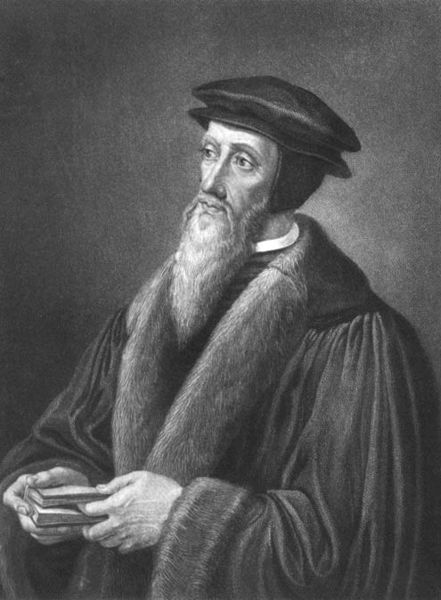
Here’s Jean Calvin, from his commentary on 1 Timothy 2: Now Moses shews that the woman was created afterwards, in order that she might be a kind of appendage to the man; and that she was joined to the man on the express condition, that she should be at hand to render obedience to him. (ref here)
Then there’s Thomas Aquinas, from Summa Theologiae: As regards the individual nature, woman is defective and misbegotten, for the active force in the male seed tends to the production of a perfect likeness in the masculine sex; while the production of woman comes from defect in the active force or from some material indisposition, or even from some external influence; such as that of a south wind, which is moist, as the Philosopher observes (De Gener. Animal. iv, 2). On the other hand, as regards human nature in general, woman is not misbegotten, but is included in nature’s intention as directed to the work of generation. (ref here)
Considered in today’s light, these quotes, and others like them, are clearly preposterous. And yet I think they have shaped our current situation, by contributing to a church culture marked by male privilege, more than we care to admit.
What about you? How do you see quotes like these influencing us today?
Defining Male Privilege
Over the last several months, when I’ve matter-of-factly mentioned that I’m doing some thinking and writing on the topic of male privilege, I’ve almost always come up against the same response:
Huh? What’s that?
Doesn’t matter if it’s pastors or seminary students, housewives or firemen, the idea of male privilege is for the most part an utterly foreign concept. So, in this post I’ll offer what has become my working definition. It’ll be in conceptual form, and then I’ll illustrate the heck out this definition in coming posts. Here you go:
Male privilege is a system of advantage based on being male.
Short and sweet, right? Let me break it down into three parts.
First, male privilege is a systemic thing. By their nature, systems are hard to see. They’re subtle. They sort of lurk in the culture, influencing from behind the curtain. I like a quote by a writer named Peggy McIntosh. McIntosh was writing about white privilege (full article here), but I think the description is apt for the context of male privilege:
“I have come to see white privilege as an invisible package of unearned assets which I can count on cashing in each day, but about which I was ‘meant’ to remain oblivious. White privilege is like an invisible weightless knapsack of special provisions, maps, passports, codebooks, visas, clothes, tools and blank checks.”
Next, male privilege is a system marked by a built-in advantage. There it is, systemically embedded in the culture, and yet it’s not passive. Instead, it is a system that clearly awards an advantage. In this way, male privilege is like most systems in that it has an intrinsic bias. I appreciate what Malcom Gladwell says in his book Outliers:
“People don’t rise from nothing. We do owe something to parentage and patronage. The people who stand before kings may look like they did it all by themselves. But in fact they are invariably the beneficiaries of hidden advantages and extraordinary opportunities and cultural legacies that allow them to learn and work hard and make sense of the world in ways others cannot. It makes a difference where and when we grew up. The culture we belong to and the legacies passed down by our forebears shape the patterns of our achievement in ways we cannot begin to imagine. It’s not enough to ask what successful people are like, in other words. It is only asking where they are from what we can unravel the logic behind who succeeds and who doesn’t.”
Finally (and obviously), the system of male privilege offers advantage to men and a simultaneous disadvantage to women. Again, it’s not like men do anything to warrant or access this advantage. It simply comes with the territory of being a male in American culture. In the coming weeks I’ll offer many examples, but given the heightened political atmosphere right now, let me offer one illustration from the realm of government:
Even though 51% of the American population are women, according to a Rutgers University survey, only 23% of elected officials across the country are women.
How do you explain that discrepancy? I submit that a major factor is our culture’s bias toward a system of advantage based on being male. Truly, you and I live in a culture marked by male privilege.
What do you think? Does this definition resonate for you? How would you define male privilege?
On Challenging Tertullian
 I’m sure Tertullian was a really nice guy. More than that, I’m sure he had a lot a great things to say. How else do you become, in the words of theologian Justo Gonzalez, “the founder of Western theology?!?”
So maybe we could chalk it up to a bad day, or just say that he he’d had some unhelpful influences in his life. Or perhaps he’d had a particularly bad dating run lately. Whatever the reason, ol’ Tertullian was the one who wrote these words to women:
“You are the Devil’s gateway; you are the unsealer of that tree; you are the first foresaker of the divine law; you are the one who persuaded him whom the Devil was not brave enough to approach; you so lightly crushed the image of God, the man Adam.”
Ouch, right? Sounds bad, and it is bad. It’s also representative, of a school of thought of which Tertullian was one pupil. And here’s the thing, if you ask me, that school was in session before Tertullian, and, significantly, we’re all enrolled in it today.
With this blog, I want to challenge Tertullian. Or, more to the point, I want to challenge the system of male privilege. I want to think about it, understand it and then discern how Jesus would have me respond to it. And I invite you to join me.
I want you to know what you’ll be getting into, so I’m going to come right out and share where I’m coming from here. Simply put, my thesis is this:
Male privilege exists in our culture and is something that benefits men like me. Since Jesus calls me to surrender everything I’ve got to his leadership, that’s as true for my privilege as it is for my car, house, etc. And as I willfully and joyfully surrender this privilege and invite Jesus to use it, I get to see him empower the women around me and advance his mission in my context.
To engage this thesis, I’ll be blogging here on Mondays and Thursdays, and on other days when the mood strikes me. I’ll be thinking through current events, my life, some theology and I’ll be exhorting us all to grapple with the reality of male privilege. Along the way we’ll have some fun as well.
So if this sounds good to you, please join me. I’ll welcome your comments, particularly if they’re civil.
And, who knows, maybe we’ll get Tertullian to show up and explain himself!
How about you? When you hear the words “male privilege,” what questions come to mind?
 Challenging Tertullian