Halloween Gone Amok
 Make no mistake about it, we Dixons aren’t really Halloween people.
What I mean is that our Halloween enthusiasm level could be called tepid at best. If you’d like to read my wife Amy’s musings on Halloween, you can do so here, but every year we sort of relucantly mark the occasion. Tonight you’ll find us at a friend’s house doing some limited trick or treating on their block, then early to bed.
Of course, in this regard, we Dixons are counter-cultural. Because Halloween is big business, nationally a 6.9 billion dollar business in fact. Locally, I know this because of the overnight proliferation of Halloween shops in the normally vacant storefronts near my house. I also know this because, come October, the elementary school “what costume are you wearing?” chatter increases exponentially every day we get closer to the 31st.
And, for the record, this year in the Dixon house, we’ll have kids dressed up as Leo Messi, a cookie monster, Belle before she became Princess Belle, and then Princess Belle herself.
Collective cost of all the Dixon family Halloween costume paraphernalia? Like $25. Again, we’re not Halloween people.
And after reading this article, you won’t be either.
Evidently, two years ago, some knucklehead produced a Halloween costume called “Anna Rexia.” Yep, you read that right. “Anna Rexia.” The tagline? “You can never be too rich or too thin.”
Because making fun of the estimated 12 million women and girls who suffer from anorexia is a sure-fired Halloween hoot.
Two years ago, a change.org petition helped remove the offensive costume from its online retailer, but this year it came back, peddled by a company called HalloweenParty13.com. Here’s a screen shot:

That’s right folks, plunk down your $39.99 and let the mocking of millions of struggling women and girls begin!
According to one report, “3 in every 100 American women suffers from an eating disorder which is the leading cause of death for girls ages 15-24.”
Shame on a company that glamorizes an illness such as this. Let’s hope that “out of stock” becomes a forever condition for this Halloween travesty.
Truth in Advertising?
So you can find Tertullian on google autocorrect, and as we’ve said before, you can find him in the land of advertising.
For instance, the other day on facebook, I noticed this ad:

Because nothing shouts “mortgage rates” like an attractive woman with striking green eyes…
Of course we know what’s going on here. Lendgo wants to promote their services, and, like everyone else, they’d love to woo the right demographic. And, evidently, for Lendgo the “right demographic” are, oh, 25-45 year old available (or not) men.
Ads like this one illustrate that premise that what a company chooses to put forward in their advertisements is designed to capture the attention of the specific constituency they are hoping to attract. I mean, don’t get me started on how World Series games double as 3+ hour opportunities to talk with my kids about erectile dysfunction…
And so I paid attention last week when the latest edition of Christianity Today arrived, complete with a “Special Advertising Section” devoted to seminaries, bible colleges and graduate schools. Just who, I wondered, are America’s Christian graduate institutions hoping to attract?
Could it be…women?
Whether it’s the same line of reasoning as Lendgo’s ad above, or, far better, if it’s because these schools are legitimately trying to attract women, for me there were a surprising number of women featured in the section’s various ads. Here’s the tale of the tape:
By my count, there are 21 schools with ads featured in the section in total (there are other ads in the magazine; I’m just counting the ones in the special advertising section).
3 have no pictures whatsoever in the ad. Seriously? You’re spending all that money on a copy-only ad? Aren’t we catering to a generation who uses instagram?!? #adfail
4 have pictures without people in them, including Baylor University’s, which features a massive dog snout. I was going to make a snarky comment about Baylor’s vision for canine theological equipping, but then I read that they are using the scent receptors in a dog’s nose to help identify cancer in humans. Um, good one Baylor.
8 have pictures of just men, most of them solo and, not surprisingly, the majority of them are white. I think my favorite is Western Seminary’s ad featuring a motorcycle rider–wait for it–with a red colander on his head. Huh? Also, honorable mention goes to Liberty University’s ad featuring none other than Kirk Cameron holding court with three cinematic arts students.
And that leaves 6 ads featuring women. And 5 of those ads have solo women. So props to Moody, Palm Beach Atlantic University, Regent University, Union Presbyterian Seminary, Bethel Seminary and Cairn University for featuring women in their ads. I have no idea what the theological bent is for any of these 6 institutions, but putting women in their ads seems to me like a step in the right direction. If these schools are hoping to attract women, they are putting their ad money where their hopes are.
So, for those of you scoring at home, 29% of the total ads feature women, but that number jumps to 43% when you remove the ads without people.
And when you consider that according to the Association of Theological School’s website, women make up just 34% of the 74K students currently enrolled in the 270 ATS member campuses…
43% starts to look pretty good.
Searching for Tertullian
 Remember when we all had encyclopedias?!?
You know, the 20-whatever volumes of World Book or Britannica fun? Growing up, we had a set and we used them. If we had to search for something for our homework, it was off to the bookshelf to dig it out of the trusty encyclopedia.
Nowadays, encyclopedia sets are archeological relics. In fact, when she was cleaning out her classroom last year, our daughter’s teacher sent kids home with volumes that matched their initials. Hence the lonely “L” volume of the World Book sitting on a shelf somewhere around the house…
Today of course we google. Oh how we google!
In theory, google makes our lives easier. We can look up maps. We can find deals. We can read books. And of course we can search. Google is the postmodern equivalent of the 15 year old me digging through a dusty encyclopedia.
And, with google autocomplete, they’ve made it even easier. You know what I mean. Type in a search term and before you’ve gone very far, you get some options. According to the google autocomplete site,
“The search queries that you see as part of autocomplete are a reflection of the search activity of all web users and the content of web pages indexed by Google.”
In other words, call autocomplete the aggregate of our collective social conscience.
Because of this, what gets autocompleted is pretty revealing. And, in the case of male privilege and sexism in general, it’s downright alarming.
This article exposits what happens when you type in terms about women. I’ll give you an example:

See the problem? And it’s similar for search terms like “women cannot,” “women need to” and “women shouldn’t.”
Curious, I did a similar search for men. For the term “men should,” google came back with:

OK, it’s not exactly a great collection of options for men either, but it’s better than the ones for women.
Most of the time, male privilege lurks in the shadows. In our post-encyclopedia world, leave it to google to bring it out into the light.
Happy Ada Lovelace Day!
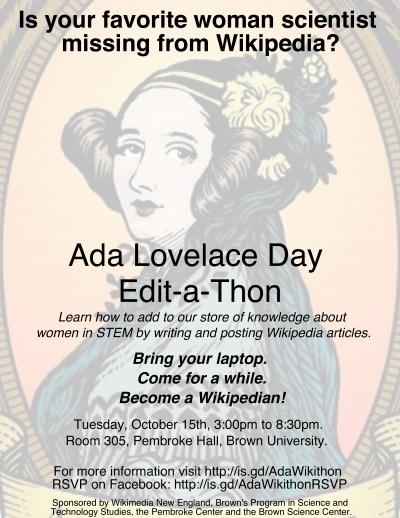 You probably missed it. No, I’m certain you missed it. We all did.
Tuesday was Ada Lovelace Day.
Who’s Ada Lovelace, you ask? Born in 1815, the daughter of English poet Lord Byron and a mathematics-loving mother named Annabella Milbanke, Ada Lovelace was a math prodigy. According to this biography,
“Fearing that Ada would inherit her father’s volatile ‘poetic’ temperament, her mother raised her under a strict regimen of science, logic, and mathematics. Ada herself from childhood had a fascination with machines– designing fanciful boats and steam flying machines, and poring over the diagrams of the new inventions of the Industrial Revolution that filled the scientific magazines of the time.”
Over time, Ada Lovelace found her way into some pretty lofty mathematics and science circles. Ultimately, in 1842, Lovelace wrote what some consider to be the first computer program, when she published an article entitled, “Sketch of the Analytical Engine, with Notes from the Translator.” Because of this, in her time, Lovelace developed quite a reputation. Check out what one of her contemporaries had to say about her:
“Babbage described her as “that Enchantress who has thrown her magical spell around the most abstract of Sciences and has grasped it with a force which few masculine intellects could have exerted over it,” or an another occasion, as “The Enchantress of Numbers”.
“The Enchantress of Numbers.” If you ask me, that’s a pretty sweet nickname.
Every year, Ada Lovelace day celebrates women in the science, technology, math and engineering fields. It won’t surprise you to know that these sectors of culture are owned by Tertullian. After all, according to this article,
“Women software developers earn 80 percent of what men with the same jobs earn. Just 18 percent of computer science degrees are awarded to women, down from 37 percent in 1985. Fewer than 5 percent of venture-backed tech start-ups are founded by women.”
Simply put, we need more Ada Lovelace Days.
For this year’s celebration, Brown University hosted a wiki editing session, where “volunteers could gather to create and expand upon entries about women in science and technology.” Talk about setting the record straight! The story is here.
Recently, my daughter Lucy and I were talking about what she wants to be when she grows up. She blew my mind when she described a job where she could design buildings that were beautiful and safe for people to live and work in. Yep, my 9 year old is trying to decide between being an architect or an engineer.
Either way, I think Ada would approve.
Over the Line
 Lester B. Pearson, former Canadian Prime Minister and winner of the 1957 Nobel Peace Prize, once said, “Politics is the skilled use of blunt objects.”
To be sure, politics is a rough and tumble business. And yet there are times when lines get crossed.
This is one of those times.
In the last number of years, women have made gains in the political world, a world historically dominated by male privilege. For instance, in the most recent election cycle, we had Michelle Bachman running on the Republican side. And, in the cycle before that, it was Hillary Clinton running for the Democrats and Sarah Palin for the Republicans. Despite what Tertullian might say, viable female candidates running on national tickets has been a welcome change.
But it hasn’t come easy.
Because unlike most male candidates (New Jersey Governor Chris Christie as one notable exception), female political candidates consistently have to weather commentary about more than their political views. Indeed, for women running in today’s political landscape, their dress, their body shape and their hairstyle are tragically fair game for everyone from political pundits to gossip columnists.
Now, as the electorate anticipates the 2016 presidential campaign, the speculation is heating up about about whether Hillary Clinton will make another run. Unfortunately, so too is the male privilege-driven hate machine.
The other day, I noticed this article about a button on offer at a recent Republican convention in Southern California. Here’s a picture tweeted by the San Francisco Chronicle’s Carla Marinucci:

Disgusting right? Yes.
The good news is that according to Marinucci, the GOP tracked down the vendor who was selling the button and removed it.
The bad news is that people think like this at all. That in 2013, women seeking office still have contend with this kind of blatantly offensive propaganda. That in today’s political landscape, the blunt objects include this brand of toxic personal attacks.
Politics is a rough and tumble business. But it shouldn’t be sexist as well.
Tertullian Here and Abroad
 I’ve never been to Saudi Arabia, but if I went, I guarantee you that I’d be thankful that I’m a man.
Because in Saudi Arabia, being a woman is a tough go. Male privilege is overt and in your face. Constantly. To demonstrate, I noticed that Saudi Arabia was in the news twice this week regarding gender issues.
First, there was this little gem from a Saudi cleric by the name of Sheikh Saleh al-Luhaydan. Evidently, in Saudi Arabia, it is illegal for a woman to drive. To drive.
Commenting on the eve of a planned day civil disobedience, where women were going to choose to drive as an act of protest, the Sheikh said this:
“(the) physiological impact (of driving) on women…could affect her ovaries and push the pelvis higher as a result of which their children are born with clinical disorders of varying degrees.”
That’s right ladies. Don’t drive; you could damage your ovaries.
The bad news? Influential Saudi clerics both think like this, and, more importantly, they teach it to their parishioners. The good news? The Sheikh is facing some degree of condemnation and mockery. I say let him have it.
And then there was this news, about how a major Saudi IT company, one with some American ties, was opening an all-female business center that one day will employ 3,000 Saudi women. Great news, right?
Sort of.
Read this quote, and let it grieve your soul:
“It’s hard for women in Saudi Arabia to find good work. For many businesses, cultural norms and strict gender segregation make hiring women seem like more trouble than its worth. Banks, factories and other companies have to create separate sections for their female employees, separate entrances, and in many cases they have to install women’s bathrooms. Even then, any workplace where women interact with men outside their family can become highly controversial. (Earlier this year, the kingdom’s religious officials issued a fatwah against women working as grocery cashiers.)”
Does that kind of segregation sound familiar?!?
What do we make of all of this? I have two reflections on the juxtaposition of male privilege in Saudi Arabia versus male privilege here at home.
One, let’s be thankful that in this country we do not, for the most part, face the brand of overt sexism and male privilege that is tragically on display around the world, and in Saudi Arabia in particular. In our country, only the most ardent sexist fringe would call for driving restrictions or segregated building entrances. Mercifully, in our culture, Tertullian is generally not as overt as that.
And yet here’s the thing. Tertullian does exist here. He’s quieter, but he’s no less insidious. Because male privilege is hidden or embedded in the systems and structures of our culture, it’s tougher to pin down. And so, by and large, both women and men suffer at the hands of something we’re unable to find and confront.
To illustrate, I think the contrast goes like this. In Saudia Arabia, Tertullian tells women straight up they cannot drive. He shouts it from the rooftops and he’s found a way to write it into the law. By contrast, in our country, when we get cut off on the freeway, Tertullian whispers this in our ears:
“Stupid women drivers…”
Tragic.
Friends, whether you can see him or not, Tertullian has to be stopped.
You want the Dodger score, you get…cleavage.
 Our family is a sports family.
For one thing, we play sports. Mom and Dad are runners. Our son and oldest daughter race cross country and play soccer. That same daughter is right now in a basketball program. Our two younger daughters are also on soccer teams. That’s right, on any given weeknight, you’re liable to find us shuttling from a cross country course to a practice soccer pitch to a sweaty gym with bathroom and water breaks in between.
But wait, there’s more…
In our family, we also coach sports. This year Mom started a 100 Mile Club at our elementary school. As such, she’s spending the year inspiring, rallying and cajoling dozens of kids through their quest to run 100 miles by year-end. On top of that, both Mom and Dad are coaching soccer teams. So, to bookend our weekdays, you can find us starting our day at school before the bell helping kids run laps and the finishing our day trying to wrangle a bunch of little girls into soccer players.
Hold on. There’s still more…
Because our family is also a sports watching family. In person and on TV. In fact, when it comes to TV, Dad is pretty well addicted. If someone’s competing and we get the channel, I’m predisposed to watch it. Especially if it’s English soccer. And particularly if Manchester United is playing.
So you can imagine my joy this year when our son caught the sports watching bug. In fact, he’s become a rabid sports fan. Honestly, it’s made us closer, and I cherish that. When asked the other day at school what his favorite TV show was, he answered, of course, “SportsCenter.”
So last night, when we went online to check the score of the Dodger game, imagine my chagrin and frustration when I saw this:

Now I’m no fool. I realize how the system works. ESPN signs on advertisers in order to generate revenue. On top of that, I also know that certain ads appeal to certain target groups. And, yes, it makes sense that sports fans are also Grand Theft Auto V game fans, and that the way to their wallets is through massive, cartoonish cleavage.
It makes sense, but that doesn’t make it right. After all, I want to talk to my boy about baseball, not boobs. I want us to check out the scores, not a woman’s chest. And when I go to ESPN, I want to help my son learn about the games I love, not our culture’s obsession with objectifying women.
Honestly, its exhausting to continue to have this conversation. Yet have it we shall. Because, in the end, our family is more than a sports family.
We’re also a family who stands for what’s right.
An Unwanted Conversation
 Recently, our daughter had a question for my wife:
“Mom, when will I be allowed to dress sexy?”
It’s a devastating question. Because little girls shouldn’t want to dress “sexy.” Heck, because little girls shouldn’t even know the word “sexy.” And, most of all, because our daughter is so young.
In fact, she just turned 9.
As it turned out, our little girl has no idea of what dressing sexy actually means. For her “sexy” is more of a synonym for “grown up.” You see, in her mind, she’s ready for the earrings, the heels, the straps and the skirts. She wants to look like the girls she sees on TV.
And, for the most part, the girls on TV dress to impress the boys on TV.
In her article “A Grown-Up, Not Sexed-Up, View of Womanhood,” writer Tish Harrison Warren explores the question of whether the church can provide an alternative paradigm to the one that suggests that female adulthood is equated with romantic or sexual availability.
Clarifying the dominant cultural model of womanhood she writes, “In order to be seen as an empowered adult in our contemporary society, we can’t just be mature sexual beings; we must be sexually available. As females, we often demonstrate adulthood by using our sexuality in ways that invite, in fact that practically beg for, the male gaze. It is a sort of post-sexual revolution version of the debutante coming out.”
As I said in a recent post on “Mileygate,” “for the most part, in Tertullian’s reductionistic world, when it comes to sexuality men are there to be serviced. It’s our privilege.” It’s tragic, and, too often, so is the church’s response.
Warren’s diagnosis reads as follows: “The church…must offer another way to attest to our adult womanhood. If we do not, when we encourage young women to remain chaste and value modesty, it will inadvertently be a message of juvenilization–to remain good “little girls.” In order for celibate adults to be acknowledged as adults in evangelical churches, our understanding of adulthood needs to be clarified and decoupled from sexual activity or marital status.”
Simply put, the church right now has no category for unmarried women who are too old for youth groups. After all, not every women will one day be married; as my friend Steph helpfully noted this week, it’s more of an “if” than a “when.” So what’s the alternative?!?
Warren sees a confirmation rite as one way to celebrate a girl’s transition to womanhood. She writes, “Unlike baptism, confirmation is not a sacrament and does not have the theological import thereof. But if we want our young women to feel valued, welcomed into adulthood, and affirmed as strong, independent women without having to reject modesty and chastity or twerk with Robin Thicke, then we need meaningful, communal rites of passage. Maybe celebrating confirmation like we mean it is a step in that direction.”
In the end, I’m not sure if some sort of initiation rite will suffice. We need wholesale culture change.
We need the kind of change that tells women and girls that their identity is in Jesus, not in men and boys. We need the kind of change that affirms women of all ages for who they are, not who they could someday become. We need the kind of change that empowers women and girls with a vision for who they can become in Jesus’ church.
Closer to home, most of all, we need God’s grace to parent our kids the best that we can.
Low Hanging Fruit
 Every once in awhile, some knucklehead does or says something that unambiguously illustrates the reality of male privilege. It’s sort of low hanging blogging fruit for me.
The other day I noticed this story, about some yahoos out of Texas who created a truck decal that depicts a bound and tied woman. Evidently this thing is so real that people have seen it and called the police. Here’s a screenshot:
 Sadly, the reaction has been mixed. On one hand, there has been an onslaught of negative response. I’m glad to know that. On the other hand, business is up, proving the adage that any publicity is good publicity…
Asked about it, the company owner said this:
“I wasn’t expecting the reactions that we got, nor was it really anything we certainly condone or anything else,” Hornet Signs owner Brad Kolb told KWTX. “But it was just something…we had to put out there to see who notices it.”
Gag me.
The truth is that you knew exactly what you were doing and you are getting the publicity you want. Who wouldn’t notice a life-sized, realistic image of a woman held captive in the back of a pick-up?
And, further, by printing and publicizing it, you are, in my estimation, condoning it. And that’s wrong. Violence against women is a real issue that should not be glorified on a truck decal.
Can we agree that it’s time for this crap to end? Honestly, we have enough trouble dealing with the hard-to-find fruit that’s hidden high up in the male privilege tree.
Let’s be done with the overt, low-hanging fruit as well.
On Being Faithful to One’s Gifting
 It’s good for me to remember that I’m not the only one challenging Tertullian.
Yesterday, I came across a helpful post by Laura Turner. You might know Laura Turner, but more likely you’ve heard of her parents, as Turner is the daughter of Christian ministers, authors and teachers John and Nancy Ortberg. The Ortbergs come from the Willow Creek church context.
The thing I appreciated about Turner’s post is how she frames the issue of the role of men and women in the church in terms of gifting. As in, if you have a spiritual gift, you are bound before the Lord to put it to work, whatever your gender.
I recommend the whole post here, but to whet your appetite, here’s an excerpt:
“From the outset at Willow Creek, there was nothing being done anywhere in the church that could not or was not being done by a woman. Every Sunday morning I took the thick gray brochure with green embossing and read five names under the “teaching pastor” positions: three men, and two women. One of those women happened to be my mother, which deserves its own separate post–she’s remarkable in ways I cannot even name–but the reality of the situation remained that I was reminded every single week that women were called to follow their gifts, too, and that their gifts weren’t relegated to the domestic sphere and that gifts of leadership and teaching did not require an all-female audience. I never once got the message that women were weaker, more emotional, less able, or needed caring for. I was part of the largest evangelical church in the country, and my dreams for the future were never limited by my gender.
The issue has always been framed, in my experience, in terms of giftedness. If there is a man who is gifted in the areas of hospitality and care, we shouldn’t put him in a preaching position simply because he’s a man. And if there is a woman who is gifted in areas of leading and teaching, then she ought to be leading and she ought to be teaching. Not to do so would to be unfaithful to our Lord.”
I appreciate Turner’s words, but I think I appreciate her story even more. Growing up at Willow Creek, she didn’t encounter the barrier of prescribed gender roles until college. That’s extraordinary.
Oh that my kids, and my girls in particular, would experience that kind of environment as well!
 Challenging Tertullian