In Our House as Well
 Thus far at Challenging Tertullian, we’ve looked at the reality of male privilege primarily in the culture at large. That is, I’ve shined the spotlight on sectors of American society such as the political world and the economic arena. But, at its core, this is a blog that examines the phenomenon of male privilege from a Christian perspective. So, with this post, it’s time to take a look at the American church.
On February 4, 1985, in its Religion section, TIME Magazine published an article provocatively entitled “Women: Second Class Citizens?” The article critiqued the Roman Catholic Church’s treatment of women, particularly its lack of women in the priesthood. Here’s a quote, from a woman named Maryann Cunningham:
“There was a time when the church sanctioned slavery and cheerfully burned heretics, and the patriarchal church still does not see that there is anything to be sorry for in its treatment of women.”
Strong words. But, and here’s the kicker, true words.
Fast forward 27 years to last week, when it was reported that the Church of England voted to NOT ordain women as bishops, effectively retaining a cap on the available leadership roles for women in the Anglican communion. Rowan Williams, archbishop of Canterbury lamented the vote because of its negative effect on the mission of the church, saying:
“We have, as a result of yesterday, undoubtedly lost a measure of credibility in our society.”
Let me just come out and say this plainly:
Male privilege is firmly and tragically entrenched in the offices and pulpits of the American church.
In other words, we’re not just talking about a problem in the larger culture. It’s in our house as well. Indeed, in the clerical (church leadership) world in particular, male privilege continues to thrive. Think about it. How many titled female leaders do you know?!?
Let’s talk statistics. Here’s the word from the Hartford Institute for Religion Research:
“Seminary remains by and large a male profession. Twice as many men as women completed the Masters in Divinity degree, the most popular of the programs, in 2005, according to ATS (The Association of Theological Schools) figures.”
To this Barna adds:
“From the early 1990s through 1999 just 5% of the Senior Pastors of Protestant churches were female. Since that time the proportion has slowly but steadily risen, doubling to 10% in 2009.”
Doubling is terrific, but it’s still just 1 in 10.
In her book A Church of Her Own pastor and professor Sarah Sentilles describes in detail, through the use of numerous stories (including her own), how difficult it is for women to gain access to a pastoral role in a mainline Christian denomination. Here’s her verdict:
“All of [the largely negative experiences of women trying to get ordained] revealed the failure of churches to celebrate and support women in ministry and betrayed a deep misogyny alive and well in most Christian denominations.”
Can you feel the effect of privilege?!?
I love the depiction of the first church from Acts 2:42-47. What an image of what the church could be!
42 They devoted themselves to the apostles’ teaching and to fellowship, to the breaking of bread and to prayer. 43 Everyone was filled with awe at the many wonders and signs performed by the apostles. 44 All the believers were together and had everything in common. 45 They sold property and possessions to give to anyone who had need. 46 Every day they continued to meet together in the temple courts. They broke bread in their homes and ate together with glad and sincere hearts, 47 praising God and enjoying the favor of all the people. And the Lord added to their number daily those who were being saved.
In this text I see a community that is growing in faith (42-43), growing in fellowship (44-47) and growing in number (47). I realize that this church was established in the context of a patriarchal culture, but in the passage I don’t see a place for institutional patriarchy. Or misogyny. Or “second class citizens” of any kind. On the contrary, according to Luke, it’s just a beautiful community full of “they.”
It’s time to build a church where everyone flourishes.
There is a whole lot more to talk about here, and we’ll get there. My purpose in this post is simply to chronicle the reality of the male privilege that lurks in our churches. In coming posts, I’ll describe the situation with more depth, and I’ll explore both questions and answers.
What about you? How do you see male privilege living in the American church?
Linking Black Friday with Male Privilege
 The Holidays are upon us! In fact, this week we celebrate two cherished American holidays, Thanksgiving and Black Friday. You know Black Friday of course; it’s the yearly post-Thanksgiving consumer orgy that last year generated some 11.4 billion dollars. That’s “billion” with a “B.”
Because of this, slowly but surely Black Friday is morphing into Black Thursday. I noticed the other day that Walmart will open at 8pm on Thanksgiving for their “family specials” and 10pm for “gadget die-hards.” Then, doors open at 5am on Friday for, evidently, the non gadget-loving single people.
Why am I talking about Black Friday and American consumerism in a blog dedicated to the topic of male privilege?
Because with the arrival of Black Friday, the season for introducing and reinforcing the reality of male privilege for the next generation is upon us.
One way to answer the question of where male privilege comes from in our culture is to point to the way we enculture our children through the toys we buy them. Think about this with me:
For the most part, toys that cater to boys present a traditionally and stereotypically masculine image marked by power, strength and control. Toys for little boys include things like superhero action figures, building sets and water guns. By contrast, toys marketed to girls communicate an image of femininity marked by softness, humility and passivity. Toys for little girls include things like tea party sets, princess dolls and jewelry.
Can you see in this the seeds of male privilege?
Make no mistake about it, the toys we buy communicate a lot. Specifically, we communicate a view of the world where men possess power and women do not. For girls and young women, the results can be devastating.
In her excellent (and disturbing) book Cinderella Ate My Daughter, journalist Peggy Orenstein details some of the fallout:
“According to the American Psychological Association, the girlie-girl culture’s emphasis on beauty and play-sexiness can increase girls’ vulnerability to the pitfalls that most concern parents: depression, eating disorders, distorted body image, risky sexual behavior. In one study of eighth-grade girls, for instance, self-objectification—judging your body by how you think it looks to others—accounted for half the differential in girls’ reports of depression and more than two-thirds of the variance in their self-esteem.”
So what’s the bottom line here?
In American culture, boys are taught at an early age that they intrinsically have more power and privilege while girls need to figure out other, often more destructive, ways to make their voices heard.
So what’s the solution here? How do we push back against this biased system? Here are some of things we’re talking about in my house:
Don’t buy toys at all. Maybe a puzzle or board game instead?
Buy toys according to how our girls are wired. Our oldest daughter is clearly an artist, so for her it’s art supplies over princess castles. Our middle daughter loves sports. That new soccer ball looks better than the costume jewelry.
Or, if we do buy some of the more traditional toys, we will aim to supplement or offset that with lots of intentional conversation about how our girls can grow up to be whoever God has called them to be.
Lastly, here’s another thought: when it comes to buying toys, forget going to Walmart this week and instead buy your little girls something like this. It’s the story of Goldieblox, and it’s a great story.
What about you? How do you identify the roots of male privilege in our culture?
The Things Pat Says…
 Say what you want about Pat Robertson, but the brother sure knows how to stir the pot. The wikipedia page “Pat Robertson Controversies” runs for, I kid you not, 25 different entries. Mr. Robertson has managed to offend or disturb groups ranging from Episcopalians to college professors to Hugo Chavez to the U.S. State Department. Impressive.
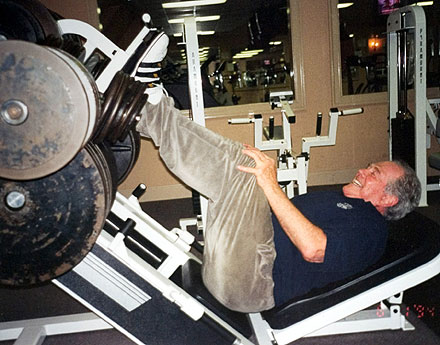
But I think my favorite Robertson controversy is when he claimed, at 74 years of age, to be able to leg press 2000 pounds. 2000 pounds! Nevermind that, according to the wiki page, “when [future NFLer] Dan Kendra set the Florida State University record of 1,335 lb (606 kg), the leg press machine required extensive modifications to hold the proper amount of weight, and the capillaries in both of Kendra’s eyes burst during his successful attempt.”
If Pat Robertson can leg press 2000 pounds, I can jog a 1:20 marathon…
With all of this as backdrop, I introduce Pat Robertson’s latest outrageous remark, a zinger he offered up two days ago on the topic of the David Petraeus sex scandal. The full article is here, but the remark I want to comment on is this one:
“The man’s off in a foreign land and he’s lonely and here’s a good-looking lady throwing herself at him. He’s a man.”
“He’s a man.” With these words, Robertson has essentially justified or at least explained away Petraeus’ actions. What Pat Robertson is implying is that it’s understandable, or reasonable, or perhaps logical that Petraeus committed this affair. After all, she was pretty, he was lonely, and, most of all, HE IS MALE.
This way of thinking is one place where privilege lives for men, in the culture at large and, get ready, in the church in particular:
Sexual transgressions are more about the woman, and, more often than not, the man is portrayed as the victim.
I’ve been reading a really engaging book by blogger and author Rachel Held Evans called A Year of Biblical Womanhood. In the book, Evans attempts to live out the Bible’s commands for women as literally as possible for a full year. It’s fascinating and insightful. In her chapter on beauty, Evans relates a story about a pastor encouraging the wives in his congregation to dress up for their husbands when they come home from work. Later, with this quote, she captures well the spirit of what I think Pat Robertson is typifying:
“At the last Christian women’s conference I attended, several speakers mentioned the importance of keeping a beauty routine that husbands will not be tempted to ‘look elsewhere.’ The message is as clear as it is ominous: Stay beautiful, or your husband might leave you…and if he does, it’s partially your fault.”
Pat Robertson has nowhere near the influence that he once had in Christendom. I think that’s largely a good thing. But he does continue to represent a brand of evangelical Christianity that holds that when it comes to sex and sexuality the onus is on women to protect the chastity of men.
So let me be clear about a few things this morning. One, General Petraeus is just as culpable as the woman who he cheated with. After all, they both transgressed their wedding vows. Two, when it comes to fidelity to the Bible’s teaching on sex and sexuality, men and women bear the burden of joyful obedience together. In fact, we need each other to honor God in this area.
And, third, for the record, as I type Amy is decked out in pink pajama sweats, fuzzy blue socks and a ratty old sweatshirt. No doubt about it, she’s absolutely beautiful.
What about you? How you have experienced this uneven gender dynamic in the church world?
Isn’t it Getting Better?!?
 Since I’ve started thinking, talking and blogging about male privilege, I’ve gotten the “Isn’t it getting better?” question a lot. Like during almost every interaction. And my answer is always a qualified yes. Let me illustrate.
On Tuesday night, the great states of Massachusetts, New York, California, Washington, North Dakota, Minnesota, Wisconsin, Michigan, Missouri and Nebraska each sent women to the United States Senate. Combined with the women already serving who were not on the ballot last night, it will make the next Senate the most diverse ever in terms of gender, with 20 women taking their seats when the Senate picks up again in the Winter.
Especially in light of other gains by women in the political world, doesn’t this mean that the situation is getting better for women? Isn’t it an indication that the playing field is leveling out?
A qualified yes.
It’s a “yes” in the sense that 20 women will be debating legislation for the first time in the Senate’s history. Indeed, just 82 years after the 19th Amendment, 20 women will be serving in the venerable Senate. Put another way, Amy’s grandmother was alive when women finally got the right to vote, and now she’s alive to see 20 women in the Senate. That’s coming a long way in a relatively short amount of time.
And yet it’s a qualified “yes” in the sense that also shows us just how far we have to go. Women make up over 50% of the population in this country, yet only 20% of our government’s most important legislative body is composed of women. In other words, when a piece of legislation is debated in the Senate, 50+ percent of the population is represented by only 20% of the present Senators.
So, yes, we’ve come along way. And, we have a long way to go.
I felt the same way when I heard the news last August that after years of effort women were finally going to be permitted to join the membership of Augusta National Golf Club, perhaps the most prestigious golf course in the world. That Condoleeza Rice and Darla Moore are now able to play Amen Corner is surely a win in the battle for gender equality. But, again, it’s a qualified win. To me it smacks of tokenism. After all, does opening the doors to two particular women suddenly mean that parity has been reached in golf in general or at Augusta in particular? I think not.
So, yes, as a society we are changing. The playing field is becoming more level. And yet the change is coming slowly and there remains a long way to go, in the political and athletic arenas and in other areas as well, in our country and around the world.
The bottom line, then, is that the march to gender equality is in large part just getting started.
I’ll close with a quote by journalists Sheryl WuDunn and Nicolas Kristof, from their book Half the Sky: “In the nineteenth century, the central moral challenge was slavery. In the twentieth century, it was the battle against totalitarianism. We believe that in this century the paramount moral challenge will be the struggle for gender equality around the world.”
What about you? Where do you see the gender playing field leveling out around you?
“Male Privilege Once Gripped the Running World as Well”
 Yesterday morning, I laced up my running shoes and did a lap around New York’s Central Park. It’s about 10K, it’s hillier than I thought, but wow is it an amazing run. The juxtaposition of park and city is almost overwhelming.
But this wasn’t just any lap around the park. I took the lap in place of the cancelled New York City Marathon.
Yesterday I wasn’t alone, not by a long stretch. Runners from around the world were doing the same lap. In fact, as an English-speaker, I’m pretty sure I was outnumbered. Runners from the Netherlands, Guatemala, Spain, Japan, Italy, all in town but unable to race, provided a beautiful multilingual soundtrack in the park yesterday.
And because the ratio of women to men was pretty much even, it’s tough to imagine a world in which women were not allowed to race a marathon like New York. But such a world existed once. That’s right, male privilege once gripped the running world as well.
So this morning, one day after my lap around Central Park, I want to commemorate something else that happened in Central Park, about 40 years ago. That’s when Nina Kuscsik and 5 other women staged a sit-in at the marathon starting line, protesting the unequal treatment of women in the sport. Here’s the story, in brief, from this article:
Forty years ago, on October 1, 1972, Kuscsik was sitting defiantly on the New York Marathon start line with the five other women competitors, in protest against an AAU ruling that they must start ten minutes ahead, to avoid the supposed health and morality risks of “competing with men.” Kuscsik still managed to win that year’s women’s race, and repeated in 1973. She also took her dissenting energies inside the sport, joining management committees to press for rule-changes that eventually achieved equal status for women.
Health risks? Morality risks? Laughable now, sure. In our day, boys and girls have (for the most part) equal access to sports, in part thanks to the groundbreaking work of Title IX. On the roads, according to this site, more women than men ran 5Ks, 10Ks and half marathons in 2011.
In 40 years, we’ve run a long way.
So here’s to Katherine Switzer, Joan Benoit Samuelson, Nina Kuscsik and women like them for doing the hard work to demonstrate that women can put down the miles as well as men can. Thanks for integrating the sport that I love.
What about you? Where do you see male privilege continuing to have a hold on America’s sports culture?
Why We Should Pay Josh 26% More to Do His Chores
 In this election cycle, you may have heard a candidate or two mention something called the wage gap. The wage gap measures the difference in earnings by gender when men and women are working the same job. Most often, the wage gap is expressed in the percentage of male earnings, but I think it’s more vivid to describe it using the percentage difference.
Not surprisingly, across the country the gap favors men. Nationally, the current wage gap sits at about 23%. In other words, if a man and a woman are working the same exact job, men make 23 cents more on the dollar compared to their female counterparts. And here’s the thing:
23% is actually something to be celebrated.
Because, historically speaking, the 23% gap is an all-time high in this country. For instance, according to this site, in 1963, the year the Equal Pay Act was passed in Congress, the gap was over 41%. The good news is that over time the gap has been closing. The bad news is that it’s closed at a glacial pace, at the rate of less than half a cent per year.
Locally, according to this site, the wage gap in Fresno County stands at 26%. By that measure, we need to revisit the allowance distribution in our house! Want to know what the gap is in your county? Check out that link.
At the end of the day:
The wage gap is a symptom of underlying reality of male privilege.
Why does the wage gap exist? That”s a tough question to answer and economists have plenty of theories (and some have plenty of pushback). Lots of factors are a part of the conversation, things like age, educational level and ethnicity. Still, at its core, the wage gap represents a systemic bias against women. It’s a consequence and a symptom of the reality of male privilege.
Lastly, two thoughts on what the wage gap means:
First and foremost, the dogged presence of a wage gap in our country means that women have less money in their pockets then men do. And of course that matters, particularly in a down economy where two thirds of American families have women as either their primary or co-breadwinners. Further, closing the wage gap would be a serious boon to the economy. This article suggests that closing the gap would grow the U.S. economy by 3-4 percentage points, the equivalent of twice the impact of the 2009 federal stimulus package.
Next, there’s the issue of dignity. What the wage gap communicates is that women are fundamentally worth 77% of what men are. Simply put, there is no dignity in a wage gap. In his book A Public Faith, theologian Miroslav Volf articulates the term “human flourishing.” I like the imagery of that idea. Imagine an economic world where men and women are free to flourish at the same level, compensated equally for the work they provide.
What about you? How does the reality of a wage gap make you feel?
You Know You’ve Been “Tertullianed” When…
 The other day I received a text message from a friend and co-worker that read like this:
“When I see you later, remind me to tell you how I got “tertullianed” this week.”
Tertullianed?!? Hooray, we’ve achieved made-up verb status! Her story basically went like this:
She was at a brainstorming/planning meeting where she was randomly assigned a table full of people to work with. It turned out that there was a guy at her table that tended to only speak to or make eye contact with the other men at the table. When my friend would offer input, it was largely ignored. On top of all of that, at one point he referred to her as “this young lady,” even though she had been introduced as a key leader at the beginning of the meeting. In the end, though my friend is a great leader with more creative ideas than I’ll ever have, she left the interaction feeling frustrated, unseen and small.
Her story got me thinking. Let’s go along with this verb thing and define “tertullianing” in this way:
tertullian (v): what happens when a woman comes up against the cultural reality of male privilege.
With this definition in mind, as a woman, you’ve been “tertullianed” when…
…you have to head off to work in the morning wondering if the neighbors are judging you for not staying home with the kids.
…you have a conversation with a man where his eyes wander from your eyes to other parts of your body.
…you have to endure language that is dominated by masculine jargon: “Man up!” “Hey you guys” “You’re the man!”
…you’re a runner and you just don’t feel safe running on unpopulated trails or at night.
…as a churchgoer, you are limited in how you can use your gifts because of your gender.
…you have to worry about whether your morning wardrobe choice will either limit your influence or send the wrong message about your sexual availability.
…in the office, you have to watch as less qualified men get promoted ahead of you.
Tertullianing.
Now keep in mind the goal here isn’t to make men feel like crap. Instead, I want to point out that guys like me have privilege and part of that privilege is, in general, not having to contend with lists like the one above. What then should men do with our privilege? Stay tuned!
What about you? What are some other examples of women getting “tertullianed?”
My Take on “Bindergate”
 Unless you live off the grid, or unless you really hate politics, you’ve no doubt heard the “binder” soundbite from last week’s presidential debate. You know, the one where candidate Mitt Romney talks about “a binder full of women.” The moment has been relentlessly (and creatively) mocked. I think my favorites are this one, this one and this one.
Anyhow, here’s the full transcript:
“I said: ‘Well, gosh, can’t we find some women that are also qualified? And so we took a concerted effort to go out and find women who had backgrounds that could be qualified to become members of our cabinet. I went to a number of women’s groups and said, ‘Can you help us find folks?’ And they brought us whole binders full of women.”
Despite a bit of a intrigue about whether Romney sought out the binder or whether it was brought to him, I know what Mitt Romney meant. He was talking about resumes and he just misspoke. He meant to say, “they brought me binders full of (resumes of qualified) women.” Choppy English, but I get his intention.
On top of that, it seems that Governor Romney actually used those binders, once he got them. In fact, his administration hired and appointed women into significant positions of leadership. The other day, former Massachusetts lieutenant governor Kerry Healey was quoted as saying that 10 of the top 20 positions in Romney’s administration were filled by women, including his chief of staff.
In some corners of the media Romney is being vilified as being misogynistic or anti-women, and for every quote like the one above, you’ll find 10 more disputing it. Still, for the most part, I think these characterizations are unfair.
Instead, for me Bindergate offers a window into the grip that male privilege has on Mr. Romney, corporate America and our culture more broadly. Here’s what I mean:
Mitt Romney comes from a corporate context. He’s also spent time in the political arena. To call these sectors of society male-dominated is to understate it. Corporate America is really a bastion of male privilege. For example, as of July only 10% of U.S. Fortune 500 companies were being led by women, and having 20 female Fortune 500 CEOs is an all time record. On top of that, at a corporate governance level, only 16.1% of Fortune 500 Board seats are held by women in this country.
With this as context, it’s not surprising that Mitt Romney needed a binder full of resumes in order to find a suitable female candidate. It’s not surprising, but it is unfortunate. Here’s my thing:
I wish Mitt Romney didn’t need the binder.
Not needing the binder would mean a couple of things. First, that Romney had made it a practice of surrounding himself with capable and gifted women, so that when it was time to fill his administration, it was simply a question of who fit where. Or, it would mean that Romney had been following the careers of up-and-coming women leaders and, now that he had an opportunity, he could champion them into positions of influence. Most of all, not needing the binder would mean that Mitt Romney recognized that in this country the corporate playing field is not level and that as governor-elect he would be in a key position to do something about that.
As long as we have male privilege, we’ll need binders full of women. And I for one am eager to get to a place where we can be binder-free.
What do you think? What would it take for us to be binder free?
The Story of Tommy our Bug Guy, or, A Time I Benefited from Male Privilege
 Recently, convinced that we had a bed bug infestation, Amy and I called out our pest control company. In response, a technician named Tommy stopped by the next day. Tommy took a look around our house, put out some glue traps, checked in with Amy, checked in with me and then he was gone. Altogether, he was in our house for 10 minutes.
After he’d left, Amy and I convened in the kitchen to compare notes, and as we did, what was obvious was that Tommy didn’t think we had a bug problem. Praise the Lord. But at the same time, it was also obvious that Amy and I had had two completely different conversations with Tommy.
To Amy, Tommy had come across as condescending and patronizing. He had treated her as if she was a panicky and uninformed child. In fact, his final words to Amy went like something this: “There, there, darlin’. There’s nothing to worry about!” By contrast, to me he had been polite and cordial, and he had treated me with respect. “Nothing to worry about sir, I think you’re fine.”
What was going on in that interaction? Amy and I had heard the same exact message (“there are no bugs in your house”) but we’d experienced two completely different conversations. I’d left mine without any angst whatsoever. Tommy had treated me as an equal and I basically felt validated by the interaction. Amy, on the other hand, was less than pleased. “Can you believe how that guy treated me?” she wanted to know. Honestly, she felt belittled, unseen and small.
And here’s the ironic thing: Amy knew far more about bed bugs than I did, thanks to hours (and I mean hours!) of research on the internet. I mean, if Tommy was going to have an intelligent conversation with someone who knew something about bed bugs during his visit, it should have been with her!
What we experienced that day is the reality of male privilege, and I clearly benefited. Conscious of it or not (and I’m sure he wasn’t), Tommy had treated me as an equal, as someone worthy of respect, simply because I am male. Of course I would know about bugs and not be troubled by the possibility of them in our house. I didn’t need to be consoled, just informed. By contrast, he treated Amy like he assumed that she needed to be comforted, pacified and instructed.
That’s male privilege in action. And I think that our experience that day was more normal than not.
How about you? Have you ever had an experience like this one? Depending on which side of the interaction you were on, how did you feel?
 Challenging Tertullian